
Your AWD Car Needs One Tire. Why Are They Recommending Four?
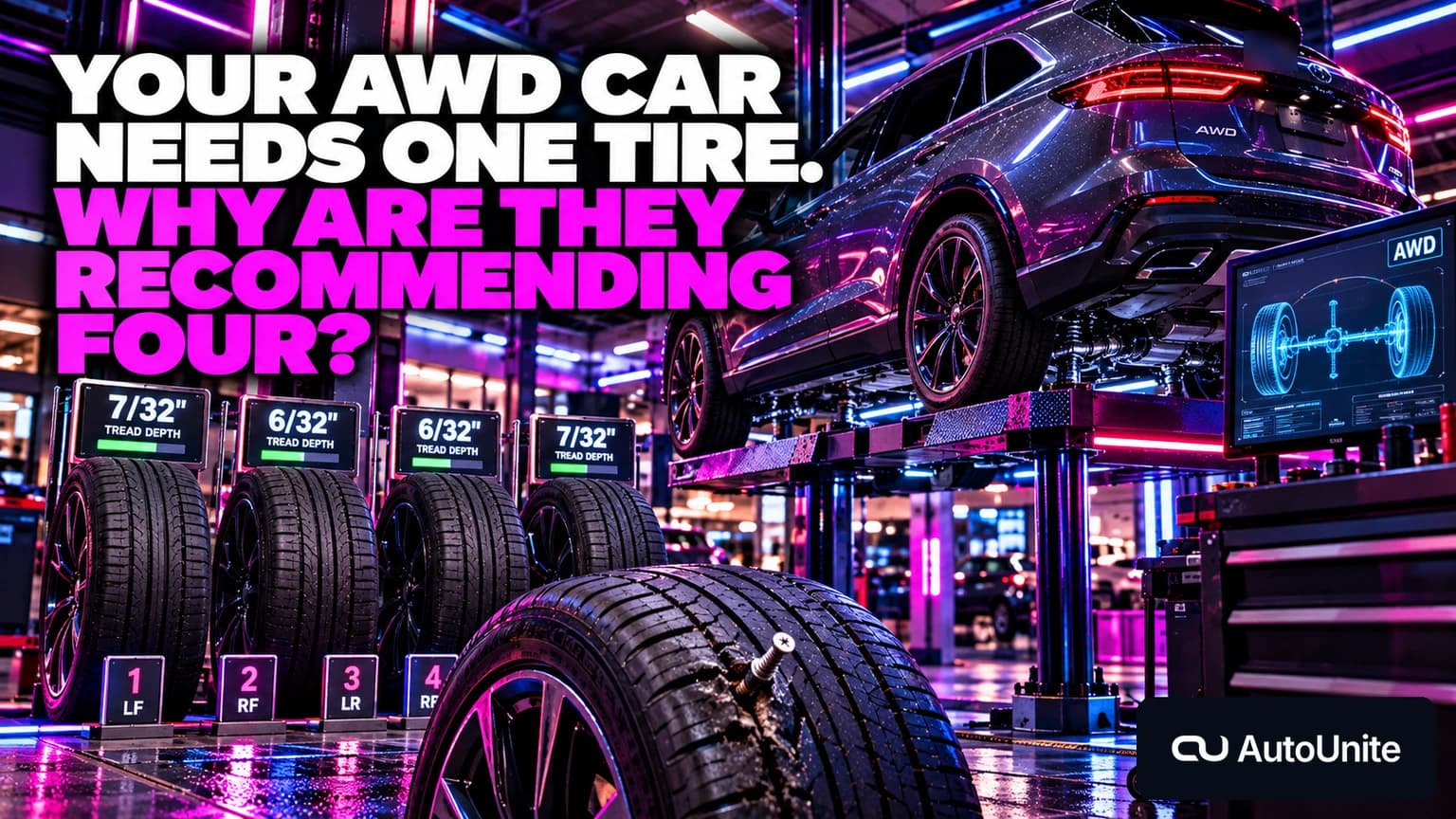
- PublishedSep 28, 2026
- Last verifiedSep 28, 2026
- Sources7
- 11 min read

Explore clearer car-buying guidance, market context, and ownership knowledge in one place.
A one-tire road-hazard problem can become a four-tire quote on AWD. The correct replacement count depends on actual tread measurements, tire matching and the exact vehicle manufacturer rule.
The tire shop finds one screw in one tire. The other three still have useful tread. You are expecting one replacement and a bill you can swallow.
Then the advisor looks at the tread gauge, asks whether the vehicle is all-wheel drive, and says the quote may be for four tires.
That is the moment this starts to sound like an upsell.
Sometimes it is a legitimate drivetrain and tire-matching issue. Sometimes one tire, a pair, or another documented solution may be possible. The part that matters is not the letters AWD on the liftgate by themselves. It is the exact vehicle rule, the exact tire set, the actual tread-depth spread, and whether the replacement tire can be made to match what the drivetrain expects.
On an AWD or 4WD vehicle, a tire is not only an isolated piece of rubber. It is one of four rolling diameters feeding a driveline that may continuously compare or mechanically connect wheel speeds. If one tire rolls a meaningfully different distance per revolution, the system can see a difference every time the car moves.
That is why the useful question is not, 'Do AWD cars always need four tires?' They do not all follow one universal rule. The useful question is: 'What mismatch does this exact vehicle allow, and where does my current tire set sit relative to that rule?'
In a front-wheel-drive or rear-wheel-drive car, tire matching still matters for handling, braking, traction, ABS and stability control. On AWD and 4WD vehicles there can be an additional mechanical issue: the drivetrain is designed around the rolling behavior of all four corners.
USTMA warns that for 4WD and AWD vehicles even small differences in outside diameter may cause drivetrain damage or mechanical malfunction, and it tells consumers to follow the vehicle manufacturer's instructions when those instructions are more specific.
That warning does not mean every 1/32-inch tread difference destroys a transfer case. It means the acceptable difference is an engineering limit, not a guess. The limit may be expressed as tread depth, circumference, diameter, revolutions per mile, matching tire model, or a combination of those factors.
As a tire wears, rubber disappears from the outside radius. The sidewall still says the same nominal size, but the tire is physically smaller than it was when new.
The geometry is simple. If one tire has 6/32 inch less tread than a new matching tire, its radius is roughly 6/32 inch smaller before accounting for load, inflation and construction. That makes its diameter roughly 12/32 inch smaller. An illustrative circumference calculation turns that into more than an inch of difference around one revolution.
AutoUnite content is educational and research-focused. Vehicle information, pricing, ownership costs, maintenance, recalls, and other details may vary by region, dealer, and time.
That is not a universal tolerance test. Real rolling circumference under load is affected by tire construction and pressure. The point is that 'same size on the sidewall' and 'same rolling size on the road' are not always the same thing once three tires have thousands of miles on them.
Two tires can both be labeled 235/55R19 and still differ in tread pattern, casing construction, new-tire tread depth, revolutions per mile, load specification, speed rating or manufacturer tuning.
That is why replacing a damaged tire with any tire that happens to fit the wheel can be the wrong shortcut. USTMA says replacement tires should meet the size, load index and speed rating specified by the vehicle or tire manufacturer. Michelin similarly advises matching size, type and other specifications, and points AWD owners back to the vehicle manufacturer's rules.
On a used vehicle, this is especially important. The three surviving tires may not even be the original model. Document what is actually mounted before comparing a new tire to what the car had when it left the factory.
There is no single safe number that applies to every AWD system.
One manufacturer may publish a tread-depth threshold. Another may emphasize matching brand, model, size or rating. A third may require all four to be replaced in a certain circumstance. Some vehicles are intentionally staggered, with different approved sizes front and rear, so 'all four must be the same size' would itself be wrong for that car.
The evidence hierarchy is straightforward: exact VIN and configuration, current owner's manual or service information, tire placard, tire-manufacturer specifications, then the measured condition of the four tires. A generic forum number belongs below all of those.
Tesla's current Model 3 service guidance is a useful example because it publishes a number instead of leaving the reader with a vague warning.
Tesla says ride quality and handling are maximized when all four tires are the same age, model and tread depth. It recommends rotation at 6,250 miles or when tread-depth difference reaches 2/32 inch, whichever comes first. For early replacement, Tesla recommends replacing tires in pairs unless the other tires are within 2/32 inch of the new tire.
That does not create a 2/32-inch rule for every AWD vehicle. It proves the opposite: a real manufacturer can define a concrete threshold for its own application. Use that specificity only where it belongs.
Audi's U.S. lease-return standards draw a different line. For quattro vehicles, Audi says all tires must match by brand, size and rating to meet its stated turn-in standard.
A lease-return standard is not the same thing as a universal mechanical damage threshold. But it illustrates a practical point: tire compatibility can involve more than measuring tread with a gauge.
If a shop quotes one replacement that is the correct size but a different model, construction or performance category from the other three, ask whether that mismatch is permitted for your exact vehicle and tire application.
Subaru tells owners that it recommends the same tires as originally equipped and, when changing brands, strongly recommends the same size and style while directing owners back to the owner's manual.
That is another reminder that 'AWD' is not the only input. The manufacturer selected a tire package as part of the vehicle's handling and driveline calibration. Replacing a tire is partly a fitment decision and partly a match-to-the-existing-set decision.
A four-tire quote can be legitimate, but the correct answer should come with evidence.
A single replacement may be possible when the vehicle manufacturer allows it and the new tire can match the existing tires closely enough in specification and rolling size. A pair may be appropriate under some manufacturer rules. All four may be justified when the remaining three are too worn, mismatched, aged, damaged, or outside the vehicle's documented tolerance relative to a new tire.
The important word is documented. If the explanation is only 'because AWD,' ask for the vehicle-specific source and the tread-depth measurements at all four corners.
The cleanest one-tire case is a relatively new matched set with one unrepairable tire and very little wear on the other three.
Suppose the vehicle manual permits a limited tread-depth difference, the three surviving tires are the same model and specification, and the new replacement falls inside that documented limit. In that situation, replacing one can be consistent with the evidence.
But do not substitute a generic tire-store policy for the vehicle's own rule. A one-tire option that is acceptable on one system may be outside the limit on another.
If the new tire would be too different from the remaining tires but the vehicle manufacturer permits pair replacement, two tires can sometimes restore a closer match without discarding all four.
The surviving pair still needs to meet the vehicle's match requirement. The new pair also needs to be installed in the position required by the manufacturer or tire guidance.
USTMA and Tesla both emphasize rear placement when only two same-size tires are replaced because the deeper tread on the rear helps reduce the risk of wet-road oversteer. That rear-placement rule is about vehicle stability, not about which axle happens to receive engine torque.
Four becomes much easier to justify when the current set is already near replacement, when wear is uneven, when the tires are not a matched set, when the required tire is no longer available, or when the manufacturer specifically advises against replacing fewer than four in the situation you have.
It can also be the cleanest answer when the remaining tires are old enough or damaged enough that spending money to preserve them has little economic value. The fact that they are above the legal tread minimum does not automatically make them good companions for a new tire.
The decision should combine compatibility, remaining life and vehicle guidance, not simply the desire to avoid buying three extra tires today.
Before deciding whether a four-tire recommendation is excessive, record the evidence that can prove or disprove it.
Measure tread depth at multiple grooves on every tire. Record the tire brand, model, size, load index and speed rating. Confirm whether the fitment is square or staggered. Set cold pressures to the placard specification before comparing rolling behavior. Pull the exact owner's-manual or service guidance for the VIN and model year.
A verbal estimate like 'these are about half worn' is not enough when a few thirty-seconds of tread can change the replacement path.
Tire pressure changes a tire's loaded radius and rolling behavior. Michelin notes that rolling radius and revolutions per mile are sensitive to inflation pressure, and NHTSA emphasizes correct inflation as a core tire-safety requirement.
That means you should not compare one tire at 29 psi to another at 36 psi and call the result a tread-depth problem. Correct the pressure first, then measure wear and apply the vehicle-specific rule.
Some AWD performance vehicles are designed with different front and rear tire sizes. On those vehicles, the correct match is not four identical sidewall labels. It is the approved front/rear combination and the rolling-diameter relationship the manufacturer designed into the system.
This is why a blanket instruction such as 'all AWD tires must be the same size' can be misleading. The owner's manual and placard define the approved architecture. Your job is to preserve that architecture when replacing tires.
A screw in the tread does not always mean the tire must be replaced. Repairability depends on the damage location, size, tire condition, whether the tire was driven while underinflated, and the tire/service guidelines that apply.
That is a separate gate from the AWD matching question. If a qualified tire professional can properly repair the existing tire, the entire one-versus-four replacement decision may disappear. If the tire is unrepairable, then move to the matching analysis.
Do not let a driveline discussion skip the basic inspection of the damaged tire itself.
A mismatch can create a mechanical concern without proving that damage has occurred. Likewise, a transfer-case or differential problem does not prove the tires caused it.
Warranty coverage, causation and repair responsibility depend on the actual failure, vehicle history, manufacturer terms and diagnosis. The evidence file should document tire measurements and manufacturer rules, not make a legal or warranty conclusion it cannot support.
A used-car shopper may see four tires with good tread and assume the set is fine. Look closer.
Are all four the same model? Are the sizes and ratings correct? Is one tire substantially newer? Is one axle wearing faster? Do the tread depths suggest that a single tire was replaced after a puncture? Is the vehicle supposed to have a staggered setup?
A mismatched set is not automatically damaged, but it is a reason to verify the approved configuration and measure the current rolling-size relationship before you buy.
AutoUnite's AWD Tire Match Proof Card is an evidence organizer. It does not diagnose a differential, approve a tire repair, or decide warranty coverage.
It keeps the decision in eight blocks:
If the manufacturer limit is blank, the tool must stay open. Unknown is not the same as within tolerance.
Imagine an AWD crossover with four identical tires that started around 10/32 inch. One tire is destroyed by a road hazard.
Case A: the surviving three measure 9/32. If the exact vehicle guidance permits the resulting difference and the same tire is available, one replacement may be supportable.
Case B: the surviving three measure 6/32. A brand-new matching tire may now be outside the manufacturer's allowed difference. A pair or four may be the documented path, depending on that vehicle's rules.
Case C: the surviving tires measure 5/32, 7/32 and 8/32 and are two different tire models. Now the problem is not just one damaged tire. The set already has uneven wear and a matching problem. Four may be the most coherent repair even before you count remaining tread life.
Same puncture. Three different evidence states.
Ask for the tread depth of all four tires in 32nds. Ask for the exact replacement tire brand, model, size, load index and speed rating. Ask what the vehicle manufacturer says about maximum difference across the set. Ask whether the damaged tire is repairable. Ask whether your vehicle is square or staggered. Ask why the recommendation is one, two or four.
A strong advisor should be able to connect the recommendation to measurements and a vehicle rule. If the answer is only 'AWD needs four,' you still do not have the proof.
Do not buy three extra tires because AWD sounds expensive. Do not force one cheap tire into a system that has a documented matching requirement either.
Measure the set. Identify the exact vehicle. Pull the manufacturer rule. Verify the proposed replacement tire. Then choose the smallest replacement plan that stays inside the documented requirement and preserves safe handling.
The right number of tires is not one, two or four in the abstract.
It is the number the evidence for your exact vehicle supports.