
Buying
How to compare car trims without getting lost
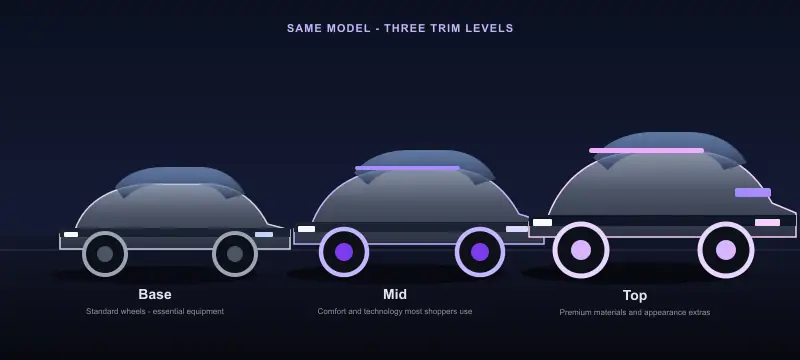
Learn how to compare base, mid, and upper trims using price, standard equipment, packages, safety features, comfort, and total ownership priorities.
On This Page
Decide First
What Matters
- Must-have features, not trim names
- Standard equipment before packages
- The actual vehicle in front of you
Watch This
- Paying for appearance items you will not use
- Assuming the top trim is automatically the better fit
- Comparing advertised starting prices only
Your Next Move
- Write three must-haves before opening spec tables
- Compare equivalent equipment, then price
- Open Research if you need a vehicle-level view
Overview
Trim levels can make a simple vehicle search feel complicated very quickly. The same model may appear with several names, equipment packages, wheel sizes, technology upgrades, and comfort features. The useful question is not which trim sounds best. It is which trim gives you the features you actually care about without paying for equipment you do not value.
Start with what you will actually use
Start by separating your must-haves from your nice-to-haves. A must-have might be a specific seating configuration, a driver-assistance feature, a powertrain choice, or a certain cargo requirement.
Start With Your Needs
Before opening specification tables, decide how the vehicle will actually be used. A daily commuter, a family vehicle, a towing vehicle, and a weekend car can all justify very different trim choices.
- How many people regularly ride in the vehicle?
- How much cargo space do you actually use?
- Do you need AWD or another specific drivetrain?
- Are there safety or driver-assistance features you consider essential?
- Do you care more about comfort, performance, technology, or price?
- Write down three must-have features.
- List nice-to-haves separately so they do not take over the comparison.
- Only then open trim and package tables.
Base vs Mid vs Top Trim
Base trim
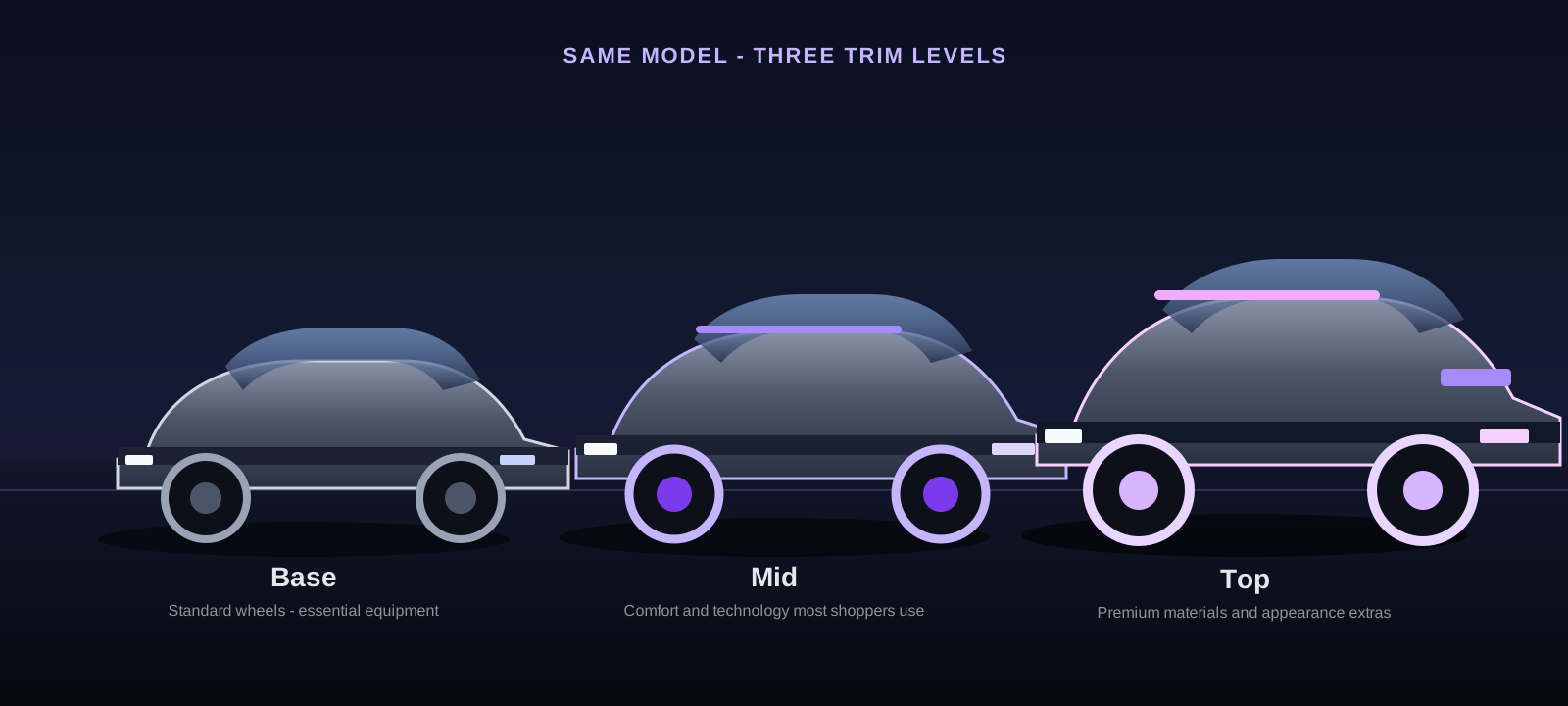
Usually the lowest entry price. Best when it already includes your must-have equipment and you do not need cosmetic or convenience upgrades.
Mid trim
Often adds the comfort, convenience, or technology features many shoppers actually use without moving all the way to the highest price.
Top trim
May add premium materials, larger wheels, additional technology, or appearance details that matter mainly if you specifically want them.
Standard Features vs Packages
A common comparison mistake is treating trim equipment and package equipment as the same thing. A feature may be standard on one trim, optional through a package on another trim, or unavailable entirely on a lower trim.
| Feature | Vehicle A | Vehicle B | What to verify |
|---|---|---|---|
| Heated seats | Standard | Package | Is the package installed on this specific vehicle? |
| Driver assistance | Standard | Standard | Are the included functions the same? |
| Premium audio | Unavailable | Optional | Is it worth the added cost to you? |
| Larger wheels | Optional | Standard | Do you actually prefer the ride and tire cost tradeoff? |
Compare the Real Numbers
The difference between two trims is not only the difference in their advertised starting prices. A lower trim with several packages can sometimes move closer to the price of the next trim.
Quick Checklist
- Pick your three must-have features.
- Compare standard equipment first.
- Identify packages separately.
- Compare the actual vehicle configuration.
- Check price differences after adding equivalent equipment.
- Do not pay for features you do not value just because the trim is higher.
Sources
- NHTSA 5-Star Safety Ratings · NHTSA
- Fuel economy ratings · U.S. DOE / EPA
Get AutoUnite Decision Guides
Buying and numbers guides when they publish. Unsubscribe anytime.
Discussion
Comments are shopper discussion, not verified article evidence.
Loading discussion…
AutoUnite content is educational and research-focused. Vehicle information, pricing, ownership costs, maintenance, recalls, and other details may vary by region, dealer, and time.