
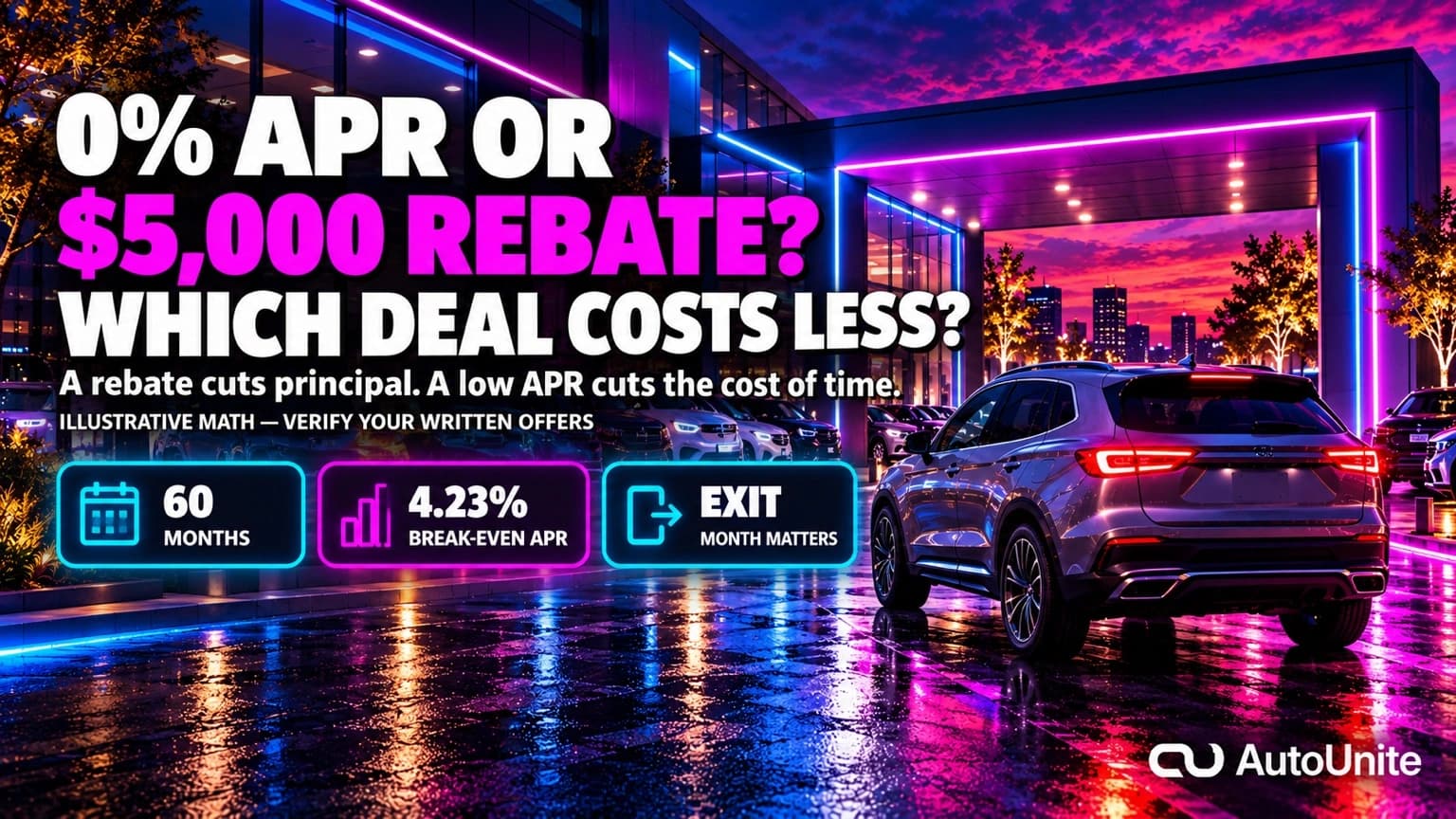
0% APR or $5,000 Rebate? Which Deal Actually Costs Less?
- PublishedSep 28, 2026
- Last verifiedSep 28, 2026
- Sources9
- 12 min read

Explore clearer car-buying guidance, market context, and ownership knowledge in one place.
A manufacturer cash rebate and a special APR discount different parts of the same deal. Newsletter 39 shows how to compare the same VIN using full-term cost, break-even APR and expected payoff month.
Do not compare two headlines before you verify the program terms.
Manufacturer incentives are often vehicle-specific, trim-specific, regional, credit-tier-specific and time-limited. Some can stack. Some cannot. Some require captive financing. Some require current ownership, military status, college-graduate status or another qualification.
A current Toyota Central Atlantic example shows why this matters. As of September 26, 2026, Toyota lists a 2026 Tundra i-FORCE MAX offer at 2.99% APR for 72 months and a separate $1,000 Customer Cash offer in DE, MD, PA, VA and WV. The offer terms say the customer cash cannot be combined with the APR offer. Both expire September 30, 2026, and Toyota states that the dealer sets the final price.
That does not mean every Toyota offer works that way. It proves the structure is real: sometimes the shopper is choosing between two forms of manufacturer support rather than receiving both.
Before calculating anything, get the written program terms for the exact VIN or eligible model and answer four questions:
If those answers are not proven, the comparison is not ready.
The Consumer Financial Protection Bureau tells borrowers to compare the amount financed, APR, loan length and monthly payment—not the payment alone. That matters here because an incentive choice can move those inputs in opposite directions.
A rebate usually lowers the amount financed. A subsidized APR usually lowers the cost applied to the balance.
One can create the lower monthly payment while the other creates the lower total cost.
That is why the decision needs two lines:
Full-term cost: What do I pay if I keep the loan until the last scheduled payment?
Exit-date cost: What do I pay if I trade, refinance or pay the loan off at the month I realistically expect?
Those can point to different winners.
The numbers below are illustrative math, not a current manufacturer offer.
Assume the same vehicle has the same $50,000 pre-tax deal price under both choices. To isolate the incentive mechanism, assume taxes, fees, trade, down payment and add-ons are the same under both choices.
AutoUnite content is educational and research-focused. Vehicle information, pricing, ownership costs, maintenance, recalls, and other details may vary by region, dealer, and time.
Offer A: 0% APR for 60 months, no $5,000 rebate.
Offer B: $5,000 rebate, then finance $45,000 for 60 months at 6.5% APR.
Offer A is easy. $50,000 divided by 60 months is about $833.33 per month. If the loan runs the full term, scheduled payments total $50,000.
Offer B starts with less principal, but the loan charges interest. A $45,000 loan at 6.5% APR for 60 months is about $880.48 per month. Scheduled payments total about $52,828.60.
Under those assumptions, the 0% offer wins the full-term comparison by about $2,828.60.
The bigger headline incentive did not create the lower total cost.
Now change only the alternate loan rate.
With the same $50,000 vehicle, $5,000 rebate and 60-month term, the rebate option roughly breaks even with 0% financing at 4.23% APR.
Below that rate, the $5,000 rebate can overcome the interest cost and win the full-term comparison. Above that rate, the 0% financing can save more than the rebate is worth.
For example:
That 4.23% threshold belongs only to this example. Change the vehicle price, rebate, term or amount financed and the break-even rate changes.
The useful habit is not memorizing 4.23%. It is calculating your own threshold.
Suppose you expect to trade the vehicle in about two years instead of carrying the loan for all 60 months.
Under the 0% offer, after 24 payments of about $833.33, you have paid $20,000 and still owe about $30,000. Your total cash needed to be completely out of the loan at month 24 is still $50,000.
Under the $5,000-rebate loan at 6.5%, after 24 payments you have paid about $21,131.44. The remaining principal is about $28,727.74. Paying the loan off then would put total paid-to-exit at about $49,859.18.
So in this example, the rebate option is still about $140.82 cheaper at month 24, even though 0% wins by more than $2,800 if both loans run the full 60 months.
Around month 25, the cumulative interest on the rebate loan crosses roughly $5,000, and the 0% path begins to edge ahead on a pure loan-cost basis.
That is why an incentive calculator should ask one more question than most online payment tools do:
How long do you realistically expect to keep this loan?
If you routinely trade every two or three years, refinance early, receive a bonus and pay down debt, or otherwise expect an early payoff, the exit-date comparison can matter as much as the full-term comparison.
And before assuming you can pay off early without friction, check the contract. CFPB guidance says whether an auto loan has a prepayment penalty depends on the contract and state law. The Truth in Lending disclosure should tell you whether a penalty may apply.
The special APR is only one financing option.
You might have a bank or credit-union preapproval. You might qualify for a promotional rate from another lender. You might be able to shorten the term. Or your credit profile may make the manufacturer’s low-rate program unavailable.
CFPB recommends shopping rates before visiting the dealership because outside quotes give you a comparison point. It also notes that dealers and lenders are not required to offer the lowest rate available to you.
This changes the incentive question from:
“Is 0% better than $5,000?”
to:
“Is 0% better than $5,000 plus the best financing I can actually obtain?”
That is the correct comparison.
A low advertised APR can be limited to well-qualified buyers. The FTC specifically warns shoppers that zero- or low-interest offers may apply only to borrowers who meet strong credit qualifications.
A shopper who does not qualify for the advertised 0% cannot use 0% as the comparison rate.
Use the rate on the written approval you can actually sign.
The same rule applies to rebates. If the $5,000 number includes loyalty cash, conquest cash, military cash, college-graduate cash or another qualification you do not meet, it is not your rebate.
Apex-level comparison means removing every incentive you do not actually qualify for before doing the math.
This is one of the easiest places for the comparison to drift.
If the vehicle is $50,000 with the special APR but $52,000 with the rebate, you are not comparing financing choices anymore. You are comparing two different vehicle-price structures.
The FTC’s September 2026 automobile pricing guidance emphasizes transparent advertised pricing and says dealers may advertise additional conditional discounts—such as a discount for dealer financing—only while keeping the price any consumer can actually pay as the most prominent amount.
For the shopper, the practical rule is simple:
Get two written worksheets for the same VIN.
Each should show the vehicle selling price before government taxes and fees, every rebate or discount, the amount financed, the APR, the term, the monthly payment and the total of payments.
Then make the two offers explain every difference.
This is another place a comparison can quietly break.
CFPB defines the interest rate as the cost paid to the lender for borrowing the principal. APR incorporates the interest rate plus certain additional loan fees. The Truth in Lending Act requires the lender to disclose the APR before the loan is finalized.
When comparing Offer A and Offer B, compare APR to APR—not an interest rate on one side and APR on the other.
Then use the Truth in Lending disclosure to verify:
The finance manager’s calculator is useful. The signed disclosure is the authority.
Do not assume a cash incentive always reduces taxable price dollar-for-dollar.
Sales-tax treatment can vary by state and by how the incentive is structured. Manufacturer rebates, dealer discounts, trade credits and other reductions are not always treated the same way.
That is why the AutoUnite comparator does not try to guess tax law from a headline rebate. It asks for the written taxable amount or the actual tax from each buyer’s order.
If the tax line is the same under both offers, the comparison stays simple. If it changes, include the actual difference.
Do not convert a national article into a state-specific tax conclusion without checking the state rule.
Imagine the 0% offer requires a larger down payment than the rebate offer.
The monthly payment may look better because more cash was moved to day one.
That is not a free savings. It is a timing difference.
A rigorous comparison treats down payment as money paid by the buyer and includes it in total cash outlay.
The same goes for trade equity.
If one offer uses $5,000 more trade equity or cash at signing, add that back into the comparison before calling its payment cheaper.
If you owe more on your trade than it is worth, the negative equity can be rolled into the new amount financed if the lender approves it.
That can make a 0% offer look unusually attractive because the buyer is avoiding interest on a larger financed balance. It can also make the rebate look more valuable because the rebate directly reduces that balance.
Either way, do not bury the old loan inside the new-car incentive comparison.
Show the negative equity as its own line.
Then ask whether the new loan still makes sense after the old obligation is included.
The longer the alternate loan runs, the more time interest has to accumulate.
A $5,000 rebate financed at 6.5% for 36 months is a different tradeoff from the same rebate financed at 6.5% for 72 months.
That means the shopper should compare the same term first.
If the manufacturer only offers 0% for 36 months but the rebate loan is being quoted at 72 months, there is no single “winner” without also deciding whether the higher 36-month payment fits the household.
The mathematically lower total cost is not useful if the payment creates a budget problem.
The right structure has to satisfy both total cost and payment fit.
Kelley Blue Book/Cox Automotive reported that August 2026 new-vehicle incentive spending averaged 6.5% of transaction price. That is meaningful support, but it was lower than a year earlier. The same report put the average new-vehicle transaction price at $50,089.
Cox’s affordability report estimated the average new-vehicle loan rate at 9.49% in August. That is a national estimate, not a rate any individual shopper should expect to receive, but it shows why a heavily subsidized manufacturer APR can carry real economic value.
A low APR is not just marketing decoration when the alternative borrowing rate is high.
A large rebate is not just marketing decoration when the shopper has strong outside financing.
The value of either incentive is relative to the alternative.
Start with the vehicle, not the payment.
1. Lock the exact VIN and selling price.
Make sure both offers use the same car and the same negotiated price before incentives.
2. List only the incentives you actually qualify for.
Mark each as stackable or mutually exclusive using the written program terms.
3. Enter the real amount financed under each offer.
Include taxes, fees, add-ons and negative equity exactly as they appear—not as estimates if written deal sheets exist.
4. Enter the real APR and term.
Use the approval you can actually sign. Compare APR to APR.
5. Compare full-term total of payments.
This answers the cost if you keep the loan to maturity.
6. Compare your expected exit month.
Calculate payments made plus the payoff balance at that month, and include any verified prepayment penalty.
7. Check payment fit.
Do not select a mathematically cheaper structure that makes the monthly payment unworkable.
8. Save the evidence.
Keep the buyer’s order, incentive terms, TILA disclosure and outside preapproval with the calculation.
Ask the salesperson or finance manager:
“Are these two offers mutually exclusive?”
“What is the selling price before incentives under each choice?”
“What rebates do I personally qualify for?”
“What APR and term am I actually approved for?”
“What is the amount financed under each option?”
“What is the total of payments?”
“Is there any prepayment penalty?”
“Can you print both structures for the same VIN?”
Those questions turn a marketing choice into a math problem.
Do not choose the rebate because the cash number is larger.
Do not choose 0% because the interest rate is smaller.
Make the offers compete on the same vehicle, same price, same term and same real financing approval. Calculate the break-even APR. Then test the month you expect to exit the loan.
If the answer changes when you change the holding period, that is not a flaw in the math. That is the decision.
A rebate buys down principal on day one. A special APR buys down the cost of time. Your better deal is the one that costs less over the time you actually expect to own the loan.
Publication-day gate: recheck all active incentive terms, offer expiration dates, APR examples and market figures before public release.