
Money
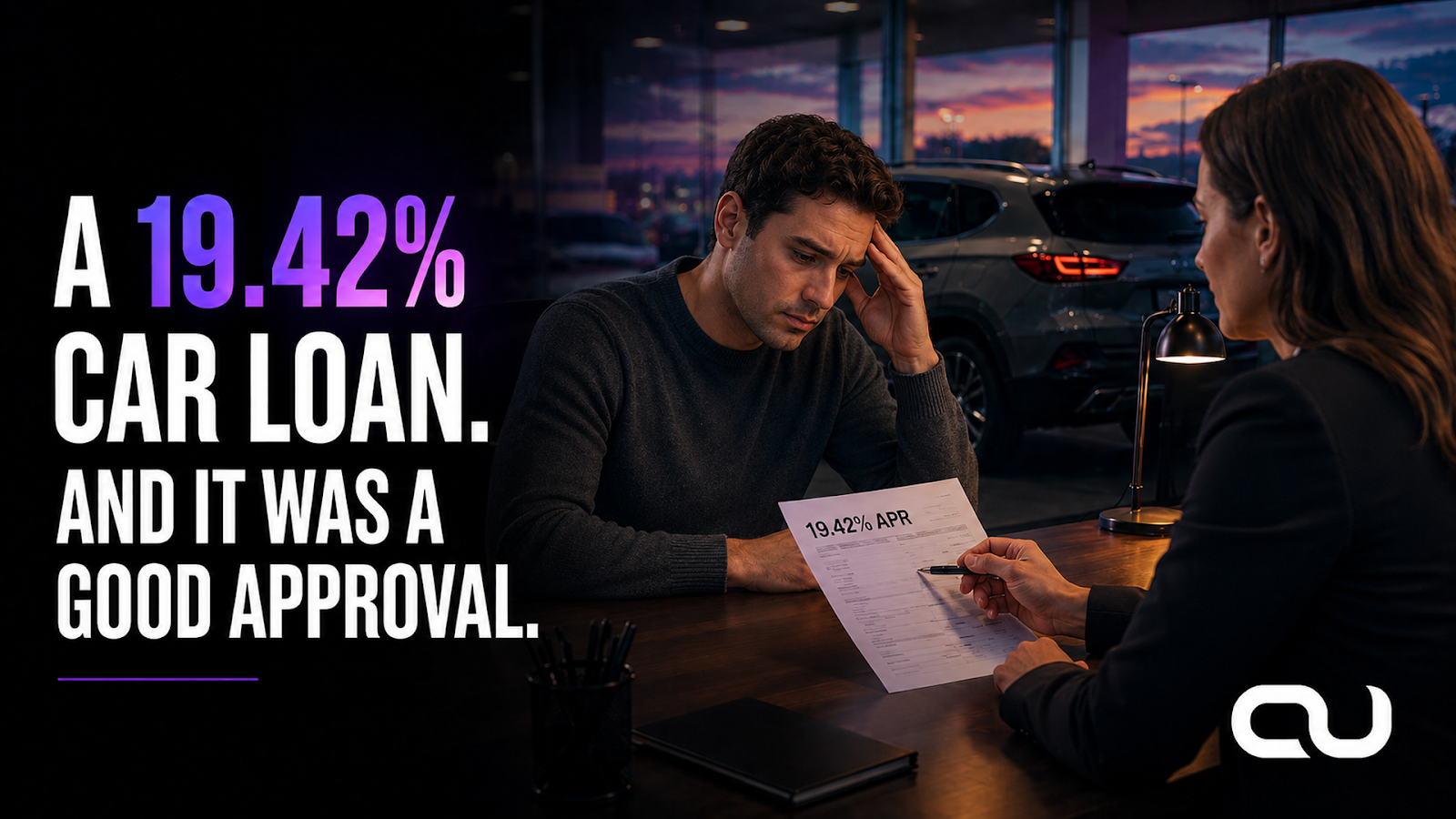
A 19.42% Car Loan. And It Was a Good Approval.
- PublishedAug 26, 2026
- Last verifiedAug 24, 2026
- Sources6
Originally published on another platform · Aug 26, 2026 · Original URL. AutoUnite is the canonical record. Last verified Aug 24, 2026.
Why an expensive rate can still be a strong approval when credit, the vehicle, negative equity and lender risk all collide.
Decide First
What Matters
- A high APR can still be a comparatively strong approval when the real alternatives are worse or no approval at all. Judge the approval against the actual borrower, vehicle, deal structure and available alternatives.
Watch This
- Credit history, income, debts, amount financed, down payment, term, vehicle value, negative equity and LTV can all affect what a lender is willing to approve.
Your Next Move
- Before signing, compare APR, amount financed, term, monthly payment, total cost and any competing bank or credit-union offer. Make sure the approval works for your situation, not just the dealership’s.
On This Page
Overview
Why an expensive rate can still be a strong approval when credit, the vehicle, negative equity and lender risk all collide.
19.42% is a high APR.
I’m not going to pretend it isn’t.
If you walk into a dealership expecting something close to 5% or 6% and the finance manager puts 19.42% in front of you, I already know what you’re probably thinking:
How in the world is that a good approval?
That reaction makes sense.
But there’s another side of that desk.
Sometimes the customer sees 19.42%.
The finance manager sees the five banks that already said no.
The desk sees the vehicle that wouldn’t finance.
They see the negative equity.
They see the amount the lender is willing to advance.
They see the credit history underneath the score.
They see everything that had to move before one lender finally said yes.
And suddenly 19.42% can look very different.
That does not make it a cheap loan.
It means a high APR and a good approval can be true at the same time.
First, where did 19.42% come from?
I didn’t pick that number because it makes a good headline.
Experian’s Q1 2026 data showed the average used-car APR for borrowers in the 501–600 VantageScore 4.0 range was 19.42%.
For 601–660, the average was 14.03%.
For 300–500, it was 21.77%.
That doesn’t mean somebody with a 550 score automatically gets 19.42%.
There is no rate chart at the dealership that says:
550 = 19.42%.
It doesn’t work like that.
The number is important because it shows just how far apart the financing world can be depending on the credit profile.
Someone with excellent credit can look at 19.42% and think it’s insane.
Someone who has been declined by lender after lender can look at that same number and eventually realize:
This may actually be the approval I have available today.
That’s a very different conversation.
A credit score does not tell you the whole deal
One of the biggest problems I’ve seen over the years is people walking into a dealership already convinced they know what their financing should look like.
They checked their score.
They saw a rate advertised somewhere.
They ran a payment calculator.
Now they believe the rest should be simple.
But the lender isn’t looking at one number.
They may be looking at your payment history.
How much revolving debt you’re carrying.
How much of your available credit is already used.
Your existing obligations.
Your income.
How much you’re trying to finance.
How much cash you’re putting down.
The term.
And the vehicle.
Two customers can have credit scores that look similar and still be completely different deals.
One might have an old late payment and not much current debt.
Another might have multiple recent late payments, credit cards close to their limits, an existing car loan that’s behind, negative equity and no money down.
Those are not the same credit situations just because the scores happen to sit in the same neighborhood.
That’s what gets lost when the entire conversation becomes:
“My score is 620. Why isn’t my rate better?”
The lender sees more than 620.
And the score you saw before you came in might not be the score the lender is using
This one causes arguments in dealerships all the time.
A customer says:
“That can’t be right. Credit Karma says I’m a 620.”
And the finance department is looking at something different.
That doesn’t automatically mean the dealership did anything wrong.
You don’t have one universal credit score that every lender in America sees the exact same way.
Credit Karma currently provides VantageScore 3.0 scores using Equifax and TransUnion data.
Auto lenders can use different scoring models, different versions and different bureau information. Some use auto-specific FICO models.
Even the Experian data behind that 19.42% figure uses VantageScore 4.0.
So the score on your phone and the score involved in an auto-loan decision can be different.
That’s not something a finance manager should brush off.
They should explain it.
Because from the customer’s perspective, they walked into the store believing one thing about their credit and suddenly they’re being told something completely different.
That is exactly where distrust starts if nobody takes the time to explain what’s happening.
But the credit score still isn’t the part of auto financing I think shoppers misunderstand the most.
The car itself can completely change the deal.
Sometimes the cheaper car is actually harder to finance
This sounds backwards until you’ve worked these deals.
A customer is trying to make a responsible decision.
They’re thinking:
I have credit problems. I should buy something older and cheaper.
Makes sense.
Except the lender doesn’t just look at the price on the windshield.
They’re also looking at what that vehicle is worth compared with how much money they’re being asked to lend.
That’s LTV — loan-to-value.
And it matters.
Let’s say the customer already has negative equity in a trade.
Now that negative equity has to go somewhere if it’s being rolled into the next loan.
Add that shortage to the amount being financed on an older vehicle and you can end up with a structure where the lender is being asked to advance far more than the vehicle supports.
That inexpensive car the customer thought would solve the problem can actually make the financing harder.
This is where the dealership starts doing work the customer may never see.
You start pulling book after book.
What’s this one worth?
What does this vehicle look like to the lender?
What happens to the LTV here?
Does the mileage work?
Does the vehicle fit the lender’s program?
Can the negative equity fit inside this structure?
Can we keep the payment somewhere the customer can actually handle?
Sometimes a different vehicle changes the entire deal.
The customer didn’t suddenly get better credit.
The late payments didn’t disappear.
Their income didn’t change.
The car changed.
And because the collateral changed, the structure the lender was being asked to approve changed with it.
That’s a huge distinction.
I am not saying somebody with challenged credit should go buy a more expensive vehicle.
I’m saying the cheapest vehicle on the lot is not automatically the easiest vehicle to finance.
Those are two different things.
Negative equity makes this even harder
If your trade is worth $15,000 and you owe $20,000, that $5,000 doesn’t vanish when you buy another car.
If it gets rolled into the next loan, the next lender is effectively being asked to finance the next vehicle plus part of the debt left over from the previous one.
That can push the LTV higher.
And at some point, a lender may simply say:
No.
Not because the salesperson didn’t work hard enough.
Not because the finance manager needs to “call another bank.”
Not because somebody at the dealership is hiding a secret approval.
The structure may simply not work for that lender.
So now the desk starts moving pieces.
Different vehicle.
Different amount financed.
Different lender.
Different term.
Different cash-down scenario if the customer has one.
Different payment.
That is the part customers often never see.
They just know they have been sitting in the dealership for three or four hours and nobody seems to be giving them a straight answer.
Sometimes those four hours are ugly
I understand why customers hate waiting in a dealership.
Dealerships can absolutely waste people’s time.
I’ve worked in this business long enough to know that.
But there are also deals where the store really is working through one problem after another behind the scenes.
The first lender declines it.
Another doesn’t like the structure.
Another option still puts the payment too high.
The vehicle doesn’t carry the negative equity.
The desk looks through inventory.
Another car gets considered.
The numbers get rebuilt.
Another lender looks at it.
A response comes back.
Something still has to change.
Meanwhile the customer is sitting there thinking:
What is taking so long?
Then finally the finance manager gets an approval.
The customer walks into the finance office.
And the first thing they see is:
19.42% APR
Now imagine being on both sides of that conversation.
The customer is thinking:
You kept me here for hours and this is what you came up with?
The finance manager may be thinking:
You have no idea how difficult it was to get this approved.
That is the disconnect.
And if the finance manager just says, “This is a good approval, trust me,” I don’t blame the customer for not believing it.
Show them why.
Explain what happened.
Explain what was declined.
Explain why the vehicle mattered.
Explain what the credit profile looks like to a lender.
Explain why the score they saw somewhere else may not match what was used here.
Explain what their other realistic options are.
People handle bad news a lot better when they understand it.
So when is 19.42% a “good approval”?
Not because 19.42% is a good rate.
It isn’t.
It is expensive borrowing.
It can be a good approval when you compare it with the actual alternatives available on that deal.
If multiple lenders are declining the application and one lender approves it at 19.42%, that approval may be strong relative to what was realistically available.
If the alternatives are no approval at all, or a materially higher APR, then 19.42% means something very different than it does for somebody comparing it with a 7% approval.
That doesn’t make the interest cheaper.
It makes the approval better relative to the situation.
That distinction matters.
Because this is where expectations can get completely disconnected from reality.
A customer may be comparing their 19.42% approval with an advertised 5.9% rate they saw online.
But that advertised rate may be available to a completely different credit profile.
Experian’s Q1 2026 used-car averages make that gap pretty clear:
| VantageScore 4.0 range | Average used-car APR |
|---|---|
| 781–850 | 6.30% |
| 661–780 | 8.77% |
| 601–660 | 14.03% |
| 501–600 | 19.42% |
| 300–500 | 21.77% |
Again, those are averages.
They are not promises.
They are not rate cards.
But they show how dramatically the borrowing environment changes across different credit profiles.
And no, that does not mean you should automatically take the loan
This part matters just as much as everything I just explained.
A dealership getting you approved does not mean you have to buy the car.
A finance manager telling you the approval is strong does not mean you should stop asking questions.
If somebody puts 19.42% in front of you, understand exactly what you are signing.
What is the amount financed?
What is the term?
What is the monthly payment?
What will the loan cost over the full term?
Do you have another offer from your bank or credit union?
Would a different vehicle improve the structure?
Would money down materially change it?
Can you realistically afford the payment?
And if buying the car can wait, would taking some time to improve the credit situation put you in a meaningfully better position?
Those are fair questions.
The dealership should not be afraid of them.
The customer shouldn’t be embarrassed to ask them.
Because the goal should not be:
Get somebody into a car at any cost.
The goal should be:
Understand the actual situation and make the best decision available from there.
That might mean buying the car.
It might mean changing vehicles.
It might mean bringing your own financing.
It might mean putting more money down.
And sometimes it might mean not doing the deal today.
That’s what one percentage can hide
When most people see 19.42%, they see the rate.
That’s understandable.
But the lender may be looking at:
the credit history,
the debt,
the income,
the amount financed,
the trade,
the negative equity,
the vehicle,
the collateral value,
the term,
the LTV,
and the total risk of the transaction.
The dealership trying to arrange that financing is working inside those same realities.
That’s why I can say this without contradicting myself:
19.42% can be a bad rate and a good approval.
The rate is expensive.
The approval may still be better than everything else that was actually available.
You deserve to know both.
Because once you understand what happened behind that percentage, you can stop arguing over whether the number looks good and start asking the question that actually matters:
Is this the best workable financing available to me — and does taking it make sense for my situation?
That’s the gap AutoUnite is being built to close
Car shoppers have access to more information than ever.
Credit scores. Rates. Payments. Vehicle values. Trade estimates. Loan calculators.
But having more numbers doesn’t always mean understanding how those numbers work together when it’s time to make the actual decision.
That’s where this gets difficult.
A shopper can know their credit score and still not understand why changing the vehicle can change the approval.
They can know the payment and still not understand what negative equity did to the LTV.
They can know the APR and still not know whether that approval was weak, average, or surprisingly strong for their specific situation.
And the dealership can be working through all of those variables while the customer sees almost none of it.
AutoUnite is being built to help shoppers understand more of the decision before they have to make it — while helping dealers have better conversations with customers who arrive more informed about what actually matters.
Not to tell someone that 19.42% is a good rate.
Not to tell them to take the deal.
To help them understand why the deal looks the way it does, what questions to ask, and what they should compare before deciding.
Because the percentage matters.
But the percentage is not the whole decision.
Research first. Understand the numbers. Then decide what makes sense for you.
Sources
- The Latest Used Car Loan Interest Rates for 2026 · Experian
- How a lender decides what interest rate to offer on an auto loan · Consumer Financial Protection Bureau
- Loan-to-value ratio in an auto loan · Consumer Financial Protection Bureau
- Understand your credit score · Consumer Financial Protection Bureau
- How Accurate Is Credit Karma? · Intuit Credit Karma
- Learn About FICO Score Versions and Their Uses · myFICO
Get AutoUnite Decision Guides
Buying and numbers guides when they publish. Unsubscribe anytime.
Discussion
Comments are shopper discussion, not verified article evidence.
Loading discussion…
Comments are not open on AutoUnite yet. Published articles and Ask AutoUnite are the current way to get answers.
AutoUnite content is educational and research-focused. Vehicle information, pricing, ownership costs, maintenance, recalls, and other details may vary by region, dealer, and time.