
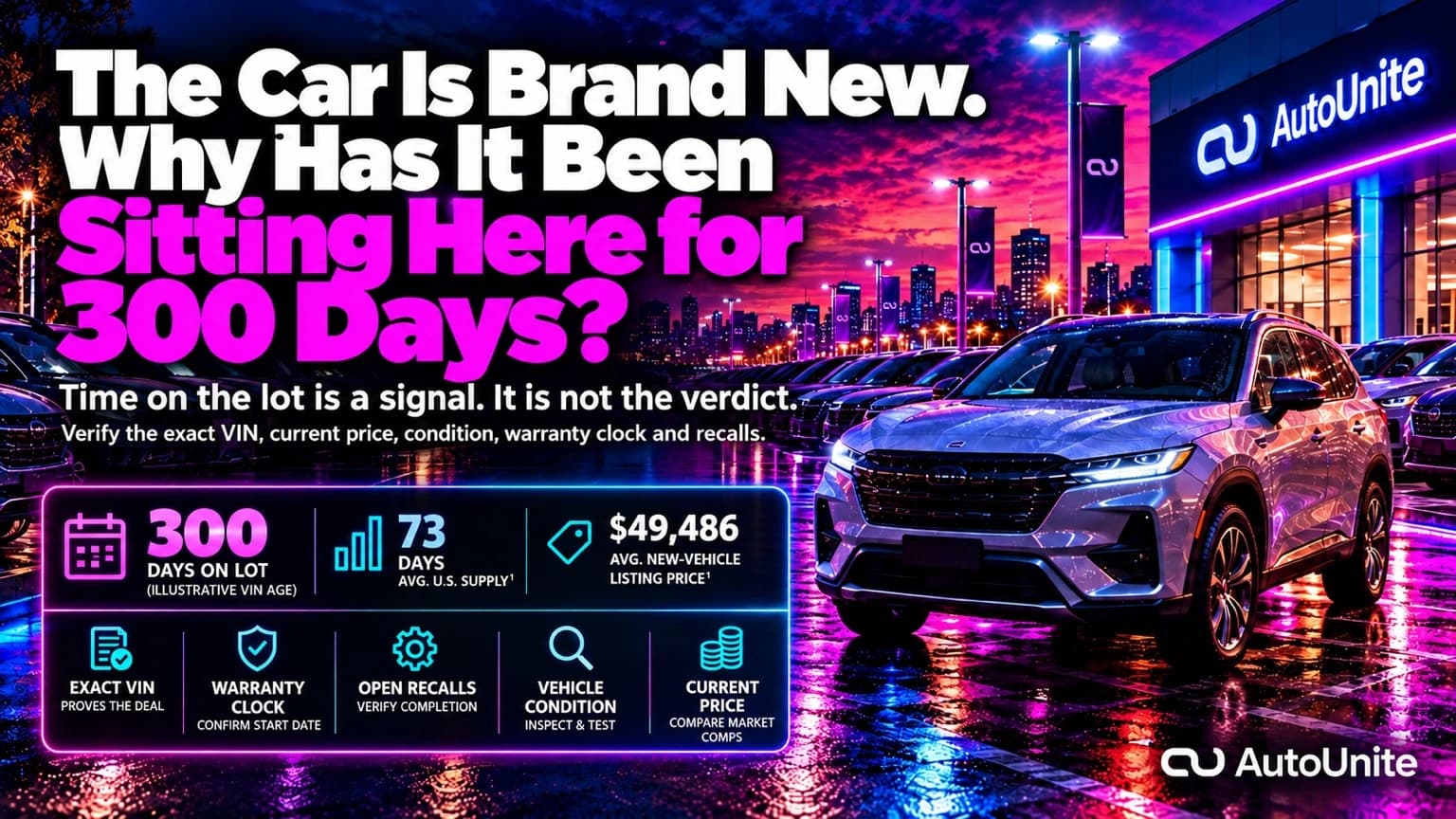
The Car Is Brand New. Why Has It Been Sitting Here for 300 Days?
- PublishedSep 27, 2026
- Last verifiedSep 27, 2026
- Sources10
- 13 min read

Explore clearer car-buying guidance, market context, and ownership knowledge in one place.
A new vehicle can sit for months without automatically being a bad buy or a bargain. Newsletter 40 shows how to verify the exact VIN, warranty clock, recalls, storage condition, current comps and written price.
A shopper finds the exact SUV online, drives to the dealership, and likes almost everything about it. The color works. The equipment is right. The price looks competitive.
Then someone says the vehicle has been there for almost 300 days.
That changes the conversation.
The first reaction is usually one of two extremes. Either the car must have something wrong with it, or the dealer must be desperate enough to take thousands more off.
Neither conclusion follows from the age alone.
A vehicle can sit because it is the wrong color for that market, the wrong package at that price, caught between model years, poorly positioned against nearby inventory, attached to the wrong incentive at the wrong time, or simply overlooked. A long stay can also give you legitimate things to verify: whether the warranty clock has started, whether open campaigns are complete, how the vehicle was stored, whether the battery and tires are healthy, whether transport or lot damage was repaired, and whether the current price actually compensates you for buying the older inventory.
Days on the lot tell you the vehicle has moved slowly; they do not tell you why, what condition it is in, or what it should cost today.
And one number needs to be clear from the start: 300 days is an illustrative example, not an industry threshold. There is no AutoUnite rule that a car becomes “aged” on day 300, becomes defective on day 300, or deserves a fixed discount on day 300.
The useful question is not, “Why is this thing still here?”
It is: “What does the exact VIN prove today?”
In August 2026, Cox Automotive reported that U.S. dealers had about 2.68 million new vehicles available, equal to 73 days' supply at the current sales pace. The same report put the average new-vehicle listing price at $49,486.
That 73-day figure does not mean the average vehicle on a dealer's lot is 73 days old.
Days' supply is a market-flow calculation: how long current inventory would last at the recent sales pace if no more vehicles arrived. The age of one VIN is a different question. One exact vehicle can sit far longer than the market's overall days' supply while many other vehicles are arriving and selling around it.
The current market is also uneven. Cox's August data showed Toyota at 33 days' supply, Lexus at 36 and Honda at 41, while several other brands carried substantially more inventory. Vehicles priced at $30,000 or less were at 54 days' supply, while vehicles above $60,000 carried more than 90 days.
AutoUnite content is educational and research-focused. Vehicle information, pricing, ownership costs, maintenance, recalls, and other details may vary by region, dealer, and time.
So an old VIN inside a well-supplied brand is one story. An old VIN inside a very tight brand is another. An expensive configuration can move at a very different pace from an entry-priced configuration even when the badges match.
Before you negotiate against “300 days,” identify the market the vehicle actually lives in.
There is rarely one universal reason.
Two vehicles with the same model name can have very different sales velocity. Trim, drivetrain, engine, color, interior, wheel package, seating configuration and factory options can all change the buyer pool.
A bright exterior color may be desirable nationally and slow locally. A premium package may make sense on a luxury-oriented lot and struggle where shoppers are price-sensitive. A rear-wheel-drive version may be perfectly normal in one region and less attractive in another.
That is why the window sticker matters. Federal law requires new automobiles to carry a manufacturer information label before delivery to a dealer. That label ties the exact VIN to its model, factory equipment and pricing information. Start with the vehicle that exists, not the generic model page.
A vehicle can remain technically available while the market around it changes.
Kelley Blue Book and Cox Automotive reported an August 2026 average new-vehicle transaction price of $50,089 and average incentive spending equal to 6.5% of transaction price. Those are national averages, not a discount formula for your vehicle. What matters is whether this VIN's current written price is competitive with equivalent inventory now.
A dealer may have reduced the price late. A manufacturer incentive may have appeared after months of slow traffic. Competing dealers may have received fresher inventory. A new model year may have arrived at a similar price. The original sticker can stay the same while the economic meaning of the deal changes around it.
A late-selling outgoing model year does not automatically mean a redesign problem. It can simply mean shoppers now have a choice between an older build and a newer model-year label.
Cox noted in August that the transition to 2027 vehicles was gaining momentum, although more slowly than the prior year's rollout. That matters because the comparison set changes when newer model-year inventory arrives.
The correct question is not “Is the newer year better?” It is “What is actually different, and what is the price difference?”
If the newer vehicle adds equipment you care about, changes the powertrain, receives a different incentive, or is likely to have a stronger near-term resale position, the aged unit may need a larger economic advantage to make sense. If the newer vehicle is essentially unchanged and costs materially more, the older VIN may be exactly the opportunity you want.
Lot age and warranty age are not automatically the same thing.
Toyota's current warranty guidance, for example, says its warranty period begins on the vehicle's in-service date—the first date the vehicle is delivered to an ultimate purchaser, leased, or used as a company car or demonstrator.
That is a Toyota-specific example, not a universal rule for every manufacturer. But it proves why the question matters.
An unsold vehicle that has simply remained in inventory may still have its full factory warranty ahead of it. A demonstrator or company-use vehicle may have a different warranty start date even if you are the first retail buyer.
Ask for the exact VIN's warranty start or in-service date in writing or from the manufacturer's dealer system. Do not rely on “it's new, so the warranty is new.”
For an aged VIN, record:
If the warranty clock has already started, that is not automatically a reason to reject the car. It is a measurable difference that belongs in the price comparison.
A vehicle sitting is not the same as a vehicle being neglected.
Dealerships move cars for service, detail, test drives, lot rotation, weather events and inventory changes. Some stores maintain stored vehicles carefully. Some exact vehicles may barely move. You cannot know the condition from the inventory age field alone.
What you can do is inspect the things that storage can make relevant.
Manufacturer manuals themselves sometimes contain extended-storage guidance. Toyota has model-specific instructions noting that a 12-volt battery can become low during long non-use. Tesla publishes model-specific storage guidance for its EVs, including charging recommendations during extended parking. Those examples are not evidence that every aged vehicle has a battery problem. They are evidence that storage practices can be vehicle-specific and worth verifying.
For the exact VIN, check:
The point is not to create an endless reason to panic. The point is to replace assumption with evidence.
NHTSA's recall lookup lets a shopper enter the exact VIN and see unrepaired safety recalls for supported manufacturers.
That is a high-value check, but NHTSA also states important limitations. Its VIN result does not show already-repaired recalls, some very recent recalls before all affected VINs have been identified, or manufacturer non-safety customer-service campaigns.
For an aged new vehicle, use two layers:
If the vehicle has been sitting across several campaign cycles, you want proof that it is current before delivery, not a promise that the system will “catch it later.”
Online listing age can be useful, but it is not always the same thing as the vehicle's total inventory history.
A VIN can move between stores. It can be transferred between dealer locations. A listing can be republished. A dealership website provider can reset or change displayed timing. A car can spend time in transit before the consumer-facing listing appears.
Do not fight over a website counter.
Ask for the best available inventory history for the exact VIN:
Then label the number honestly. “300 days since first listing” is different from “300 days since dealer arrival.” If the store cannot verify the date, leave it open instead of turning an estimate into a fact.
This is where shoppers often make the wrong leap.
A 300-day-old VIN is not automatically worth 300 days of discount.
The current written price has to be compared with the current alternatives.
The FTC's September 2026 automobile pricing guidance says that when a dealer advertises a vehicle price, the most prominent price should be the actual price any consumer can pay, excluding government-required consumer charges. Conditional discounts can be shown, but they should not be used to make an unavailable price look like the real starting point.
For the shopper, that creates a clean process.
Get the written current price for the aged VIN. Then separate:
Now find current comparable new vehicles.
The strongest comps are not merely the same model name. Match as closely as practical on:
If the 300-day vehicle is already priced materially below several equivalent fresh units, “it's old” may not produce another large concession. If it is priced exactly like fresh inventory despite a material model-year disadvantage or a partially consumed warranty, you have a concrete reason to ask why.
The following numbers are illustrative math, not a current offer.
Suppose an aged new SUV has:
You find three closely matched fresh units at:
The median comparable price is $46,100. The aged VIN is already $900 below that median before any additional negotiation.
That $900 is not automatically “enough.” It is simply the proven current price position.
Now change one fact.
Suppose the vehicle had been put into demonstrator service eight months ago and the manufacturer's warranty clock had already started. You would now be comparing a lower price against less remaining warranty time and higher mileage. The same $900 price gap has a different meaning.
Change another fact.
Suppose the newer model year has a $1,500 customer incentive you qualify for, making a comparable fresh vehicle effectively $44,950. The aged unit at $45,200 is no longer cheaper.
Nothing about the 300-day number changed. The decision changed because the evidence around it changed.
There is nothing irrational about buying old new inventory when the evidence works.
A vehicle can sit for months and still be mechanically sound, fully warrantied, current on campaigns, cosmetically clean and meaningfully cheaper than the best equivalent alternatives.
In that situation, the age may simply explain why the opportunity exists.
The aged VIN becomes especially interesting when:
The mistake is not buying an old VIN.
The mistake is paying a “fresh inventory” price without checking whether you are receiving fresh-inventory economics and evidence.
A discount does not fix a vehicle you do not actually want.
If the aged unit is the wrong color, wrong drivetrain, missing a safety or convenience feature you care about, already deep into its warranty, or materially disadvantaged against the newer model year, a lower price may not create value.
The same applies if the vehicle's history cannot be explained cleanly.
If the store cannot tell you when the warranty started, cannot produce an exact-VIN campaign check, cannot explain repaired damage, or cannot give you a written current price, the problem is no longer that the car is old inventory. The problem is that the evidence is weak.
Save the VIN, stock number, model year, trim, drivetrain and window sticker. Do not compare a generic online configuration to the actual car.
Record the best-supported dealer arrival date, first listing date and any transfer history. If the date is uncertain, mark it uncertain.
Get the in-service date and actual warranty expiration dates from the manufacturer/dealer system.
Run the VIN through NHTSA. Then ask the dealer for the manufacturer's campaign/software/pre-delivery status.
Battery, tires, road test, warning lights, paint, repaired damage, interior and required storage/PDI items for that exact vehicle.
Do not build your comparison from a crossed-out MSRP or a rebate you do not qualify for.
Use current equivalent new vehicles, not a national average. Match configuration and market as closely as you can.
List only the differences that matter to you: equipment, powertrain, warranty, incentives, price and expected ownership horizon.
If the exact vehicle is clean, fully documented and economically stronger, buy it because the evidence says so—not because “300 days” sounds scary or because the salesperson calls it a steal.
Ask the salesperson or manager:
“What's the exact dealer-arrival or first-stock date for this VIN?”
“Has the factory warranty clock started? Can you show me the in-service date?”
“Was this ever a demo or company-use vehicle?”
“Can you print the open recall and manufacturer campaign status?”
“Has it had any transport, lot or cosmetic damage repaired?”
“Can I see the battery test, tire condition and current pre-delivery inspection?”
“What is the actual written selling price before government taxes and registration?”
“What incentives do I personally qualify for?”
“What are the closest equivalent new VINs you would compare this one against?”
“What's different on the newer model year?”
Those questions turn “old inventory” from a story into a file.
A vehicle that has sat for 300 days is not automatically a lemon and it is not automatically a bargain.
Inventory age tells you one useful thing: this exact vehicle has moved more slowly than you would normally expect.
Your job is to find out why and decide whether the reason matters to you.
Verify the VIN. Verify the time line. Verify the warranty clock. Verify recalls and campaigns. Inspect the current condition. Compare the written price with real fresh inventory and the next model year.
Then let the evidence—not the age counter—set the value.
Days on the lot tell you the vehicle has moved slowly; they do not tell you why, what condition it is in, or what it should cost today.
Cox Automotive — August 2026 New-Vehicle Inventory https://www.coxautoinc.com/insights/august-2026-new-vehicle-inventory/
Cox Automotive / Kelley Blue Book — August 2026 Average Transaction Price Report https://www.coxautoinc.com/insights/august-2026-atp-report/
Federal Trade Commission — Automobile Industry Pricing Transparency FAQs, September 2026 https://www.ftc.gov/business-guidance/resources/automobile-industry-pricing-transparency-faqs
NHTSA — Recall Lookup https://www.nhtsa.gov/recalls
NHTSA — VIN Decoder https://www.nhtsa.gov/vin-decoder
U.S. Code, 15 U.S.C. §1232 — Automobile Information Disclosure label requirements https://www.govinfo.gov/content/pkg/USCODE-2021-title15/html/USCODE-2021-title15-chap28-sec1232.htm
Toyota — 2026 Warranty & Maintenance Guide https://assets.sia.toyota.com/publications/en/omms-s/T-MMS-26SequoiaHV/pdf/T-MMS-26SequoiaHV.pdf
Toyota Support — Warranty coverage / in-service date https://support.toyota.com/s/article/What-warranty-coverag-7683?language=en_US
Toyota owner manual — extended non-use example https://assets.sia.toyota.com/publications/en/om-s/OM42G23U/pdf/OM42G23U.pdf
Tesla Owner's Manual — storage guidance example https://www.tesla.com/ownersmanual/model3/en_us/
Publication-day gate: refresh active incentives, comparable inventory, model-year availability, recall status and any manufacturer-specific warranty/storage references before public release.