Car Buying, Vehicle Research & Ownership Guides
Explore clearer car-buying guidance, market context, and ownership knowledge in one place.

Explore clearer car-buying guidance, market context, and ownership knowledge in one place.
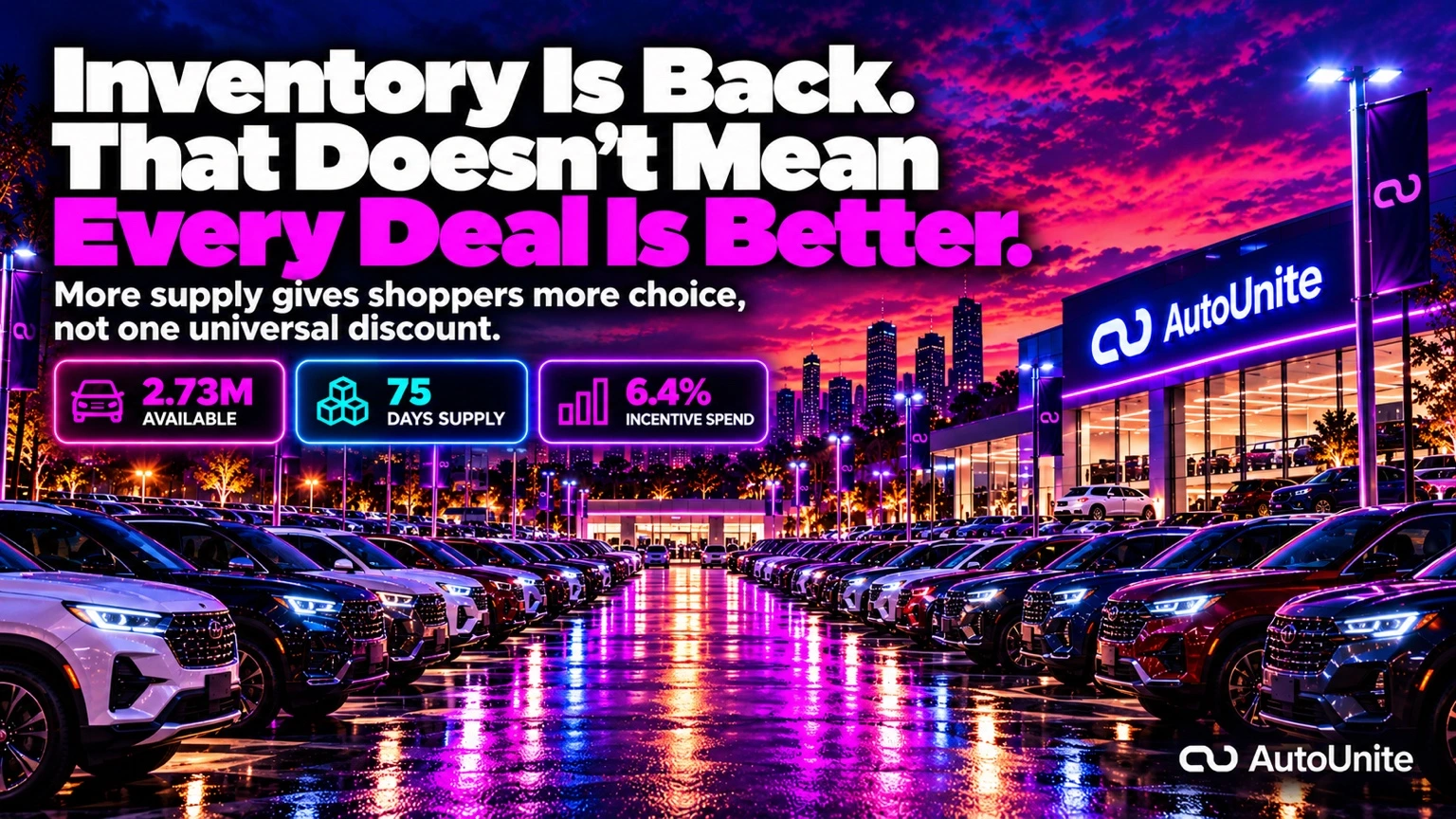
More choice is real. A guaranteed discount on every VIN is not.
The shortage years trained shoppers to treat any vehicle on the ground like it could disappear before the second cup of coffee. By September 2026, that was no longer the whole market.
Cox Automotive counted **2.68 million new vehicles available at the start of September**, equal to **73 days of supply**. August inventory declined for a third consecutive month while the sales pace increased, pushing national supply to its lowest level since spring 2025.
That is a healthier market. It is not a distressed market.
The practical change is choice. A shopper can compare colors, trims, model years and nearby stores again. A dealer can have enough depth to offer alternatives instead of saying, "This is the only one coming for three weeks." But more inventory does not create one national discount that applies to every unit.
When supply is thin, the customer often starts with availability: Can I even get one?
With 73 days of national supply, the question can move back toward fit: Which one should I buy, and what is a fair transaction on this exact vehicle?
That is meaningful leverage. It lets a shopper walk from the wrong trim without assuming the entire search starts over. It also lets a salesperson solve the customer's actual need instead of forcing the closest available configuration into the deal.
The mistake is translating that improved choice into a blanket statement like, Lots are full, so every dealer should be desperate.
The prior month already showed the pattern: Cox’s July inventory report recorded stronger sales and tightening supply in major truck and SUV segments. August continued the broader drawdown. A national total can tighten while a specific brand or configuration remains plentiful—and the reverse can also be true.
A 73-day national supply number is a market statistic. It is not a birthday for the vehicle in front of you.
One rooftop can have two versions of the same model with completely different histories. One may have arrived yesterday. Another may be from the outgoing model year and have been sitting long enough that the store is more motivated to move it. A third may be a rare configuration the dealer knows it will struggle to replace.
Those are three different conversations even though all three vehicles live inside the same national 75-day figure.
If you want to understand the exact unit, ask for information that belongs to the unit: stock number, model year, trim, equipment, arrival timing, current factory support and whether there is a comparable unit nearby.
Cox/Kelley Blue Book’s current market snapshot put the August 2026 average new-vehicle transaction price at $50,089 and the average new listing price at $49,486. July incentive spending had been 6.4% of transaction price, down from 7.0% in June. The point is not that every car got more expensive; it is that healthier inventory did not automatically reset transaction prices.
Those numbers break the old shortcut that “more cars equals lower prices.” Inventory can normalize while prices remain elevated and incentive support moves differently by segment. That is what the summer 2026 market has been showing.
Kelley Blue Book’s market context reinforces the same distinction: shoppers can gain choice without every exact transaction reverting to old pricing behavior.
From outside the store, inventory can look like one pile of cars.
Inside the store, the questions are more specific:
A good negotiation gets closer to those questions instead of arguing from a national average.
The shopper's strongest position is not "I know dealers have too many cars." It is "I found three comparable vehicles, I know which model year I want, I understand the available programs, and I can move today if this exact transaction makes sense."
That is useful leverage because it is connected to a decision the store can actually make.
Cox reported that the 2027 rollout was running slower than the prior year while 2026 inventory remained a large share of what dealers had available. That creates a useful September question: am I negotiating against an outgoing 2026 the store wants to clear, or an incoming 2027 it expects to replace slowly?
Two vehicles with nearly the same MSRP can deserve different strategies because the factory program, model-year timing and replacement risk are different. “Inventory is back” is too broad to answer any of those questions.
Late summer is also a transition period. New model-year vehicles begin arriving while prior-year inventory is still on the ground.
That creates a comparison shoppers should make deliberately.
An outgoing model year may carry stronger support or a more aggressive dealer position. The incoming model year may have updated equipment, packaging or resale advantages that matter more than the discount. The cheaper transaction is not automatically the better ownership decision.
Put both vehicles on the same sheet:
| Question | Outgoing model year | Incoming model year |
|---|---|---|
| Selling price | What is the actual price after dealer discount? | What is the actual price? |
| Factory support | Which incentives apply to you? | Which incentives apply to you? |
| Equipment | Are you giving up anything you value? | What changed? |
| Financing | Does promotional APR replace cash support? | What rate and term apply? |
| Ownership horizon | Does the model-year difference matter for your planned trade timing? | Is the newer year worth the extra cost? |
Inventory becomes useful when more choice lets you compare the tradeoff instead of accepting whichever vehicle happens to exist.
Cox’s August inventory data shows why “the market has 73 days of supply” is only the beginning of the conversation. Toyota ended August at about 33 days of supply, Lexus at 36, Honda at 41, and Nissan at 67. Cox said Stellantis brands, Buick and Lincoln were among the higher-supply names.
That dispersion is the market in one picture. A shopper negotiating a high-demand Toyota can be operating in a much tighter local environment than a shopper looking at a heavily stocked configuration from another brand.
So the useful research sequence is:
That sequence is more work than saying “lots are full.” It is also far more likely to produce a real negotiation.
Kelley Blue Book reported an August 2026 average transaction price of $50,089, up 1.9% from a year earlier. Average manufacturer suggested retail price was $51,852. Incentive spending averaged 6.5% of transaction price, down from 7.2% a year earlier.
That combination matters. Supply is healthier than it was during the shortage, but the average new vehicle is still expensive and factories are not using one uniform incentive strategy.
For the customer, the implication is practical: use inventory recovery to widen the comparison set, not to assume the market owes a fixed percentage off MSRP. For the dealer, the implication is equally practical: if a unit is aged or duplicated, show why the deal is stronger on that exact VIN instead of telling the shopper the national market does not matter.
Picture the same Saturday with three shoppers:
The national inventory report is the same for all three. The dealer’s replacement risk, aging pressure and factory support are not.
That is why the strongest shopper question is not, “How much off because inventory is back?” It is, “What makes this VIN worth this transaction compared with the other real options I can buy?”
A larger cash incentive is not always the lowest-cost option if accepting it means giving up a subsidized finance rate. The reverse can also be true. That is why the final comparison should use the same selling price, same trade position, same cash down and the exact programs the shopper actually qualifies for.
The clean worksheet shows two complete paths when both are available:
The customer can then choose based on total transaction economics and household cash flow rather than the largest number in an advertisement.
Inventory recovery gives shoppers enough alternatives to make that comparison more often. It does not remove the need to do the math.
Use it as context, not a weapon.
The market is better for shoppers than it was when every desirable unit had a waiting list. That improvement is real.
The useful conclusion is not that every deal should be cheap. It is that buyers have enough choice again to be selective, compare real alternatives and make the dealer compete on the exact vehicle and transaction.
More inventory gives you more decisions. It does not make those decisions for you.
AutoUnite content is educational and research-focused. Vehicle information, pricing, ownership costs, maintenance, recalls, and other details may vary by region, dealer, and time.
New-car inventory is healthier again, but supply varies by brand, segment, model year and VIN. Use more choice to compare real deals—not assume discounts.
Decide First