
How Much Dealership Follow-Up Is Too Much?
- PublishedSep 27, 2026
- Last verifiedSep 27, 2026
- Sources5
- 11 min read

Explore clearer car-buying guidance, market context, and ownership knowledge in one place.
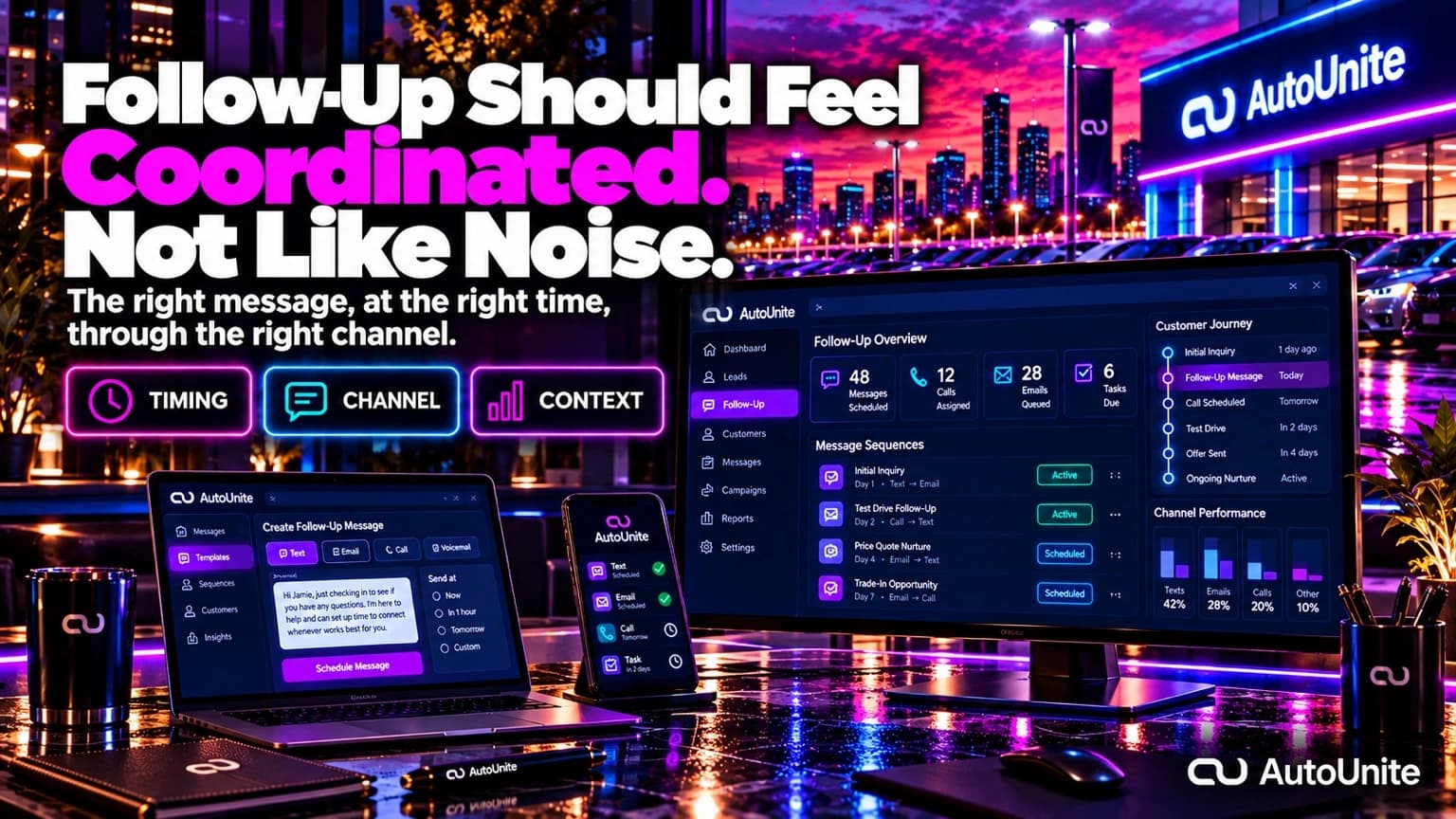
Car shoppers can be ignored and over-contacted at the same time. See how CRM, BDC, AI, texts, calls and emails create follow-up overload.
Here is a dealership paradox.
A store can fail to follow up enough.
And a customer can feel followed up with far too much.
At the same time.
Foureyes analyzed 1.4 billion dealership website visits across more than 22,900 dealership and group websites for its 2026 benchmark report.
It found 42.7% of qualified leads were mishandled.
15.2% were never logged to the CRM.
And 62.8% of sales leads did not hear from a salesperson within 24 hours after returning to the dealership website.
That sounds like an industry that should contact people more.
Now look at the shopper's side.
CarGurus found 61% of recent buyers visited two or more dealerships.
Cox Automotive says 40% of dealers are already using AI to coordinate customer follow-up.
Add CRM automation.
BDC calls.
Salesperson texts.
Email campaigns.
Chat.
AI assistants.
Manager follow-up.
Retargeting.
Now one shopper can experience more communication than any single dealership realizes.
The problem is not simply volume.
It is that every system sees its own piece of the relationship.
The customer receives the sum.
Inside Store A, the process may look perfectly reasonable.
Lead arrives at 9:03.
Automated confirmation at 9:04.
BDC call at 9:15.
Text at 9:18.
Salesperson email at 10:02.
Manager "checking in" later.
Next-day follow-up.
Three-day follow-up.
Seven-day follow-up.
Each activity can be justified.
Speed matters.
Persistence matters.
Customers do go quiet and later buy.
Foureyes found that among sales leads who eventually purchased, 61.2% closed within three days of the initial website inquiry.
That still leaves 38.8% closing after day three.
AutoUnite content is educational and research-focused. Vehicle information, pricing, ownership costs, maintenance, recalls, and other details may vary by region, dealer, and time.
But the shopper may not have contacted only Store A.
Imagine a shopper sends one question to three dealerships:
"Is this exact vehicle available, and can you send me an out-the-door price?"
Store A sends:
Confirmation email.
Text.
Call.
Generic salesperson email.
Store B sends:
AI chat follow-up.
BDC text.
Two calls.
Store C sends:
Email.
Salesperson text.
Manager email.
That is eleven contacts.
The number is illustrative.
It is not an industry average.
The point is structural.
Each dealership sees a reasonable sequence.
The shopper sees eleven interruptions.
And maybe none of them answered the question.
That is how a business can simultaneously under-follow-up and over-contact.
The fastest response is not automatically the best response.
Suppose the customer asks whether a VIN is available.
Bad fast response:
"Hi Kenny! Thanks for your interest! When can you come in?"
Better response:
"Yes, VIN ending 4821 is here now. I physically confirmed it at 10:12 this morning. Here is the out-the-door breakdown you asked for. If text is easiest, I'll stay here."
The second response does something.
It reduces uncertainty.
The customer knows:
The car exists.
The person read the question.
The dealership is willing to provide information.
The channel can stay simple.
That is a relationship.
The first message is activity.
Dealership dashboards are good at counting.
Calls.
Texts.
Emails.
Appointments.
Tasks.
Responses.
They are weaker at answering:
Did we solve the customer's problem?
A salesperson can complete every task and still add no value.
A store can be "100% worked" and feel completely unresponsive to the shopper.
That is the danger of activity metrics.
The customer does not care whether the task turned green in the CRM.
They care whether the dealership helped.
Foureyes uses a specific data methodology for its benchmarks.
Its "mishandled" category can include leads that did not get into the CRM correctly, delays and process failures.
That is important because follow-up failure is often a systems problem before it is a people problem.
A website call may not log.
A chat lead may route badly.
Duplicate records can split history.
A salesperson may not see a lead assigned elsewhere.
A customer can change email.
An AI tool can communicate outside the salesperson's view.
A BDC can book an appointment without enough context.
Now the store has multiple versions of the customer.
The shopper has one life.
The best reason to have a CRM is not to remind a salesperson to call.
A calendar can do that.
The value is shared memory.
What did the customer ask?
What did we answer?
Which VIN matters?
Which channel do they want?
What did we promise?
What did the trade estimate show?
Did they ask not to be called?
Did they already speak with someone?
Is there an appointment?
Did the vehicle sell?
Has the price changed?
Without that continuity, every contact risks restarting the conversation.
"Still interested?"
"Can I help?"
"When can you come in?"
The customer thinks:
I told you yesterday.
That is where repetition becomes disrespectful.
Customer:
"Please text only. I cannot take calls at work."
Five minutes later:
Phone rings.
Customer:
"I am not trading anything."
Next email:
"What's your trade worth?"
Customer:
"I am comparing the blue Limited and white XLE."
AI assistant:
"Which model are you interested in?"
These are not volume problems.
They are memory problems.
One perfectly timed message can feel worse than five if it ignores what the customer already said.
Cox Automotive's 2026 AI in Auto Retail Tracker found 82% of dealers report using AI.
The top use cases include routine task automation and coordinating customer follow-up, both at 40%.
That is a huge operational change.
AI can solve real problems.
Respond after hours.
Summarize conversations.
Prioritize opportunities.
Draft useful answers.
Keep routine questions from sitting overnight.
But AI can also multiply process flaws.
If the underlying CRM data is wrong, AI can act faster on the wrong information.
If the customer has two records, automation can contact both.
If a salesperson is already talking to the customer, AI can start a second conversation.
If the system optimizes only for response rate, it may create messages that earn replies without earning trust.
Technology raises the importance of governance.
There is no universal correct number.
A buyer who asked for immediate help on a car they plan to purchase today may welcome multiple coordinated updates.
A shopper who said "I am six months out, email only" may find two phone calls excessive.
A customer waiting on a promised price update may want contact the moment the answer arrives.
A lead who never responded may require a different cadence.
The count is context-dependent.
A more useful framework asks:
Was this contact expected?
Did it add new information?
Was it in the right channel?
Did it acknowledge the previous interaction?
Was the timing reasonable?
Does the customer still want this relationship?
Those questions are harder to dashboard.
They are closer to what people experience.
Phone.
Text.
Email.
Chat.
Some customers have a strong preference.
That preference should travel with the lead.
If a customer says text only, that is operational information.
If they opt out of commercial email, the dealership has legal and operational obligations to honor that preference.
The FTC's CAN-SPAM guidance requires commercial email senders to provide an opt-out method and honor opt-out requests within the required period.
Texting and calling can involve separate federal and state requirements depending on technology, consent and message type, so dealerships should follow current legal guidance and vendor controls rather than improvising.
The editorial lesson is simple:
A customer communication preference is not a soft suggestion for the CRM to forget.
The phrase is not evil.
Sometimes it is perfectly human.
But repeated "just checking in" messages often reveal that the dealership has nothing new to say.
A useful follow-up can provide:
The exact vehicle is still available.
The vehicle sold and here are two real alternatives.
The incentive changed.
The requested photos are attached.
The trade appraisal needs one missing piece.
The manager approved the revised number.
The service records arrived.
A new matching VIN landed.
The customer's ordered vehicle moved status.
That is information.
If every follow-up is only asking the customer to create the next step, the dealership is transferring all the work back to the shopper.
Phones are intimate.
Texts appear beside messages from family.
Calls interrupt work.
Email competes with everything else.
Every contact spends a tiny piece of customer attention.
The dealership should get something for that cost.
Not just a CRM disposition.
Progress.
Clarity.
Relevance.
An answer.
Salespeople often experience silence as rejection.
Sometimes it is.
Sometimes the shopper is at work.
Sometimes they are comparing stores.
Sometimes they asked a simple question and did not receive the answer.
Sometimes they are waiting for a spouse.
Sometimes they are not ready.
Sometimes another dealership solved the problem.
Silence does not tell you which.
The danger is treating nonresponse as permission to increase message volume mechanically.
A better sequence changes content, not just timing.
Initial answer.
Useful follow-up.
New information.
Clear invitation.
Then give the shopper control.
This article should not become an excuse to stop following up.
Foureyes' data says a meaningful share of buyers close after the first three days.
A dealership that quits on day three can miss real business.
The better interpretation is:
Long-term follow-up has to become more relevant, not more repetitive.
Day 10 cannot sound like hour 1.
A customer who did not buy the original vehicle may respond to:
A price change.
A new arrival.
A materially better alternative.
A new incentive.
A trade-market movement.
Useful ownership information.
The relationship can continue without pretending the customer is still in the exact same moment.
Pull ten lost leads.
Read the full timeline as the customer experienced it.
Not the dashboard summary.
The actual messages.
Ask:
Was the original question answered?
How many people contacted the customer?
How many channels?
Did messages contradict?
Did automation continue after human engagement?
Was there a gap after the customer returned to the site?
Did someone send something useful after day three?
Was the customer preference recorded?
Were there duplicate records?
Did the store stop because the cadence ended rather than because the opportunity ended?
That audit will tell you more than "92% task completion."
Take one anonymous lead and print the full communication timeline.
Put every call, text, email and chat in chronological order.
Then hide the internal sender labels.
Read it as if it came from one company.
What does the conversation feel like?
Does it sound like one team?
Or five strangers?
Can you tell that the dealership remembers anything?
Is there a clear owner?
Did the customer ever get the answer?
This is where process becomes visible.
A shopper should not need to say:
"I already spoke with Mike."
"I sent that yesterday."
"Please stop calling."
"I told the chatbot that."
"I already have an appointment."
"I don't have a trade."
"The car you keep emailing me about sold."
Every one of those sentences is the customer doing internal coordination for the store.
That is friction.
Even if AI, BDC, manager and salesperson contribute, the customer should understand who owns the relationship.
Conversation context should survive channel changes.
Phone, text, email, timing and opt-outs should be honored.
Availability and pricing should update across systems.
Automation handles routine moments and alerts humans when complexity or intent increases.
A person steps in when the customer needs judgment, negotiation or problem-solving.
The system knows when to pause, suppress or change outreach rather than continuing forever.
That is a real follow-up system.
Not:
How many conversations can AI automate?
Ask:
How much continuity can AI preserve?
Summarize the last interaction.
Surface the unanswered question.
Warn the salesperson not to duplicate outreach.
Detect that the customer asked for text only.
Identify a new matching VIN.
Flag that the vehicle sold.
Keep the record current.
Those use cases make the human better.
They do not simply create more messages.
If you are being overwhelmed, say what you want explicitly.
"Text only."
"Email me if the price changes."
"Do not call."
"I am not buying until November."
"I am only interested in this VIN."
"I already purchased."
Then use available opt-out tools when appropriate.
A good dealership should treat those statements as instructions, not objections to overcome.
Add one question to the management review:
How many contacts added information the customer did not already have?
It will be harder to measure than call count.
That is why it is valuable.
A dealership can make 1,000 calls.
The customer experiences one conversation.
The business should optimize the conversation.
Automotive retail has spent years trying to solve slow follow-up.
That problem is real.
The next problem is coordinated follow-up.
More systems.
More channels.
More AI.
More automation.
More data.
Without shared context, all of that creates more opportunities for the customer to feel unseen.
The goal is not to contact people less.
It is to make every contact feel like the same competent dealership remembers why the customer raised their hand in the first place.