Car Buying, Vehicle Research & Ownership Guides
Explore clearer car-buying guidance, market context, and ownership knowledge in one place.

Explore clearer car-buying guidance, market context, and ownership knowledge in one place.
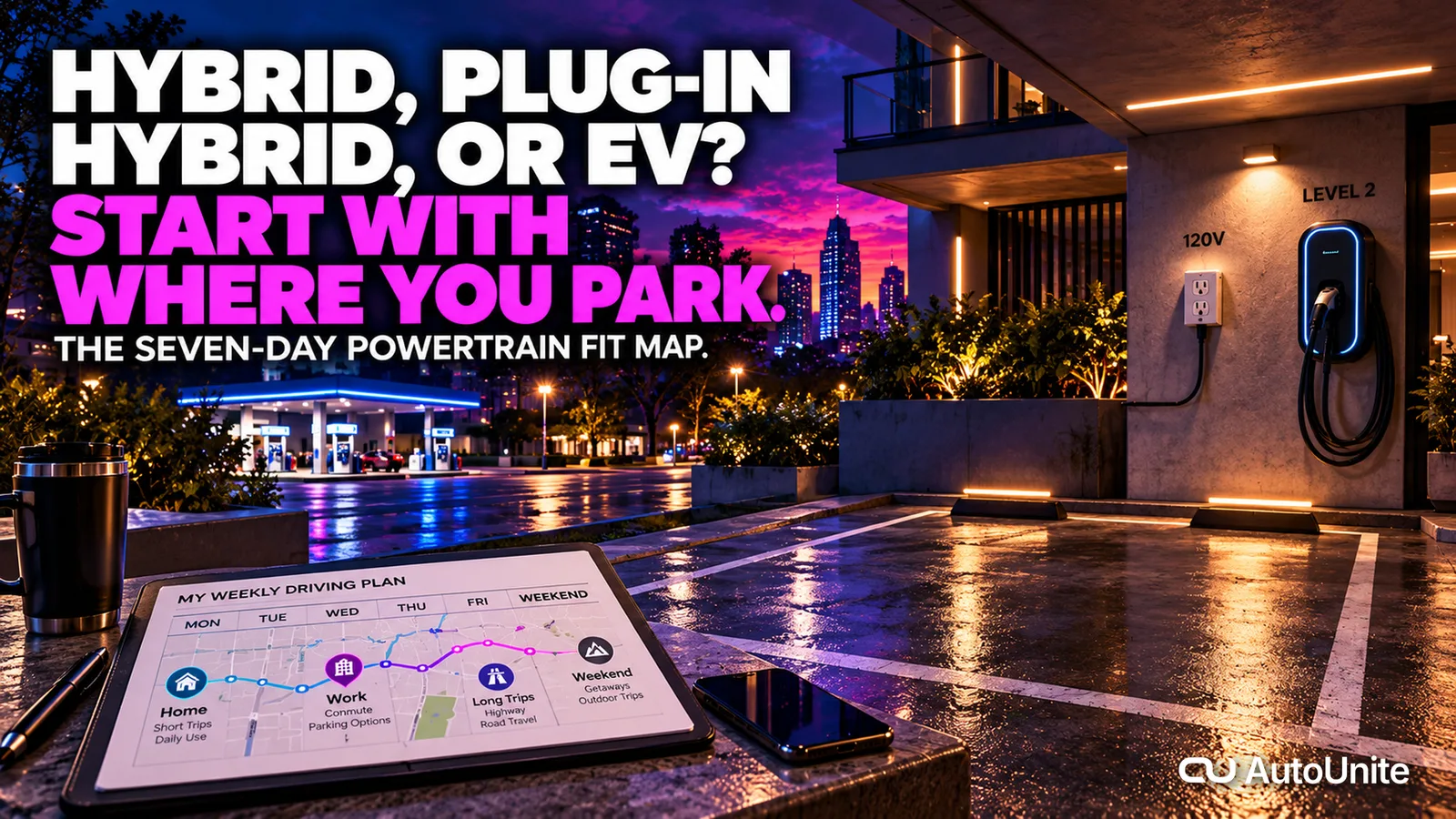
Before you compare range, horsepower, tax incentives, or charging speed, answer a less glamorous question:
Where does the car sleep?
A garage with a standard outlet is one ownership system. A driveway where a 240-volt charger can be installed is another. Assigned apartment parking with a shared charger is another. Street parking with no dependable charging is another.
That one detail changes how easy an electric vehicle is to live with, how much of a plug-in hybrid's electric capability you can actually use, and whether a conventional hybrid gives you most of the benefit you want without adding a charging routine.
The labels can make these vehicles look like three versions of the same idea. They are not. A hybrid does not plug in. A plug-in hybrid can run on electricity for part of the trip and then continue on fuel. A battery EV depends on charging for every mile. The U.S. Department of Energy's Alternative Fuels Data Center describes those operating differences clearly, and it also notes that most EV drivers charge overnight at home when that option is available. DOE AFDC - Electric Vehicles DOE AFDC - Charging Electric Vehicles at Home
That is why AutoUnite starts this comparison with a Seven-Day Powertrain Fit Map instead of a generic pros-and-cons list. The map asks what the vehicle actually has to do from Monday through Sunday, where it parks while it is doing nothing, and how much effort the owner is willing to put into fueling or charging it.
The best powertrain on paper is not necessarily the best powertrain for your week.
A conventional hybrid, or HEV, combines a gasoline engine with an electric motor and battery. The battery is charged through regenerative braking and the engine; it is not plugged into an outside power source. That means the driver still uses gas stations normally while the vehicle manages the electric side in the background. DOE AFDC - Hybrid Electric Vehicles
A plug-in hybrid, or PHEV, has a larger battery that can be charged from the grid. DOE says most current PHEVs can travel roughly 20 to 40 miles on electricity alone before continuing on gasoline in a hybrid-like operating mode. How much fuel a PHEV uses depends heavily on how far it is driven between charges. DOE is direct about the ownership behavior: consistently charging the vehicle is the best way to maximize the electric benefit. DOE AFDC - Plug-In Hybrid Electric Vehicles DOE AFDC - Electric Vehicles
A battery-electric vehicle, or BEV, has no gasoline engine. Its battery must be charged from an external electricity source. The driving range and energy use can change with speed, temperature, terrain, load, towing, HVAC use, and driving style. DOE AFDC - All-Electric Vehicles
None of those descriptions tells you what to buy. They tell you what each vehicle will ask from you.
Take one normal week and write down seven things before you shop:
This map does something a specification table cannot: it shows whether the advantages of the powertrain line up with the places the vehicle spends its time.
A shopper driving 35 miles a day with reliable overnight charging has a different problem from a shopper driving the same 35 miles while parking on the street. The commute is identical. The ownership system is not.
For the right household, charging is not a weekly errand. It is what happens while the car is parked anyway.
DOE says Level 1 charging from a standard 120-volt outlet generally adds about 2 to 5 miles of range per hour, while Level 2 charging generally adds 10 to 30 miles per hour. Those are broad charging-speed ranges, not promises for a particular vehicle, but they explain why the parking window matters. A car sitting for ten or twelve hours can recover a meaningful amount of energy even when the charging rate is modest. DOE AFDC - Electric Vehicles for Consumers
That is why Level 1 gets dismissed too quickly. If a household drives 20 or 25 miles on many days and the car sits overnight beside a suitable dedicated outlet, slow charging may cover the routine. A household regularly driving 80 or 100 miles a day may need Level 2 to make overnight recovery dependable.
Level 2 changes the experience, but it is not free infrastructure. DOE notes that Level 2 equipment can range from roughly $500 to $4,000 before installation and incentives, and installation cost depends on electrical service, wire run, permitting, and the property itself. DOE AFDC - Electric Vehicles for Consumers
Treat the charging setup as part of the vehicle decision when the vehicle needs that setup to work well.
Multifamily housing is not simply "home charging, but shared."
The parking space might not be assigned. The electrical panel may be far away. The property owner or association may control installation. Billing may be separate. Shared chargers may have time limits or availability issues. DOE's multifamily guidance specifically calls out parking, electrical service access, billing, and legal considerations. DOE AFDC - Electric Vehicle Charging for Multifamily Housing
An EV can work very well in an apartment or condo. The mistake is assuming that a charger visible on a map is the same thing as dependable charging attached to your routine.
Before buying, test the actual plan. Is the charger available when you arrive? What does it cost? Can the car stay there overnight? Is there a backup? How often would you have to move the vehicle after charging?
If the weekly plan depends on public charging, put that time and price into the decision instead of treating it as background infrastructure.
A plug-in hybrid can solve a very specific household problem elegantly.
Imagine a 30-mile weekday routine, reliable overnight charging, and several long interstate trips every year. A PHEV with enough electric range to cover most normal days can use electricity for local driving and gasoline when the trip gets longer than the battery range. The gasoline engine is the built-in backup for the rare day.
Now put the same PHEV in a household that rarely plugs it in.
It still works, but the ownership logic changes. DOE notes that if a PHEV is never plugged in, its fuel economy will be about the same as a similarly sized hybrid. The owner is carrying a larger battery and paying for plug-in capability without using much of it. DOE AFDC - Plug-In Hybrid Electric Vehicles
That makes PHEV shopping unusually sensitive to behavior. Do not ask only how many electric miles the vehicle can drive. Ask how many of your miles will actually begin with a charged battery.
The AutoUnite worksheet in this package calculates that share transparently using your seven-day mileage and the electric range you enter. It is an estimate, not a prediction, but it exposes whether the plug-in capability has a real job to do.
A hybrid asks very little new from the owner. Fuel it at a gas station, drive it normally, and let the vehicle manage regenerative braking and electric assistance in the background.
That can be a strong fit when charging access is poor, the vehicle spends nights on the street, road-trip frequency is high, or the household simply does not want charging to become part of the routine.
AAA's 2026 Your Driving Costs analysis found hybrids were the most consistently lower-cost alternative to gasoline vehicles across the vehicle categories AAA studied. In that analysis, hybrids combined fuel savings with smaller tradeoffs in depreciation and financing than the EVs in several categories. That is not a promise that every hybrid costs less than every gasoline car or EV. It is a reminder that total ownership depends on the specific vehicle, not just the energy source. AAA - 2026 Your Driving Costs
AAA's 2026 analysis found EV charging costs were roughly 66% to 70% lower than gasoline fuel costs across the categories it studied. That is a meaningful operating advantage.
The same analysis also found that higher depreciation, fees, purchase price, and finance costs could outweigh the energy savings in some categories. AAA's overall new-vehicle ownership estimate for 2026 was $12,863 per year, using its standardized methodology across ownership and operating costs. AAA - 2026 Your Driving Costs
That is why an EV-versus-hybrid decision should not stop at cents per mile for energy.
For the exact vehicles you are considering, compare:
Fuel or electricity is one line in the ownership ledger, not the whole ledger.
Cold weather affects both hybrids and EVs. The important question is how much the effect matters for the actual route.
The practical lesson is more useful than the headline percentage. If your normal day uses a small fraction of an EV's available range and you charge at home, a winter reduction may be easy to absorb. If you already depend on nearly all of the rated range, cold weather can turn a comfortable plan into a charging problem.
AAA also found public-charging prices changed the winter cost comparison materially. That reinforces the same theme: where you charge matters alongside what you drive.
A gasoline hybrid can refuel quickly almost anywhere. A PHEV can continue on gasoline when the battery is depleted. An EV needs charging stops.
For an EV, the road-trip experience depends on more than the advertised battery range. Charging curve, fast-charge capability, battery preconditioning, route planning, charger availability, weather, speed, and detours all affect the trip.
DOE notes that public DC fast charging can add roughly 100 to 200-plus miles in 30 minutes depending on the vehicle and equipment. That is a general planning range, not a guarantee. DOE AFDC - Electric Vehicles for Consumers
The frequency of long trips matters too. A household taking one 600-mile trip a year should not automatically choose its daily vehicle around that one day. A household making a 400-mile run twice a month may reasonably give road-trip convenience much more weight.
Put the unusual trip on the Seven-Day Map, then mark how often it actually happens.
Towing is not a footnote for any powertrain. More weight and aerodynamic drag increase energy use. DOE notes that hauling heavy loads and driving on significant inclines can reduce BEV range. DOE AFDC - All-Electric Vehicles
If towing is central to the vehicle's job, investigate the exact vehicle with the exact kind of trailer. Rated range without a trailer is not the number to use for a towing trip. Charger access also matters because some stations are awkward with a trailer attached.
If towing happens twice a year, that is a different decision from towing every weekend. Again, frequency changes the answer.
These are illustrative scenarios, not recommendations or claims about real consumers.
A conventional hybrid deserves a hard look because it can reduce fuel use without creating a charging dependency the household cannot reliably support. The question is not whether an EV can technically cover 65 miles. It can. The question is how the household would replenish that energy every week without turning charging into a recurring errand.
A PHEV can fit this pattern well if its electric range covers much of the normal week and the owner actually plugs it in. The gasoline side remains available for the long trip. The value comes from using both systems for the jobs they are good at.
A BEV can make the daily routine simple: park, plug in, leave with the battery replenished. The second vehicle also means the BEV does not have to be perfect at every transportation task the household might face.
The important part is not which scenario "wins." It is how quickly the answer changes when parking, charging access, trip frequency, and household flexibility change.
National averages are useful for context and weak for a household budget.
Home electricity rates vary. Some utilities offer time-of-use plans. Public DC fast charging may cost much more than home charging. Workplace charging can be free, subsidized, or priced separately. Apartment charging can add network or session fees.
The Seven-Day Powertrain Fit Map asks for your actual home electricity rate, likely public-charging rate, and gasoline price. That turns the comparison from "electricity is cheaper" into a transparent estimate of what your normal week costs under the assumptions you entered.
Do the same with insurance. Get quotes for the exact vehicles. A monthly insurance difference can erase part of an expected fuel or charging advantage before you ever drive the car.
Manufacturer offers, state programs, utility programs, charging-equipment rebates, and eligibility rules can change. Some apply only to specific models, locations, income bands, lease structures, or installation types.
Treat every incentive as transaction-specific money. Verify it when you are ready to buy. If the powertrain only makes sense because of an incentive you have not confirmed, the comparison is not finished.
For a hybrid shopper: Do I want lower fuel use without adding a charging routine?
For a PHEV shopper: Will I actually plug this vehicle in often enough to use the electric range I am paying for?
For an EV shopper: Can I make charging boring?
That last question is more practical than asking whether public chargers exist somewhere nearby. The best charging plan is one that fits into time the vehicle was going to spend parked anyway.
The first EV question is often not range. It is where the car sleeps.
What Matters: Map one real week before you compare badges. Daily miles, overnight parking, charging access, long trips, towing, climate, local energy prices, insurance, and whether another household vehicle exists can change the answer.
Watch This: Do not assume a PHEV saves fuel if you will not charge it, do not assume an EV's home-charging economics apply if you will rely heavily on public charging, and do not assume the lowest energy cost equals the lowest total ownership cost.
Your Next Move: Complete the AutoUnite Seven-Day Powertrain Fit Map using your actual weekly miles, parking and charging situation. Then compare the exact hybrid, PHEV, and EV you are considering with current transaction prices, insurance quotes, efficiency ratings, and ownership costs.
AutoUnite content is educational and research-focused. Vehicle information, pricing, ownership costs, maintenance, recalls, and other details may vary by region, dealer, and time.
A Seven-Day Powertrain Fit Map that starts with where the vehicle sleeps, then adds daily miles, charging access, long trips, towing, climate and real ownership inputs before comparing HEV, PHEV and BEV.
Decide First