Car Buying, Vehicle Research & Ownership Guides
Explore clearer car-buying guidance, market context, and ownership knowledge in one place.

Explore clearer car-buying guidance, market context, and ownership knowledge in one place.
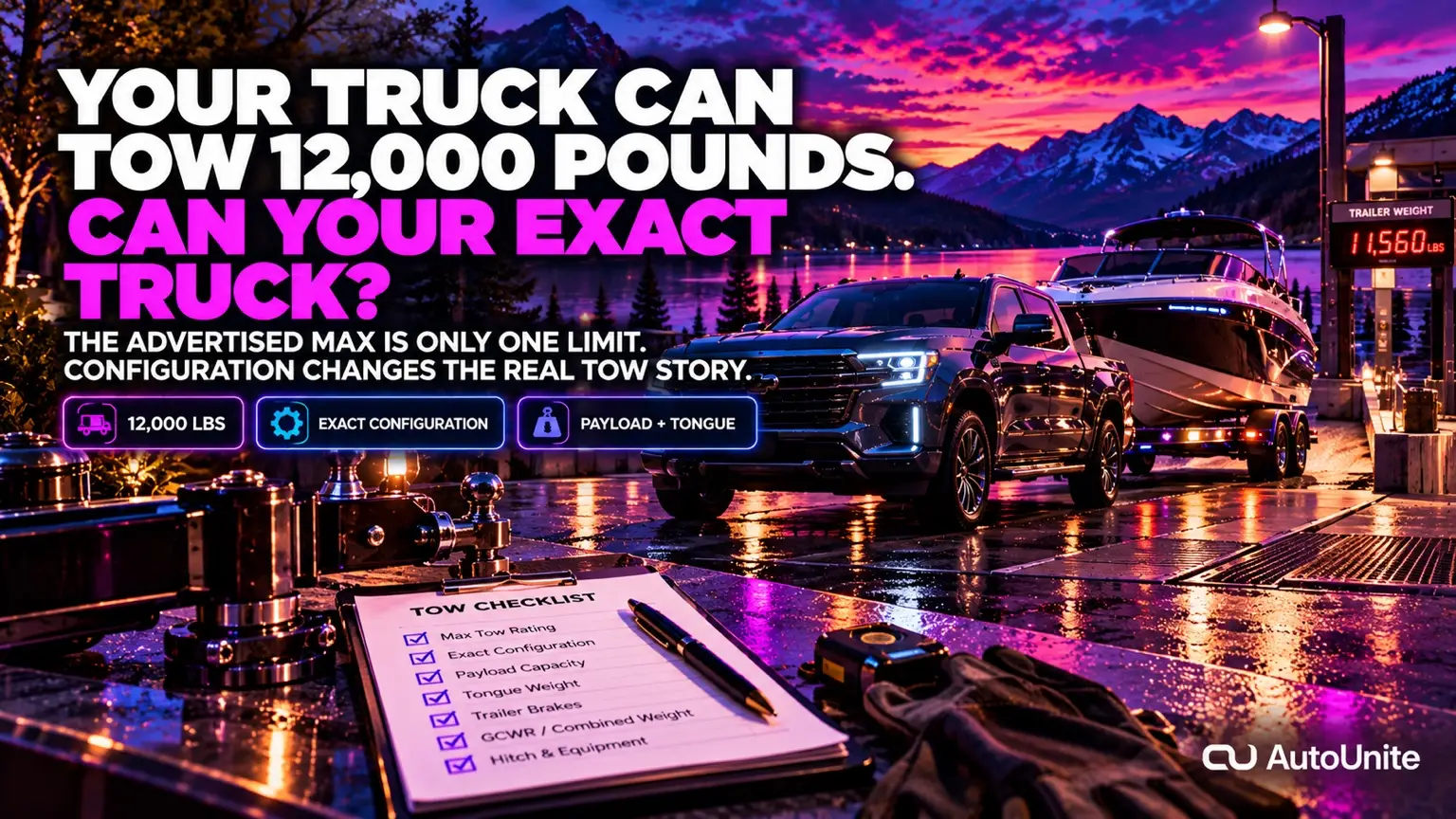
13,500 pounds.
13,300 pounds.
11,610 pounds.
Those are real current maximum towing figures for 2026 half-ton pickups from Ford, Chevrolet, and Ram. They are useful for comparing truck lines. They are not the answer to the question most owners are actually asking.
The useful question is narrower:
What can this exact truck tow with this exact trailer, loaded the way I will actually use it?
That answer lives in a stack of numbers: the truck's configuration, the vehicle-specific payload and certification labels, trailer weight, tongue or pin weight, passengers, bed cargo, hitch hardware, axle loads, GVWR, GCWR, and the hitch itself.
A pickup can sit thousands of pounds below the headline trailer rating and still run out of payload or rear-axle capacity first.
That is why AutoUnite treats towing as a weight-budget problem, not a single-number problem.
Ford lists a maximum available tow rating of 13,500 pounds for the 2026 F-150. Chevrolet lists 13,300 pounds for the 2026 Silverado 1500. Ram lists 11,610 pounds for the 2026 Ram 1500.
All three attach the same kind of qualifier: when properly equipped.
That phrase matters.
Ford's current F-150 towing guide breaks ratings down by engine, axle ratio, wheelbase, cab, drivetrain, and other equipment, and says towing varies with configuration, option content, cargo, and passengers. Ford's 2026 guide also directs owners to the vehicle's safety certification label for axle and vehicle ratings.
Chevrolet's 2026 Trailering Guide makes the same point from a different angle: the maximum trailer rating is a comparison tool, while passengers, cargo, equipment, and the vehicle's actual configuration can reduce what a specific vehicle can tow.
Ram's 2026 payload and towing guide publishes towing and payload together and explicitly warns that trailer-weight and payload ratings are mutually exclusive.
The badge on the tailgate tells you the truck family.
It does not finish the calculation.
Before buying a truck for a trailer, put five things on one page:
AutoUnite's Exact-Truck Tow Budget turns those inputs into a set of remaining-capacity checks instead of one green/red tow number.
The rule is simple:
Every applicable limit has to work at the same time. The lowest remaining margin is the one that controls.
The familiar one is the maximum trailer weight rating: the heaviest loaded trailer the manufacturer rates that configuration to pull under its stated conditions.
Then there is GVWR, gross vehicle weight rating. That is the maximum allowed weight of the loaded truck itself. People, cargo, accessories, hitch hardware, and the trailer load pressing down on the truck all count toward it.
GAWR is the gross axle weight rating. A conventional trailer often adds substantial load to the rear axle, along with bed cargo and hitch equipment.
GCWR is gross combined weight rating: the ceiling for the loaded truck and loaded trailer together.
The receiver and hitch system can have their own trailer and tongue-weight limits.
The trailer has limits too: its own GVWR, axle ratings, tire ratings, and cargo-carrying capacity.
None of those disappears because the engine feels strong.
Payload is easy to overlook because it rarely gets the billboard treatment.
Use a simple illustrative case.
Exact truck payload allowance: 1,450 pounds
Two adults: 350 pounds
Two children: 180 pounds
Dog: 60 pounds
Cooler, tools, bed cargo, and hitch-related gear: 160 pounds
Before the trailer is attached, the truck is carrying 750 pounds.
Now connect a 7,500-pound loaded travel trailer. At an illustrative 12% tongue weight, about 900 pounds is pressing on the hitch.
Total payload demand becomes 1,650 pounds.
The trailer can be comfortably below a five-figure advertised tow rating while this particular loading example is already 200 pounds over the truck's 1,450-pound payload allowance.
Change the truck, the passenger load, or the trailer and the result can change. Trailer weight by itself cannot close the decision.
The exact payload label changes the answer.
A trailer does not merely follow behind the vehicle. Some of its weight is carried by the tow vehicle.
Ford's current 2026 F-150 guide says conventional trailer tongue load should be 10% of total loaded trailer weight for its published F-150 ratings, and that tongue load plus passengers and cargo cannot cause the truck to exceed GVWR or rear GAWR.
Chevrolet's 2026 guide gives a broader general conventional-trailer range of 10% to 15% of loaded trailer weight, while also telling owners to follow trailer-specific instructions when they differ.
So an illustrative 8,000-pound loaded conventional trailer can put roughly 800 to 1,200 pounds on the hitch before you add people, cargo, accessories, or hitch hardware.
Use the trailer and truck manufacturer's actual instructions. The range is a planning tool, not permission to pick whichever percentage makes the math work.
A conventional travel trailer pushes down at the rear receiver. A fifth-wheel or gooseneck transfers its pin load into the bed, usually closer to the rear axle. The truck still has to carry that load, but the geometry and the percentages are different.
Chevrolet's current guide says conventional tongue weight should generally be 10% to 15% of loaded trailer weight, while gooseneck and fifth-wheel pin weight should generally be 15% to 25%. Ford's current F-150 guide uses 15% king-pin weight in its fifth-wheel/gooseneck tables.
Those are not interchangeable assumptions.
An 8,000-pound conventional trailer at 12% tongue weight contributes about 960 pounds at the hitch. An 8,000-pound fifth-wheel at 20% pin weight contributes about 1,600 pounds into the truck bed. The trailer weight is the same. The truck-side load is not.
That difference is why a buyer can choose a truck with a seemingly generous trailer rating and still discover that the payload or rear-axle budget is too tight for the trailer type.
The hitch equipment matters too. A receiver, fifth-wheel hitch, or gooseneck setup has its own rated limits and adds physical weight to the truck. The hitch itself therefore uses some of the capacity it is helping you use.
When AutoUnite says to verify the exact combination, this is what that means: the trailer style, hitch system, loaded tongue or pin weight, vehicle payload, axle limits, and combined rating all have to describe the same real setup.
Trailer shopping often starts with an unloaded or dry weight because it is easy to compare.
But the trailer you tow is carrying batteries, propane, food, water when carried, tools, clothing, hoses, dishes, chairs, bikes, camping gear, and whatever else accumulates before departure.
That is why the AutoUnite Tow Budget asks for realistic loaded trailer weight, not just brochure dry weight.
Federal vehicle-load labeling rules exist for the same reason: cargo changes the vehicle. For recreational trailers, federal requirements include cargo-carrying-capacity information so owners can see how much load the trailer is designed to carry.
If you already own the trailer, a measured loaded weight is stronger evidence than a catalog estimate.
A weight-distributing hitch can change how load is distributed through the truck-and-trailer combination. That can be important for handling and may be required above certain trailer weights.
It still does not rewrite the truck's GVWR, rear GAWR, GCWR, receiver rating, or vehicle-specific trailer rating.
Ford's 2026 F-150 guide, for example, shows separate weight-carrying and weight-distributing receiver limits and still tells the owner not to exceed the truck's maximum loaded trailer weight or combined limits.
The same caution applies to helper springs, airbags, or upgraded shocks. Those parts can change ride behavior. They are not a substitute for the manufacturer ratings attached to the vehicle.
Modern truck ratings are much easier to compare than they once were because of SAE J2807.
The current SAE recommended practice was reaffirmed in November 2024. It establishes performance criteria at GCWR and a common methodology for determining trailer-weight ratings for light vehicles up to 14,000 pounds GVWR. SAE's current standard gives manufacturers a common testing framework.
That solves an important comparison problem.
It does not make every truck in a model line identical.
It does not remove passengers, factory options, bed cargo, hitch load, or axle limits from your trip.
Standardized testing makes the published rating more meaningful. The exact-vehicle calculation is still yours to finish.
Ford's inventory site now exposes estimated towing information for some exact vehicles.
A current 2026 F-150 Platinum, VIN 1FTFW7LD2TFA44289, is listed with:
That vehicle is a useful real-world comparison because the 2026 F-150 family can advertise a 13,500-pound maximum, while this specific luxury-equipped VIN shows a much lower estimated trailer rating and a payload number that can disappear quickly once passengers, cargo, accessories, and tongue weight arrive.
You can see the current Ford VIN-specific listing here.
Neither number is wrong.
They answer different questions.
Towing mismatches do not require anyone to be dishonest.
A shopper says, "I need an F-150 that can tow 10,000 pounds."
The salesperson knows an F-150 can reach that figure. They find a truck with the right color, cab, interior, screen, and payment.
Then that truck sells.
A nearly identical unit is substituted from another store.
Same trim badge. Same body color. Same screen.
Different axle ratio. Different towing package. Different option weight. Different payload label.
The customer asked for a capability. The process treated it like a feature.
A stronger handoff is explicit:
If the VIN changes, repeat the verification.
This is an illustrative calculation, not an AutoUnite customer case and not a rating for a named vehicle.
Loaded travel trailer: 7,800 pounds
Truck's trailer rating: 10,500 pounds
At first glance, the trailer is 2,700 pounds below the trailer rating.
Now add the truck-side load.
Illustrative tongue weight at 12%: 936 pounds
Occupants: 420 pounds
Bed cargo: 120 pounds
Hitch hardware/accessories: 80 pounds
Total truck payload demand: 1,556 pounds
If the truck's actual payload allowance is 1,500 pounds, the combination is already 56 pounds over that payload allowance before checking rear axle load, GCWR, receiver limits, or any additional cargo.
The advertised tow margin looked huge.
The payload margin was already gone.
That is the value of doing the entire budget before buying the truck.
A public vehicle scale can turn the towing conversation from estimates into measured loads.
A useful weigh can tell you:
Those numbers can then be compared with the exact truck's GVWR, front and rear GAWR, GCWR, receiver/tongue limits, trailer GVWR, and tire limits.
The process is especially useful after the setup changes. A generator, toolbox, bike rack, larger batteries, hitch equipment, extra water, or permanent accessories can alter the budget long after the original purchase.
Capacity is not a one-time shopping question.
Some of the most important towing information is attached to the vehicle.
Vehicle certification and tire/loading labels provide vehicle-specific weight information. Chevrolet also uses a vehicle-specific Trailering Information Label on certain products. Ford directs F-150 owners to the Safety Compliance Certification Label for axle information and to VIN-based tools where available.
That means part of good towing research is almost comically simple:
Open the driver's door.
The brochure tells you what the product line can achieve.
The label helps tell you what this truck has to work with.
You do not need to memorize every towing acronym before shopping.
You do need better inputs.
That is enough to turn a confusing towing conversation into a manageable one.
Modern pickups can make a heavy trailer feel surprisingly easy to accelerate.
That can create false confidence.
Towing limits exist because different parts of the system do different jobs: structure, tires, axles, hitch hardware, brakes, cooling, suspension, stability systems, and the trailer itself.
The question is not just whether the engine can pull the trailer up a hill.
It is whether the entire loaded combination stays within every rating that applies to it.
That is the standard that matters.
Before buying a tow vehicle, get these five things on the same page:
Then check the whole combination.
If the answer you receive is only, "This model can tow 12,000 pounds," the conversation is not finished.
The headline number tells you what a properly equipped configuration can achieve.
The exact truck, exact trailer, and actual load tell you whether your combination works.
AutoUnite content is educational and research-focused. Vehicle information, pricing, ownership costs, maintenance, recalls, and other details may vary by region, dealer, and time.
An Exact-Truck Tow Budget that verifies the exact VIN/configuration, trailer, payload, tongue or pin load, axle and combined limits, hitch ratings and scale-ticket readback before trusting a model-line tow number.
Decide First