Car Buying, Vehicle Research & Ownership Guides
Explore clearer car-buying guidance, market context, and ownership knowledge in one place.

Explore clearer car-buying guidance, market context, and ownership knowledge in one place.
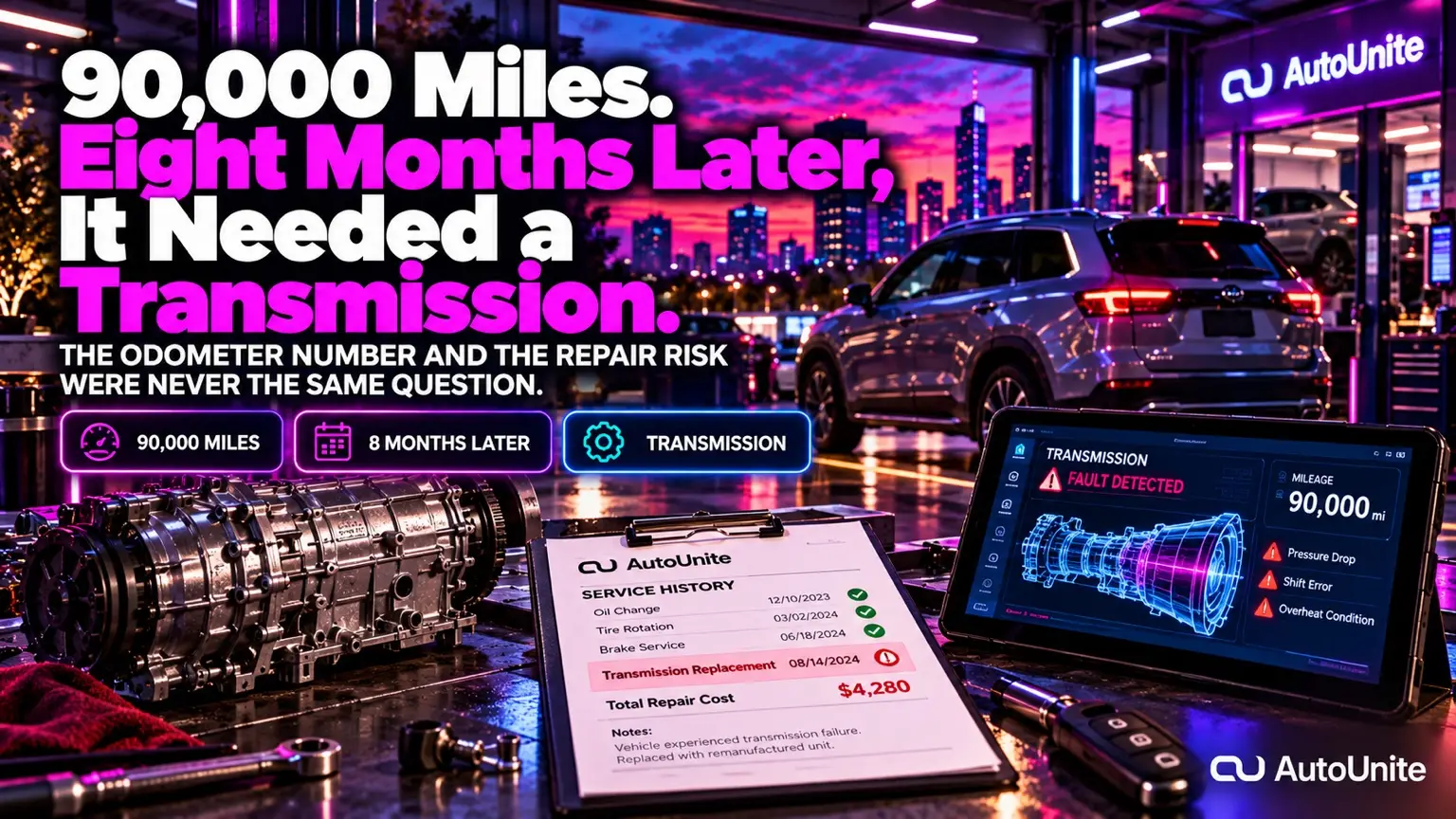
The out-the-door number worked. The repair-risk decision was separate.
The customer had already arranged financing through his own bank.
He knew what he wanted his payment to be. He knew roughly what the bank would approve.
So when he came into the dealership, his focus was simple:
Get the out-the-door number low enough to make the deal fit.
The vehicle was a used 2019 Chevrolet Suburban with about 90,000 miles.
The finance manager presented additional protection.
The customer shut it down pretty quickly.
He said he never bought that stuff.
The dealership had already included a 3-month / 3,000-mile JM&A powertrain protection plan at no additional cost to him.
Beyond that, the dealership’s position was that the vehicle was being sold as is.
The customer took the Suburban home.
About eight months later, after driving more than 10,000 additional miles, the transmission needed to be replaced.
Now he was back at the dealership saying:
I bought this vehicle from you. I shouldn’t have to pay for this.
The repair dispute starts there.
A transmission is not a minor repair.
When somebody buys a used vehicle and eight months later gets told it needs a transmission, it is reasonable to have questions.
Was something already wrong when I bought it?
Should the dealership have caught it?
Did the inspection miss something?
Was I supposed to be covered?
Did somebody sell me a bad vehicle?
Those are fair questions. The mistake is assuming the answer before anybody looks at the file.
Buying the vehicle from the dealership does not, by itself, answer who is responsible for every repair that happens later.
And the dealership cannot simply say: “As is.”
And pretend nothing else matters.
You have to look at what was actually disclosed, what coverage existed, what the customer declined, what the vehicle’s condition was at the time of sale, what happened over the next eight months and what the current diagnosis shows.
Reviewing the file is better than deciding who is wrong based on who is louder.
FTC used-car dealer guidance requires covered dealer-sold used vehicles to display a Buyers Guide and provide the buyer a copy at sale.
The Buyers Guide tells the customer whether the vehicle is being sold “as is” or with a dealer warranty. It also tells buyers to get promises in writing and consider having the vehicle independently inspected before buying.
That paperwork matters because people remember conversations differently after a major repair bill arrives.
In this case, the dealership’s position was that the Suburban was sold as is, the included 3-month / 3,000-mile JM&A powertrain protection had expired, and the additional protection offered in the finance office had been declined.
That does not mean two words on a form answer every possible dispute.
It means the paperwork becomes the starting point.
What did the Buyers Guide say?
What protection came with the vehicle?
What optional protection was offered?
What did the customer accept?
What did the customer decline?
What promises, if any, were made?
Those answers matter more than what either side remembers eight months later.
There is another fact that matters with this vehicle.
Chevrolet’s 2019 Suburban literature states that the vehicle originally came with a transferable 5-year / 60,000-mile powertrain limited warranty.
This Suburban was already around 90,000 miles when the customer bought it.
So regardless of where it stood by calendar time, it was already approximately 30,000 miles beyond the original factory powertrain warranty’s mileage limit.
This was not a 20,000-mile vehicle with years of unused factory powertrain mileage sitting behind it.
It was a higher-mileage used Suburban. The mileage alone does not make it a bad vehicle.
It does mean the repair-risk conversation is different.
Dealership conversations can go sideways fast at this point.
The customer says:
“You told me the vehicle was inspected. If it was inspected, how did the transmission fail?”
Because “inspected” does not mean “guaranteed never to break.”
Virginia law sets pre-sale inspection/disclosure requirements for qualifying dealer-sold vehicles.
But a Virginia safety inspection is not a teardown of the transmission.
And it is not a prediction of how long every internal component will last.
FTC consumer guidance recommends that used-car buyers consider an independent mechanical inspection rather than relying only on dealer inspection or certification.
A technician can evaluate what a vehicle is doing at that point in time.
Road-test it. Look for warning lights.
Check for leaks. Listen for abnormal noises.
Evaluate how it drives and shifts. Investigate symptoms that are actually present.
No inspection can guarantee the remaining life of every internal component.
A vehicle can be operating correctly today and still need a major repair months later.
The important question is whether there was evidence of a problem at the time of sale and what the actual records show.
This part deserves accuracy because it is easy to overstate.
General Motors has published technical information covering certain Chevrolet Suburban configurations describing transmission-related concerns.
GM PIP5504E addresses shake/shudder complaints on certain Suburban configurations and diagnostic procedures for torque-converter-clutch concerns.
GM PIP5175E covers certain 6L80-equipped Suburbans and symptoms including delayed engagement, launch shudder and lower-gear shift concerns.
So there is legitimate manufacturer documentation showing that some Suburban configurations have had transmission-related concerns.
The claim has to stop there.
It does not tell us that every 2019 Suburban has a defective transmission.
It does not establish that these transmissions normally fail between 90,000 and 125,000 miles.
It does not give us a credible public failure percentage.
And it does not prove what caused the failure in this customer’s vehicle.
Chevrolet’s own 2019 vehicle literature also shows that not every Suburban that model year used the same transmission.
Without the VIN-specific configuration and actual diagnosis, a technical bulletin cannot diagnose this Suburban.
It is context. Not proof.
Finding other owners with transmission complaints does not prove the dealership sold this customer a failing transmission eight months earlier.
Nor does it mean the customer’s concern was unreasonable.
Both can be true.
This part matters because the lesson is not:
The customer was wrong. He arranged his financing before coming to the store.
He knew the payment range he wanted. He negotiated the out-the-door number.
He did not automatically say yes to every product presented in finance.
None of those decisions is inherently bad.
There is discipline in knowing your budget and refusing to let a transaction move beyond it.
The problem came from narrowing the entire decision down to the one number that mattered that day.
The purchase worksheet answered one question:
Can I get this Suburban bought inside the amount my bank will finance?
It did not answer:
What will this Suburban cost me to own after I leave?
Those are different questions.
Customers often hear a finance manager talk about additional protection and think:
Here comes another product. Another thing increasing my payment.
Another thing making my deal more expensive. That reaction is understandable.
But the better way to look at the conversation is not whether somebody “believes in warranties.”
It is:
Who is carrying the repair risk if something expensive breaks?
Optional protection is not automatically a good buy.
Coverage varies. Exclusions vary.
Deductibles vary. Claim limits vary.
The administrator matters. The price matters.
The FTC advises consumers considering service contracts or other protection to understand coverage, exclusions, deductibles and repair requirements before making the decision.
A customer with enough savings may decide to keep the repair risk and pay for repairs himself.
That can be completely rational. But understand what that choice means.
If the transmission fails after your existing protection ends, who pays?
If the engine fails, who pays?
If another major repair shows up, can you handle it?
Declining additional protection is not automatically a bad decision.
It is a decision about how much repair risk you are willing to keep.
The customer was focused on keeping the deal inside his bank approval and payment target.
That made sense in the moment.
But a bank approval only tells you what the bank is willing to finance.
It does not create a repair reserve. It does not pay for tires.
Brakes. Maintenance.
Insurance. Or a transmission eight months later.
A 90,000-mile Suburban can fit perfectly into somebody’s payment budget and still carry more ownership risk than that household budget is prepared to absorb.
Purchase affordability and ownership affordability are not the same thing.
A shopper can negotiate a great number today and still be unprepared for a significant repair tomorrow.
That does not mean the customer should have paid whatever the dealership asked.
It means the best deal is not defined by today’s price alone.
Eight months later, the customer was not thinking about any of that.
He had a Suburban that needed a transmission.
He wanted the dealership to repair it for free.
When the store said it was not taking full responsibility for the repair, the situation escalated.
Upper management became involved. There were threats of a lawsuit.
Threats of bad reviews. Threats of the Better Business Bureau.
Threats of the Attorney General. The confrontation became loud in the service lane and showroom.
Anyone who has spent enough time in a dealership has seen some version of this.
The customer is angry because the expense is real.
The service department is caught in the middle because they are looking at a repair order, not the original sales conversation.
Management is looking at the deal file, the timeline, the mileage, the available coverage and whatever precedent its decision creates.
And everybody starts talking about responsibility before they are talking about solutions.
The customer did not come back the next morning.
He did not come back after 200 miles.
He did not come back while the 3-month / 3,000-mile JM&A powertrain protection was still in effect.
He came back about eight months later after putting more than 10,000 additional miles on the vehicle.
That does not automatically prove the transmission was perfect when the vehicle was sold.
But it is a material fact. A substantial amount of vehicle use occurred between delivery and the failure.
That history matters when anyone is trying to determine what existed at sale, what developed afterward and what can actually be proven.
The evidence has to carry more weight than the emotion.
The store’s position was that it did not owe the customer a free transmission.
But that was not the end of the conversation.
The dealership offered to explore trading him out of the Suburban.
It offered to help with part of the repair cost.
It offered financing options for the repair. That matters.
Goodwill and responsibility are not the same thing.
A dealership can believe the facts do not support paying 100% of a repair and still decide to help.
Sometimes the customer relationship matters.
Sometimes a customer is in a legitimately difficult situation and the store wants to find a reasonable middle ground.
Sometimes participating in a repair or helping someone trade out is simply good business.
But goodwill has to remain goodwill.
If outcomes are determined only by who escalates the hardest instead of by the documents, facts and a consistent dealership process, the store creates another problem.
The process should not reward confrontation.
The job is to review the facts and find a fair solution when one exists.
Once the conversation cooled down and the timeline, mileage, coverage and available options were reviewed, the customer paid for the transmission repair.
That does not mean every customer in a similar situation should get the same outcome.
In this particular case, the repair became the customer’s expense.
There is a dealer lesson here too.
Do not rely on a customer remembering a fast F&I presentation eight months later.
Especially on a higher-mileage used vehicle. Make the risk conversation plain.
This is the protection included with the vehicle.
This is how long it lasts. This is the optional protection.
This is what it costs. This is what it covers.
This is what it does not cover. This is the deductible, if there is one.
This is who administers it. This is what happens when the coverage ends.
If the customer says no, that is the customer’s decision.
Document it accurately. Then move on.
That is better than trying to scare somebody into buying a product.
And if the customer comes back later with a major repair, reopen the file before taking a position.
Look at the Buyers Guide. Look at the protection documents.
Look at the inspection and repair history that actually exists.
Look at the mileage. Look at the timeline.
Look at the diagnosis.
Then determine what the documents require and whether a goodwill solution still makes sense.
Do not ask only:
Can I afford the payment?
Ask:
Can I afford the vehicle?
They are different questions.
A customer can fit the monthly payment into the budget and still not be financially prepared for a major repair.
That becomes more important as vehicles get older and mileage increases.
Sometimes the answer is additional protection. Sometimes the answer is keeping money aside for repairs.
Sometimes it is choosing a lower-mileage vehicle.
Sometimes it is buying a less expensive vehicle and keeping more cash available after the sale.
There is no single answer for everybody.
The point is to make the decision before the repair bill makes it for you.
The negotiated purchase number had done its job.
Eight months later, the transmission bill raised a different question about ownership risk.
Neither fact by itself tells you who was responsible.
The full story shows why the answer was never as simple as one repair bill.
The Suburban had about 90,000 miles when it was purchased.
The original Chevrolet powertrain warranty was already beyond its 60,000-mile limit.
That included short-term powertrain protection had already expired by time and mileage. Additional protection was offered and declined. The vehicle was driven more than 10,000 additional miles.
Then the transmission failed. The customer asked the dealership to repair it for free.
The store declined to take full responsibility but still offered several ways to help.
Eventually, the customer paid for the repair.
That is not a story about why customers should always buy a warranty.
And it is not a story about why dealerships should never help after the sale.
It is a story about understanding the decision before you make it.
Price matters. Payment matters.
Mileage matters. Coverage matters.
Condition matters. Repair reserves matter.
The paperwork matters. And the risk you keep matters.
A better question goes beyond:
What will this vehicle cost me today?
It is also:
What am I prepared to own if something expensive breaks tomorrow?
That is the part of a used-car deal most people do not think about until the vehicle is already in the service lane.
The GM/NHTSA technical bulletins cited in this article are useful because they show that certain symptoms and diagnostic paths were important enough for the manufacturer to communicate to technicians. They do not prove that this Suburban had the covered configuration, that its transmission was defective at sale, or that every 2019 Suburban will develop the same problem.
That distinction protects both sides. The customer gets a real technical starting point instead of being dismissed. The dealership avoids turning a broad bulletin into a diagnosis the VIN and inspection do not support.
AutoUnite content is educational and research-focused. Vehicle information, pricing, ownership costs, maintenance, recalls, and other details may vary by region, dealer, and time.
A used Suburban needed a transmission eight months after sale. See how as-is terms, warranties, inspections, mileage and repair responsibility interact.
Decide First