Car Buying, Vehicle Research & Ownership Guides
Explore clearer car-buying guidance, market context, and ownership knowledge in one place.

Explore clearer car-buying guidance, market context, and ownership knowledge in one place.
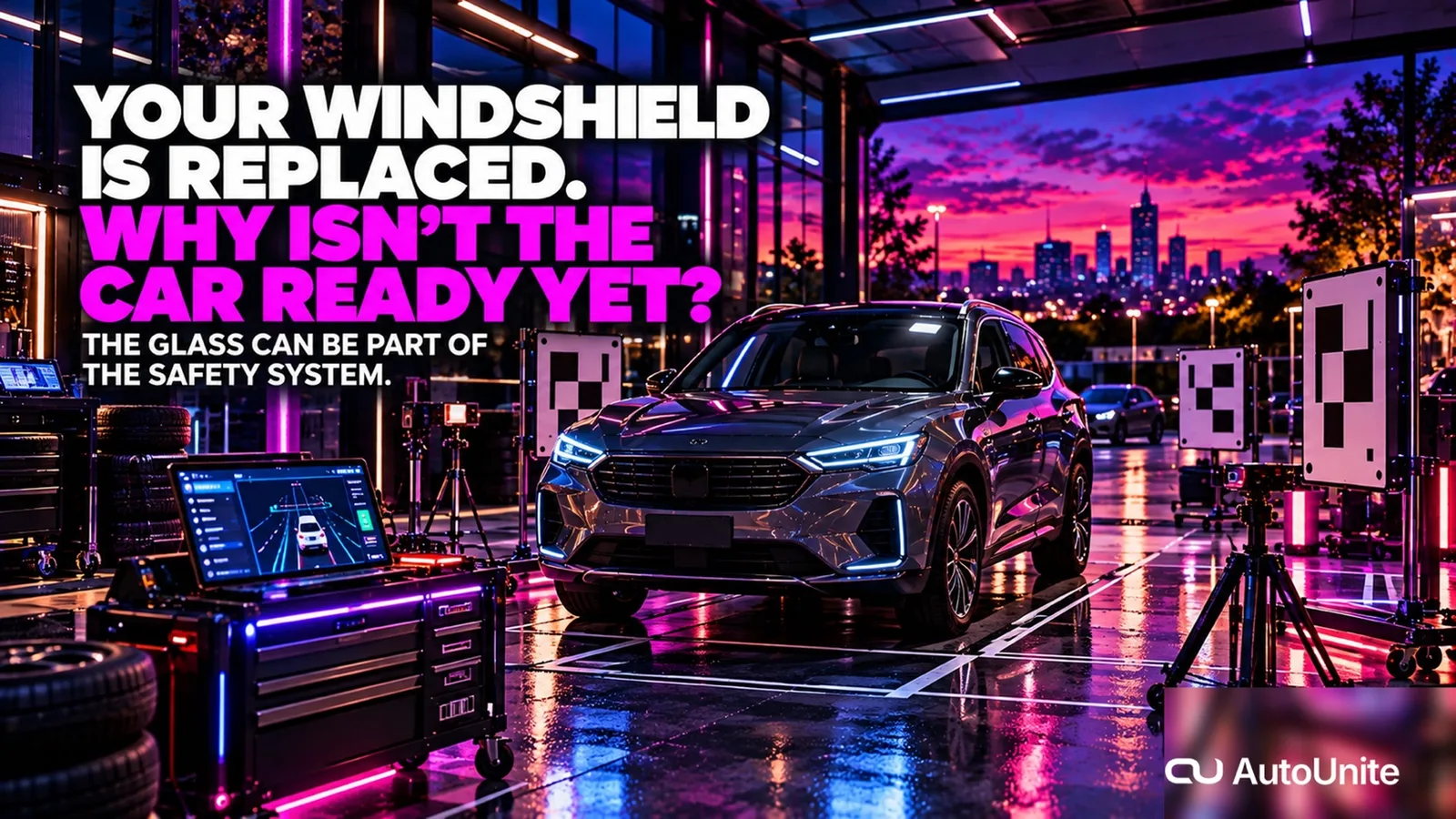
If your vehicle has a forward-facing camera behind the windshield, replacing the glass can create another repair step: ADAS camera calibration. The reason is straightforward. The camera may use the windshield, its mounting bracket and the vehicle's geometry as part of its reference to the road.
That does not create a universal rule that every windshield replacement requires calibration. The current OEM procedure for the exact vehicle and repair event controls.
For an owner, the practical questions are: what equipment is on the vehicle, what repair occurred, what does the manufacturer require, who will perform the calibration, and what documentation proves the required process was completed?
The windshield did not become a computer. It became part of the camera's view.
A forward camera mounted near the mirror is looking through a manufactured optical surface. Its bracket has to hold the camera in the intended position. The replacement glass has to match the application. Curvature, optical distortion, coatings, shaded areas, bracket geometry, installation position, and the way the camera seats can all matter because the software is interpreting objects far beyond the glass.
Small physical or optical changes that are almost invisible to the driver can change the camera's reference to the road.
Toyota gives a direct example. Its current 2025 RAV4 Hybrid owner guidance says the front camera must be recalibrated after windshield replacement. Its 2026 bZ driving-support guidance likewise calls for front-camera recalibration when the windshield is replaced. Toyota's RAV4 Hybrid guidance is useful because it shows the requirement coming from the vehicle maker rather than from a glass-shop sales script.
Ford's current ADAS repair position also treats glass in a sensor's field of view as part of the repair problem and directs repairers back to Ford procedures for scanning, calibration and verification. Subaru publishes model-specific camera-adjustment procedures after certain windshield and camera repair events.
Those examples are deliberately manufacturer-specific. They show the mechanism without pretending every brand or every model uses the same trigger.
ADAS calibration establishes or confirms a sensor's intended relationship to the vehicle and its surroundings after a repair event that can disturb that reference. It is separate from simply reading diagnostic trouble codes.
The process may be static, with the vehicle stationary and calibrated to physical targets; dynamic, with a prescribed road drive; or a combination of both. The exact procedure and prerequisites come from the manufacturer.
A scan communicates with the vehicle's modules. Calibration confirms or re-establishes sensor reference. A system can lack an obvious warning light and still have an OEM-required calibration step after windshield work.
The repair provider should therefore identify the requirement from current OEM information rather than from the dashboard alone.
Forward-camera calibration is not one universal operation.
A static calibration is performed with the vehicle stationary while targets, reflectors, measuring equipment and a scan tool are positioned according to the OEM procedure. The work area may need a defined amount of clear floor space, a level surface, controlled lighting, correct tire pressures, steering position, ride height or other prerequisites.
A dynamic calibration uses a prescribed drive so the system can learn from lane markings and the surrounding environment. The OEM procedure may specify speed range, road type, lane quality, weather, traffic or other conditions.
Some vehicles require both static and dynamic steps.
I-CAR's calibration resources repeatedly make the same operating point: identify the exact OEM requirement, then follow the vehicle maker's procedure. “ADAS calibration” on an invoice therefore does not describe one interchangeable service. It describes a family of manufacturer-defined procedures.
Mobile glass service can be convenient because the physical windshield replacement may be possible at a home or workplace.
The calibration environment can be a separate question.
If the required procedure needs target boards at measured distances, a level floor, controlled lighting, wheel-alignment confirmation, specialized equipment or a prescribed road drive, the driveway may not satisfy the procedure. A glass company can still own the repair, but it may perform the calibration at a fixed facility, bring in a qualified calibration provider, send the vehicle to a collision center, or sublet to a dealer or specialist.
That is not automatically evidence that the glass company is unqualified. It can be evidence that the company understands the limits of the first work location.
The useful question is simple: who performs the required calibration, where, and what completion record comes back with the repair order?
A failed or incomplete calibration does not automatically mean the camera is bad.
OEM procedures can have prerequisites. Depending on the vehicle, those may include correct tire pressure, steering angle, ride height, battery voltage, wheel alignment, a clean camera viewing area, correct glass and bracket installation, a specific amount of open floor space, targets placed within tight measurement tolerances, road markings, speed, weather or traffic conditions.
The repair can also uncover a different problem. General Motors' June 2026 PIT6503A bulletin, for the applications it covers, tells technicians to consider windshield glass, glass installation, camera bracket seating, tint or obstruction, software, low voltage and other conditions before jumping to camera replacement. That is valuable repair-process context: a camera fault can be a system-level problem, not a one-part diagnosis.
If a procedure stops, the next step should come from the diagnostic path—not from repeatedly pushing the same button until the screen says pass.
At first, wheel alignment sounds unrelated to glass.
Some calibration procedures use the vehicle's geometric relationship to the road as part of the reference. If thrust angle, steering position, ride height or another chassis condition is outside the OEM prerequisite, camera calibration can be blocked or can require the alignment issue to be corrected first.
This is another reason a calibration line item can expand into more than scan-tool time. The camera is not being aimed in isolation. The vehicle's physical geometry may be part of the setup.
An owner does not need to diagnose this. The repair file should simply show whether the applicable OEM procedure required alignment verification and, if it did, whether that prerequisite was satisfied.
Sometimes, yes.
The camera is looking through the glass, so optical quality, curvature, camera-window characteristics, bracket placement, coatings and installation can affect what reaches the sensor.
The safe consumer rule is not “aftermarket glass is bad” and not “OEM glass is always required.” Those are both too broad.
Ford, for example, has a brand-specific position calling for Ford OEM glass in the situations covered by its glass statement and links the issue to ADAS performance and recalibration. GM PIT6503A, for the applications it covers, tells technicians to verify GM original-equipment glass and proper installation when diagnosing front-camera concerns.
Other manufacturers and applications may permit different glass choices while still imposing specifications or calibration requirements.
Ask the shop what glass is being installed, its manufacturer and part number when available, what designation is being relied on, and what the current OEM information says for the exact vehicle.
The evidence should be specific enough that “correct glass” means something more than “it fit in the opening.”
There is no universal rule that every calibration must be performed by a dealership.
A dealer, collision center, glass company, mobile calibration business or independent specialist can be the right provider if it has the current OEM information, correct equipment, suitable environment and trained personnel for the vehicle and procedure involved.
I-CAR's repair guidance is useful here because it centers the procedure rather than the sign on the building. The provider needs to know what is required, satisfy the prerequisites, run the correct routine, address failures and document completion.
The same standard applies to a dealership. Factory access does not replace execution. The job still has to be performed correctly.
A confusing repair becomes much easier to evaluate when the evidence is organized in the order the work actually happens.
The AutoUnite ADAS Windshield Repair Proof File uses seven evidence groups.
1. Vehicle + ADAS
Record the VIN, year, make, model, trim or configuration when relevant, the forward-camera or ADAS equipment identified, and the source used to identify that equipment.
2. Repair event
Record what actually happened: chip repair, windshield replacement, removal/reinstallation, camera or bracket work, mirror-assembly work, collision-related glass work, or another trigger. The repair event matters because a small chip repair is not automatically the same event as removing and replacing the glass.
3. Glass
Record the replacement-glass manufacturer, part number if available, any OEM/OE-equivalent designation that can actually be supported, whether the camera bracket is present and properly seated, and any coatings, tint or sensor-area concerns. Also record the source for the glass requirement.
4. OEM requirement
Record the manufacturer, exact procedure or source, and the status of the requirement: VERIFIED, NOT VERIFIED, CONDITIONAL, NOT APPLICABLE, or UNRESOLVED. If calibration applies, record whether the procedure is static, dynamic, or both, plus prerequisites, alignment requirements, scan requirements and environmental requirements when applicable.
5. Calibration
Record the provider, method, date, equipment or procedure reference, pass/fail result, retry reason when applicable, and whether completion was successfully documented.
6. Final verification
Record whether any required pre-scan and post-scan were completed, whether the calibration report was received, whether diagnostic faults remain, whether required road verification was completed, whether warnings remain, whether the ADAS function was restored according to the procedure, and whether the completion documents are attached.
7. Source record
Keep the links, document names, dates, source authority and the claim each source supports.
The workbook is an evidence organizer. It does not certify that a vehicle is safe and it does not replace a technician's judgment or OEM service information.
Its job is narrower: make it difficult for an unresolved requirement to disappear inside a vague line item.
Consider a modern crossover with a forward-facing camera mounted behind the windshield.
This is not a customer case and it is not a procedure for a named vehicle. The sequence is only meant to show what a complete evidence file can look like.
Repair event: windshield replacement.
OEM lookup: the current procedure for that exact VIN/configuration says camera calibration is required after windshield replacement and calls for a static calibration step, a post-repair scan and documented completion.
The owner-facing repair sequence could look like this:
Glass removed → correct replacement glass installed → camera/bracket seating verified → OEM prerequisites checked → required calibration performed → post-repair scan completed → completion report attached → vehicle returned.
If the calibration does not complete because a prerequisite is not met, the repair file should not silently jump to “done.” The status becomes OPEN REQUIREMENT or CALIBRATION NOT YET VERIFIED until the missing step is resolved.
Once the required evidence is present, the file can read REPAIR FILE COMPLETE.
That status still is not an AutoUnite safety certification. It says the consumer evidence file contains the documented steps and records that the selected OEM process called for.
A calibration performed early in a collision repair may have to be repeated after later work changes vehicle geometry or sensor position.
For example, if a vehicle is calibrated before a required wheel alignment, suspension correction, bracket adjustment or another geometry-changing step, the final configuration may no longer match the earlier calibration conditions. Some repair procedures therefore place calibration at a specific point in the sequence, and some require verification or recalibration after later work.
This is why the repair order should show when the calibration occurred, not merely that the word “calibration” appears somewhere on the invoice.
Sequence matters.
AAA's 2023 ADAS repair study gives a useful cost example, but it needs to stay inside its study boundaries.
AAA evaluated three 2023 vehicles—a Ford F-150, Nissan Rogue and Toyota Camry. In its windshield-replacement scenario, the average ADAS-attributable portion was about $360, representing 25.4% of the average repair estimate. The average total repair estimate was $1,439.78 under the study's assumptions.
Those are not universal 2026 windshield prices. Labor rates, glass, vehicle design, calibration method, insurer rules and local conditions can all change the bill.
The useful takeaway is structural: a forward-camera system can add a material amount to a windshield repair even when the camera itself was not replaced.
If a current estimate differs sharply from the study, that difference is not evidence of overcharging by itself. The exact vehicle, required glass, local labor and OEM procedure have to be checked.
A small chip that is repaired without removing the windshield is not automatically the same repair event as windshield replacement or removal/reinstallation.
The location of the damage can also matter when it falls in a camera's field of view or another sensor-sensitive area.
This is where blanket online answers break down. “I repaired a chip and did not calibrate” says almost nothing about a different vehicle that had its windshield removed. “My last car needed calibration” does not prove a new car does.
The event, sensor design and OEM procedure decide the requirement.
Forward cameras and other driver-assistance sensors are common across mainstream cars, trucks and SUVs.
NHTSA's FMVSS No. 127 final rule reinforces the direction of travel: automatic emergency braking, including pedestrian AEB, is required to become standard on new passenger cars and light trucks by September 2029.
That federal rule is not a windshield-calibration rule. It belongs here only as fleet context. More vehicles will depend on sensors for functions that owners increasingly treat as ordinary equipment.
That shifts what “routine repair” means. A windshield, bumper, grille emblem, mirror, wheel alignment or suspension repair can now cross into sensor and software work.
You do not need to understand target placement or learn a scan tool to pick up your car intelligently.
You do need a clean answer to a few questions:
If the shop cannot answer one of those immediately, that does not prove the repair is wrong. It does tell you what part of the repair file still needs clarification.
A quiet dashboard is reassuring. A documented, vehicle-specific repair sequence is stronger evidence.
When a windshield estimate includes calibration, start with the evidence rather than assuming the line item is either necessary or unnecessary.
Begin with the exact vehicle and the exact repair event.
Ask the shop to show which OEM requirement applies, what type of calibration or verification it calls for, who will perform it and what documentation you will receive when the job is complete.
If the estimate does not include calibration, ask the same question in reverse: Does the current OEM procedure for this exact vehicle require any camera calibration or verification after this windshield work?
The strongest answer is not a blanket yes or no.
It is a repair file that connects the VIN, the glass, the OEM requirement, the calibration step and the completion documentation without leaving an unresolved gap.
AutoUnite content is educational and research-focused. Vehicle information, pricing, ownership costs, maintenance, recalls, and other details may vary by region, dealer, and time.
A vehicle-specific guide to why windshield replacement can trigger ADAS camera calibration, what the repair sequence should document, and how owners can verify completion without assuming every vehicle follows the same rule.
Decide First