
The $500 Payment Problem
- PublishedSep 26, 2026
- Last verifiedSep 26, 2026
- Sources14
- 12 min read

Explore clearer car-buying guidance, market context, and ownership knowledge in one place.
Originally published on LinkedIn · Jun 4, 2026. AutoUnite is the canonical record. Last verified Sep 26, 2026.
See how APR, loan term, taxes, fees, down payment and trade equity change what a $500 monthly car payment can actually buy.
Decide First
What shoppers think it buys, what the desk can actually build, and why the same monthly target can point to completely different vehicles.
A customer has a compact SUV open on their phone. The photos look right. The payment in their head feels comfortable. Before anyone talks about APR, trade equity, taxes, or term, they say the sentence every dealership knows:
“I want to be around $500 a month.”
Fair question.
The trouble starts when everyone hears a different question.
The shopper is asking, “What can I comfortably spend each month?”
The salesperson may hear, “Which vehicle can I show that might land near that number?”
The finance desk has to answer something harder: “What structure can actually produce $500 without hiding what makes it possible?”
That gap is the $500 payment problem.
A monthly target is useful. It just is not a vehicle price.
It is the output of a deal.
APR. Term. Taxes. Fees. Down payment. Trade equity. Negative equity. Incentives. Lender approval. Products. Mileage if it is a lease. Sometimes even the exact trim.
Change one of those and the same customer can move from a Trax-sized conversation to an Equinox-sized conversation, or from a clean 72-month structure to an 84-month stretch.
The customer brings the payment.
The desk builds the truth.
The number itself is not strange. It is simply below where much of the current new-car market lives.
Experian reported an average new-car payment of $765 in Q2 2026, with an average new-car APR of 6.35%. Edmunds measured an average financed new-vehicle payment of $777 in the same quarter. Edmunds also found that 23.9% of financed new-vehicle buyers took terms of 84 months or longer, while 36.5% went beyond 72 months.
That does not make a $500 payment impossible. It means the structure has to be tighter than the market average.
A shopper can still land near $500. The path may involve a lower-priced vehicle, a stronger APR, more money down, positive trade equity, an incentive, a longer term, or some combination of those pieces.
The mistake is starting with a vehicle and treating the target payment as if the rest of the deal will somehow bend around it.
AutoUnite content is educational and research-focused. Vehicle information, pricing, ownership costs, maintenance, recalls, and other details may vary by region, dealer, and time.
The original LinkedIn benchmark used a Virginia-style reality check: new vehicle, Virginia’s 4.15% motor vehicle Sales and Use Tax, realistic title/tag assumptions, no negative equity, no protection products, and no hidden rebate assumption.
These examples are illustrations, not quotes or lender offers.
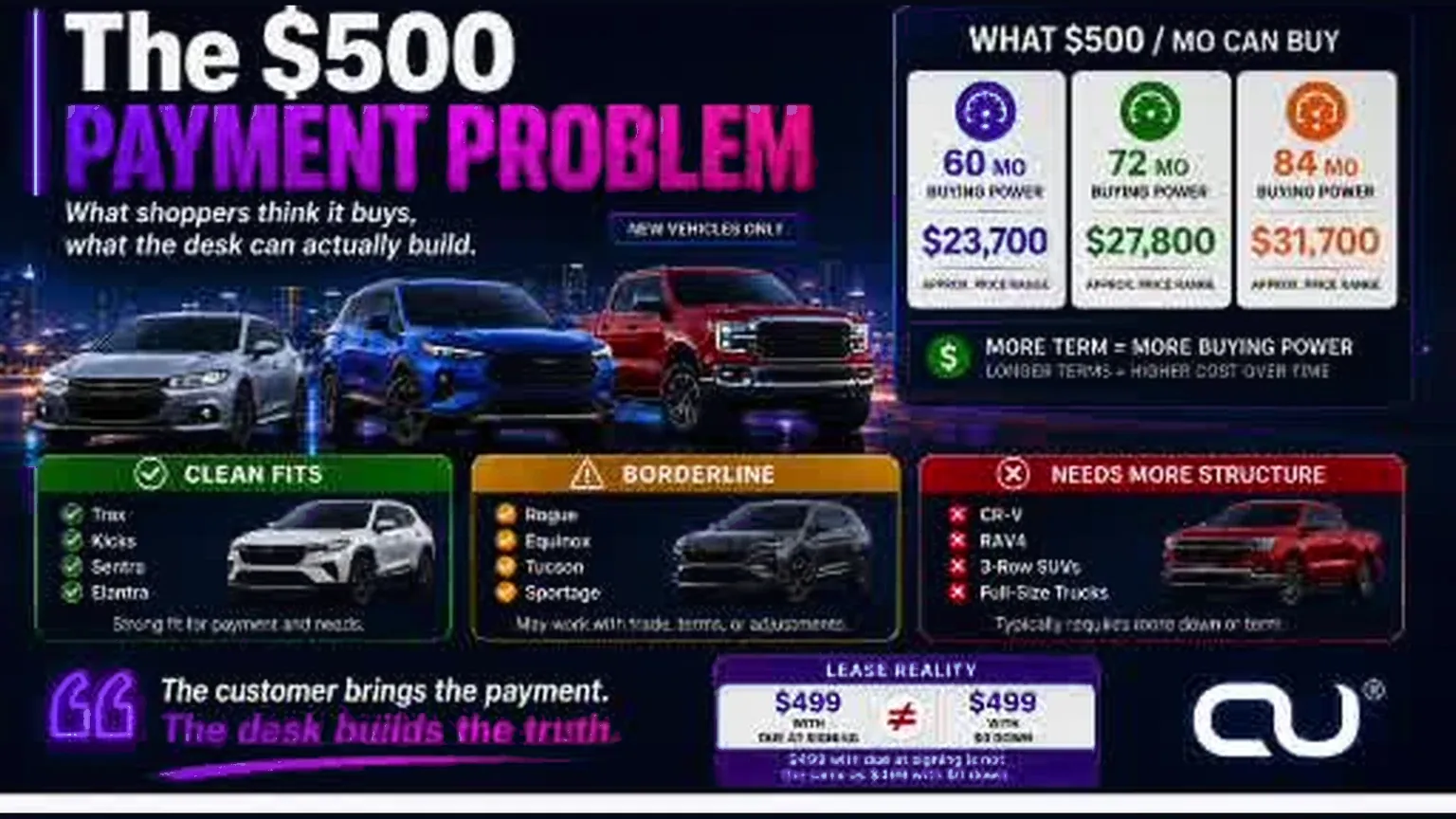
With $0 down, a $500 payment supports approximately these vehicle selling prices before taxes and fees:
The headline lesson is simple: $500 at 60 months is not the same purchase as $500 at 84 months.
The longer term creates more buying power today and more time in debt tomorrow.
That tradeoff matters because the FTC specifically warns shoppers not to judge a deal by monthly payment alone. A lower monthly payment can come from a longer term, and a longer term can increase total borrowing cost and the risk of owing more than the vehicle is worth.
Experian’s Q2 2026 averages make the point even clearer.
Average new-car APRs ranged from 4.41% for super-prime borrowers to 16.11% for deep-subprime borrowers. The same $500 monthly budget therefore supports very different loan amounts before taxes, fees, products, or trade carry are added.
At a $500 payment, the approximate amount financed is:
| Term | 4.41% APR | 6.15% APR | 9.71% APR | 13.52% APR | 16.11% APR |
| --- | ---: | ---: | ---: | ---: | ---: |
| 60 months | $26,879 | $25,770 | $23,691 | $21,720 | $20,512 |
| 72 months | $31,580 | $30,041 | $27,204 | $24,571 | $22,986 |
| 84 months | $36,079 | $34,059 | $30,392 | $27,062 | $25,094 |
Those are loan amounts, not sticker prices. Taxes, title, registration, dealer processing fees, financed products, and negative equity can all reduce how much vehicle fits inside the target.
This is why a customer and a salesperson can both be telling the truth and still feel miles apart.
The customer sees one number: $500.
The desk sees the number of variables required to make it real.
The easiest way to understand the problem is to look at current starting prices.
As of September 2026, manufacturer pages showed:
Starting MSRP is not an out-the-door price. Destination charges, taxes, fees, options, dealer pricing, incentives, and regional programs can change the transaction materially.
Still, the ladder explains why the conversations feel different.
A Trax, Elantra, or Corolla starts much closer to the range a $500 target can support at mainstream terms. An Equinox sits closer to the edge. A CR-V or RAV4 can move from plausible to difficult depending on rate, term, trim, money down, and fees. A full-size truck or three-row SUV usually needs substantially more structure because the starting vehicle price is already far above the cleanest $500 range.
No one needs to call the customer unrealistic.
The better move is to show the structure.
Imagine two people looking at the same Equinox.
The shopper sees a vehicle in the high-$20,000s and thinks, “I am close.”
The desk sees the price plus tax, registration, processing fee, the customer’s approved APR, the term, and whether the trade is helping or hurting the deal.
Now add a trade that is $4,000 upside down.
Nothing about the Equinox changed.
The amount that has to be financed did.
Or change the APR from a prime-level rate to a near-prime rate.
Same SUV. Same down payment. Same customer payment target. Different ceiling.
Or shorten the requested term from 84 months to 60.
The target stays at $500. Buying power drops sharply.
The monthly number did not lie. It simply never told the whole story.
A shopper may receive a lower payment from another store and assume the first dealer is high.
Sometimes that is true. Dealers can price the same vehicle differently.
But the monthly number is not comparable until the structures match.
Ask whether both quotes use the same:
If one quote assumes 84 months and the other assumes 72, the payment comparison is incomplete.
If one includes $3,500 down and the other is true $0 down, it is incomplete.
If one buries negative equity inside the amount financed and the other does not, the monthly number alone tells almost nothing.
That is why a stronger question is:
“What has to be true for this payment to be real?”
That question helps the shopper and the dealership at the same time.
A finance customer is asking what they can buy for $500.
A lease customer is asking what they can drive for $500 under a specific program.
Those are different calculations.
Lease payment depends on capitalized cost, residual value, money factor, term, mileage, acquisition fee, taxes, incentives, and due-at-signing money.
A headline such as $499/month with $3,499 due at signing is not the same thing as $499/month with $0 down.
The upfront money still exists. If the customer wants to preserve that cash, some or all of it has to be rolled into the lease, which raises the monthly payment.
A lease offer can also look inexpensive until the shopper realizes it was built at a lower annual mileage allowance than they actually need.
The FTC’s guidance is useful here: compare the full terms, not just the advertised monthly number.
This customer is flexible on model and trim. They care most about a new vehicle, warranty, efficient ownership, and staying close to the monthly target.
The conversation is productive because the vehicle list starts inside the math instead of outside it.
A Trax, Elantra, Corolla, Kicks, Sentra, K4, or another lower-priced car or crossover may belong in the first set of possibilities depending on local pricing and program support.
This customer wants an Equinox, Rogue, Tucson, Sportage, Corolla Cross, CR-V, or RAV4-type vehicle.
The vehicle may be possible, but the answer depends on the exact structure. A lower trim, stronger APR, manufacturer support, positive trade equity, or money down may solve the gap. A shorter term or weaker rate may reopen it.
The right response is not “yes” or “no” before the numbers are built.
It is: “Here is what changes if we keep the payment fixed.”
This customer wants a full-size pickup, a well-equipped three-row SUV, or a vehicle in the $40,000-plus range while holding tightly to $500 and minimal cash down.
That is where frustration becomes almost guaranteed if the conversation begins with vehicle desire and postpones payment structure until the end.
A 2026 F-150 starts around $37,290. A 2026 Grand Highlander starts around $42,260. Taxes and fees have not entered the deal yet.
The shopper is not wrong for wanting the vehicle.
The dealership is not wrong for showing the math.
The mismatch is between the target and the structure required to reach it.
Dealership employees deal with a difficult tension.
They want to keep the customer engaged. They also know that a blunt response such as “That payment is impossible” can end the conversation before they have the information needed to know whether it is actually impossible.
So the salesperson gathers the pieces:
Credit tier. Trade. Payoff. Cash down. Desired term. Mileage. Trim. Rebates. Lender. Sometimes a co-buyer.
From the customer’s side, that can feel like the store is avoiding a simple question.
From the desk’s side, those questions are the answer.
The fix is not to make customers learn dealership math before they shop.
The fix is to expose enough of the structure early that the shopper understands why the answer moves.
Customers have a reasonable instinct: start with a monthly number that fits the household.
That is better than falling in love with a vehicle and asking about affordability at the end.
The risk comes from stopping at the payment.
A monthly target should be paired with three more questions:
1. How long am I willing to make this payment?
2. How much cash am I willing to put into the deal?
3. What is my total transportation cost after insurance, fuel, maintenance, and registration?
A $500 loan payment can still produce an uncomfortable vehicle budget if insurance jumps, fuel use is high, or the term stretches well beyond the shopper’s expected ownership cycle.
That is why “Can I make the payment?” and “Does this vehicle fit my life?” are different questions.
Before the shopper becomes attached to a specific vehicle, show four things together:
Payment target. Term. Estimated APR range. Vehicle-price range.
Then add down payment and trade position.
That single view makes the hidden structure visible.
The shopper can decide whether they would rather:
No pressure is required. The math gives the shopper choices.
That is better retail.
Most shopping websites are excellent at helping people find vehicles.
They are less useful at showing which vehicles fit the deal the shopper is actually trying to build.
That difference matters.
A customer can search 200 SUVs and still have no idea which six belong inside a $500 conversation.
A dealer can receive that lead and spend the next hour unwinding an expectation that started before anyone at the store spoke to the customer.
Better math earlier does not remove the dealership from the process.
It gives the dealership a better starting point.
It also gives the shopper a fairer one.
The future of car shopping should not be another page of inventory with a payment badge next to every vehicle.
It should help a person understand what creates the payment, what changes it, and which tradeoffs they are actually making.
Decide First. Submit Later.
The payment examples are illustrative and are not financing offers. Actual terms depend on credit, lender, vehicle, taxes, fees, trade position, products, incentives, and dealer pricing.
Current-market validation used Virginia DMV, Experian, Edmunds, FTC consumer guidance, and manufacturer pricing pages from Chevrolet, Hyundai, Toyota, Honda, and Ford. Full URLs and caveats are preserved in the package Source Register.