Car Buying, Vehicle Research & Ownership Guides
Explore clearer car-buying guidance, market context, and ownership knowledge in one place.

Explore clearer car-buying guidance, market context, and ownership knowledge in one place.
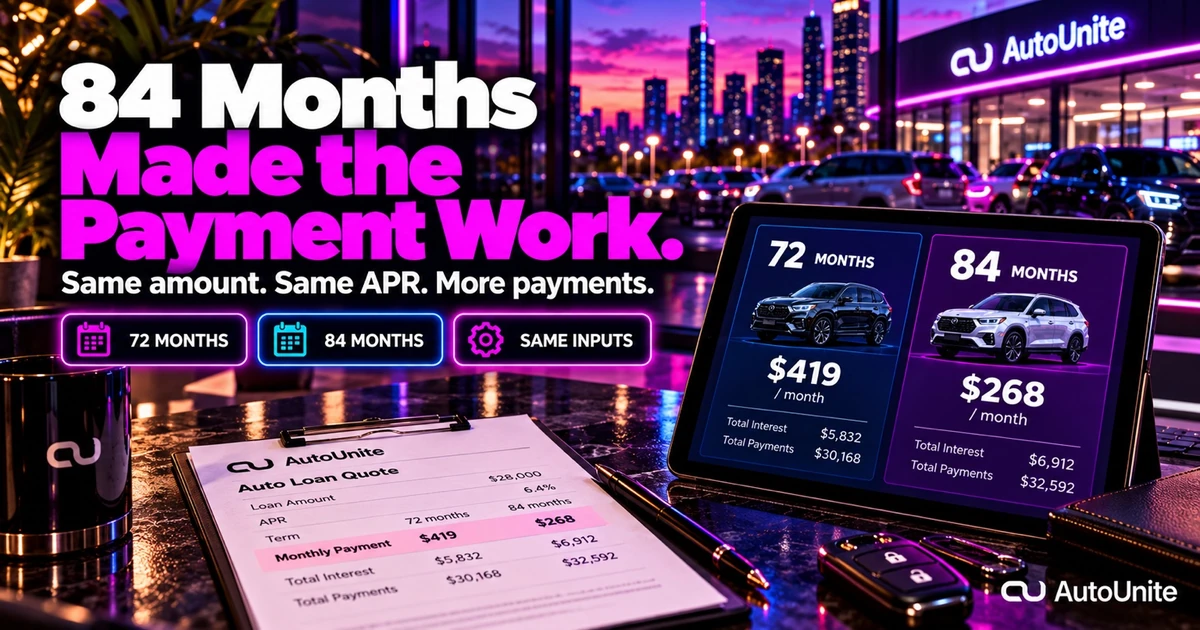
The payment came down. The cost did not.
The first pencil was 72 months.
The vehicle fit the family. The approval was there. The trade worked well enough to keep moving.
The payment was still too high.
So the desk kept the same vehicle, the same rate, the same cash down and the same amount financed.
The term moved to 84 months.
Now the payment worked.
Nothing dishonest happened. The customer was not switched into another vehicle, and the figures were not rearranged behind the scenes.
The loan simply got another year.
The payment worked because the deal got longer.
Anyone who has worked a desk long enough has watched the center move.
Sixty months used to be the normal comparison. Then 72 became a regular part of the pencil. Now 84 months shows up often enough that it no longer feels unusual.
Edmunds’ Q2 2026 financing analysis found:
36.5% of financed new-vehicle buyers selected terms of 73 months or longer.
23.9% selected 84 months or longer.
The average new-vehicle payment reached $777.
The average amount financed reached $44,156.
The 73-month and 84-month figures were both record highs.
That is how 84 starts becoming the new 72.
Not because buyers suddenly want a seven-year car note.
Because the 60- or 72-month number often does not fit the household anymore.
The longer-term trend is visible in more than one dataset. Experian’s Q2 2026 automotive finance summary says one in three vehicle loans now exceeds 72 months. Edmunds measured an average new-car term of 70.4 months in the same quarter, with 23.9% of financed new-vehicle buyers at 84 months or longer.
Those numbers do not mean 84 months is automatically a mistake. They show why the decision deserves more than a monthly-payment conversation. When a term becomes common, it can start to feel normal before the customer has compared the total interest, remaining balance and likely ownership horizon.
The finance manager sees a structure that gets a real family into the vehicle they chose. The customer sees the first number that finally fits the household. Both views can be true. The missing piece is the future balance.
Honda’s official 2026 Pilot page lists a $42,395 starting MSRP, excluding the $1,495 destination charge, taxes, license, registration, accessories and premium-color charges. It is a mainstream three-row family SUV with seating for up to eight—not an exotic or six-figure example.
A customer can arrive with a completely reasonable need:
Three rows
Room for children
Space for luggage
Current safety and convenience equipment
A vehicle expected to stay in the household for years
But once the vehicle, destination charge, options, taxes, fees and the customer's trade position are put together, a mainstream family SUV can still create an amount financed well into the $40,000 range.
Now the desk has to make that amount fit a monthly budget.
Use the current average amount financed of $44,156 with a 7% APR.
This is an illustrative comparison - not a Honda offer, dealership quote or lender approval.
Nothing changes except the term.
At 72 months:
Approximate payment: $753
Approximate total interest: $10,047
At 84 months:
Approximate payment: $666
Approximate total interest: $11,824
The longer term lowers the monthly obligation by about $86.
For a household paying for groceries, insurance, daycare, utilities and everything else competing for the same income, $86 is not pocket change.
But if both loans are carried to maturity, the 84-month structure adds approximately $1,778 in interest.
The rate did not improve.
The amount financed did not fall.
Twelve more payments created the lower number.
The extra interest is only part of the story.
After 36 payments under the same illustration:
The 72-month loan would have an approximate balance of $24,381.
The 84-month loan would have an approximate balance of $27,830.
The customer who selected 84 months would still owe about $3,449 more after three years.
That may not matter to someone who keeps the Pilot for eight or ten years.
It matters when the customer returns early because the commute changed, another child arrived, the mileage climbed faster than expected or the family now needs something different.
The used-car manager appraises the vehicle.
The bank supplies the payoff.
The desk puts both numbers on the same screen.
The lower payment that helped make the first deal work can also leave more payoff attached to the vehicle when the customer comes back early.
An 84-month term does not automatically put a customer upside down.
Vehicle depreciation, cash down, trade equity, mileage, condition, APR, amount financed and market timing all affect the equity position.
In a same-rate, same-amount comparison, the longer term reduces principal more slowly. That leaves less room when the customer wants to trade before the note is close to paid off.
CFPB warns that carrying an unpaid trade balance into the replacement loan makes the new borrowing larger and more expensive. The longer-term illustration here does not claim an 84-month loan created every dollar of negative equity; it shows why slower principal reduction matters when a customer returns early.
An 84-month term did not necessarily create every dollar of that shortage.
It means the customer needs to understand how the longer term may affect the next trade.
The argument gets distorted when the only two choices presented are “short loan good” and “long loan bad.” A household may need the lower required payment. A family may also know they keep vehicles for ten years, drive modest annual mileage and have no plan to trade in three. That ownership pattern changes the risk.
What matters is whether the customer sees the tradeoff before signing. The FTC tells shoppers not to focus only on the monthly payment because longer terms can raise total financing cost. That is the exact conversation the worksheet should make visible.
A useful four-line comparison is enough:
For the $44,156 illustration in this story, 84 months creates roughly $86 of monthly relief. That is meaningful cash flow. It also leaves roughly $3,449 more principal after 36 payments than the 72-month version. Neither number should be hidden behind the other.
There is another side that often gets missed. A longer contractual term sets the minimum required payment. It does not require a borrower to remain in debt for all 84 months if the contract permits early principal reduction without penalty.
That can create flexibility for a household whose income varies: make the required payment in a tight month, then send extra principal when cash flow is stronger. But that only helps if the borrower understands the contract, confirms how extra payments are applied, and actually follows through.
The dealership should not promise that strategy will work for every loan. The cleaner instruction is to ask the lender how principal-only or extra payments are handled and whether any prepayment limitation applies.
The point is not to turn the finance office into a personal-finance seminar. It is to keep “$86 less per month” from becoming the only number the customer remembers.
The real choice is not always:
A smart 60-month loan
A foolish 84-month loan
It may be:
Keep an unreliable vehicle
Give up the third row the family needs
Pull money from savings
Accept a payment the household cannot carry
Use the longer term to keep the monthly obligation inside the budget
That does not make every 84-month loan a good decision.
It means the customer deserves the whole pencil, not a lecture.
The customer is trying to solve this month. The store should also help them see what the same decision may look like three years from now.
The customer drove the vehicle.
The spouse likes it.
The children fit.
The trade has been appraised.
The approval is in place.
Then the first pencil comes back beyond what the customer can comfortably handle.
Now the deal starts moving:
More cash down
A different trim
A less expensive vehicle
A better rate
A longer term
A used alternative
Keeping the current vehicle
Term can be the cleanest move because it does not require the customer to give up the vehicle or bring cash that may not exist.
But the job is not finished when the payment becomes acceptable.
The strongest presentation is not:
“Good news. We got your payment down.”
That gives the customer the result without showing how it happened.
A cleaner conversation sounds more like this:
“At 72 months, the payment is about $753. At 84 months, it is about $666. The amount financed and APR are the same. The lower payment comes from adding twelve payments, and it increases the total interest if you carry the loan through the full term.”
That is not a scare tactic.
It is the pencil.
The customer can now compare:
Lower monthly obligation
Longer loan
More total interest
Higher remaining balance for a longer period
Maybe the $86 matters more to the household than the additional interest.
Maybe a less expensive trim or additional cash down creates a better structure.
Maybe the customer intends to keep the vehicle for eight years and chooses the longer term after seeing both pencils.
The customer can choose either structure. The figures presented for each one should stay the same.
The store can move the vehicle, cash down, trade, rate, incentive or term.
The manufacturer can help with lower-priced trims, rebate money, captive-finance support and lease programs.
But those tools are not unlimited.
Edmunds’ Q2 2026 analysis reported that only 1.2% of financed new-vehicle purchases used 0% APR. When strong rate support is not available and vehicle prices remain high, more of the affordability work falls on the term.
That may help deliver a vehicle today.
It can also bring the customer back three years later with more payoff still attached to it.
That problem does not stop with the customer or the store. Vehicle price, incentive money, rate support and the replacement cycle all end up in the same pencil.
An 84-month structure may fit when:
The customer receives a competitive rate
The vehicle will remain in the household for many years
The monthly difference protects needed household cash flow
There is enough cash down or trade equity to support the deal
The customer understands the finance charge and complete scheduled-payment total
The vehicle will continue fitting the family beyond the next few years
The customer plans to make additional principal payments when possible
A well-structured 84-month loan on the right vehicle may serve a customer better than a shorter loan on the wrong vehicle with no money left after delivery.
The problem begins when the longer term is presented as though the price came down.
It did not.
The customer bought more time.
FTC consumer financing guidance is a good reason to keep the final contract terms visible. Before the contract is completed, the customer should be able to answer five questions:
How much am I financing?
What is the APR?
How many payments am I making?
What is the total finance charge?
How long do I realistically expect to keep the vehicle?
The payment may be exactly where the household needs it.
The customer should still know what moved to get it there.
Eighty-four months can make the payment work.
It cannot make the vehicle cheaper.
When 84 months is the pencil that saves the deal, what do you make sure the customer understands before they sign?
AutoUnite content is educational and research-focused. Vehicle information, pricing, ownership costs, maintenance, recalls, and other details may vary by region, dealer, and time.
An 84-month car loan can lower the payment while increasing total interest and extending the time you may owe more than the vehicle is worth.
Decide First