
Would You Buy a Former Rental Car?
- PublishedSep 25, 2026
- Last verifiedSep 25, 2026
- Sources6
- 13 min read

Explore clearer car-buying guidance, market context, and ownership knowledge in one place.
A Former-Rental Proof File that separates vehicle provenance, VIN-linked maintenance, current condition, warranty timing, recalls and the evidence-adjusted price advantage.
Decide First
A former rental car arrives with a story already attached to it.
Some shoppers hear "rental" and picture hundreds of careless drivers, slammed doors and curbs. Others hear "fleet maintained" and assume the opposite: newer model year, regular service, lower price, easy bargain.
Neither shortcut tells you whether the exact VIN in front of you is worth buying.
Rental history is provenance. It changes the questions. It does not answer them.
That distinction matters because former rentals can combine traits that pull in opposite directions: relatively young age, high mileage for that age, many drivers, structured fleet service, simple equipment, visible cosmetic wear, remaining warranty in some cases, and a price that may or may not compensate you for the uncertainty. Edmunds' current guide describes that same basic tension: former rentals are often newer, higher-mileage, lightly optioned and maintained on fleet schedules, but their condition still has to be judged vehicle by vehicle. Edmunds - Are Rental Cars Good to Buy?
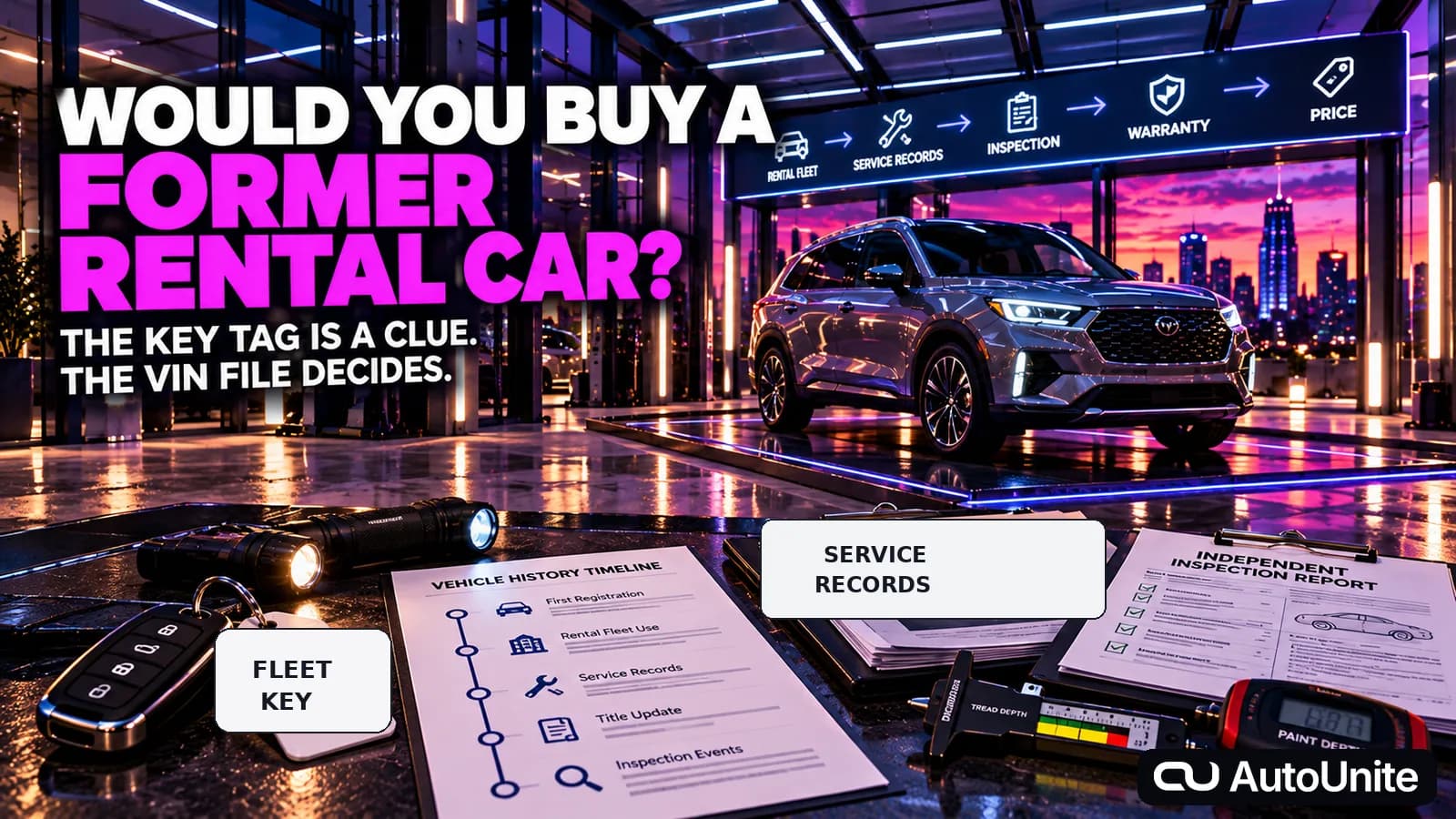
AutoUnite's framework for this decision is the Former-Rental Proof File. Instead of asking whether rental cars are "good" or "bad," build the evidence around one VIN and find out whether the price, condition and protection are strong enough to justify its history.
The first job is not inspection. It is chronology.
Write down:
That timeline changes how you interpret everything else.
"Former rental" could mean a vehicle that left a rental fleet last month. It could also describe a car that spent one year in rental service, then three years with a private owner. The label is the same. The evidence is not.
The Federal Trade Commission recommends obtaining a vehicle-history report when shopping for a used car, and notes that reports can provide ownership history, accident or title information and mileage progression. The FTC is equally clear about the limit: a history report is a substitute for an independent mechanical inspection.
AutoUnite content is educational and research-focused. Vehicle information, pricing, ownership costs, maintenance, recalls, and other details may vary by region, dealer, and time.
A rental vehicle can have far more drivers than a privately owned car. That is real.
What you usually cannot know is how each renter treated it.
Some were careful. Some were not. Some vehicles accumulated long highway trips. Others spent their lives in dense urban use, airport loops and parking garages. A fleet label does not reconstruct each mile.
That uncertainty should push you toward evidence, not stereotype.
The useful questions are physical:
A rental key tag can tell you where the story started. It cannot tell you what the car is today.
For one VIN, assemble five evidence layers before you decide.
Capture the rental/fleet period, mileage timeline, title/registration events and ownership transitions.
Ask for service records tied to the VIN, not a statement about how a fleet "usually" maintains its cars.
Get an independent pre-purchase inspection and record tires, brakes, alignment, suspension, fluids, battery, body, paint, glass, interior and underbody condition.
Verify remaining manufacturer warranty using the original in-service date and current mileage. Then separate any seller warranty, roadside assistance, return/buyback policy or optional service contract.
Compare the exact vehicle with genuinely similar alternatives: same year or close, same trim, similar mileage, equipment, title/accident history and warranty position. Then subtract the near-term work the rental actually needs.
That last step is where many "cheap rental" claims fall apart. A $2,500 lower asking price is not a $2,500 advantage if the vehicle immediately needs $1,400 of tires, brakes and alignment work.
Former rentals can accumulate mileage quickly because they are working assets. Edmunds notes that high mileage for age is common in the category. Edmunds - Are Rental Cars Good to Buy?
Mileage matters because it consumes wear items and warranty limits. It can affect:
But mileage alone does not describe condition.
A 40,000-mile vehicle with documented maintenance, matching tires, healthy brakes and a clean independent inspection can be a stronger file than a 25,000-mile vehicle with deferred service and collision repairs. The odometer is an input, not a verdict.
What matters is whether the price reflects both the mileage and the evidence you uncover.
"Rental companies maintain their cars" is too broad to use as a buying rule.
A better question is:
What can this seller prove about this VIN?
As a current seller-specific example, Enterprise Car Sales says vehicles it sells are inspected by ASE-certified technicians, and its buying-rental guide says sale vehicles include a third-party vehicle-history report. Enterprise also states that many vehicles come from its rental or affiliated lease fleets, while some are acquired from other sources. Those facts are useful when evaluating a specific Enterprise vehicle; they should not be generalized to every rental company or every former rental sold elsewhere. Enterprise - Guide to Buying a Rental Car Enterprise - Used Cars
If the seller has records, read them. If the records are incomplete, mark that uncertainty instead of filling it with reputation.
A fleet may inspect a vehicle before disposition. A seller may inspect it again before retail.
The buyer's independent technician has a different assignment:
What should the next owner know before paying for this exact vehicle?
The FTC recommends an independent mechanical inspection even when a dealer has inspected the car or it is being sold with a warranty or service contract. The FTC also recommends asking for a written report with estimates for needed repairs. FTC - Buying a Used Car From a Dealer
That written inspection becomes part of the Proof File. It converts vague concern into specific numbers.
"Rental car might need work" is not useful.
"Two tires are at 3/32, front pads have limited remaining life, right-front wheel is bent, alignment is out and there are no active diagnostic faults" is useful.
Now you can price the decision.
Look at all four tires, not only tread depth.
Check:
Mismatched tires do not prove abuse. They can indicate staggered replacement, road damage or cost-focused fleet maintenance. Either way, they tell you something about the car's history and your likely next expense.
Then inspect the wheels and steering behavior. Curb rash is cosmetic. A bent wheel, vibration, uneven wear or steering pull deserves diagnosis.
The job is not to hunt for a scandal. It is to convert wear into evidence and cost.
A relatively young rental can show more contact wear than a privately owned car of the same age.
Look at:
Smell belongs on the inspection too. Smoke, mildew, heavy deodorizer and persistent food or pet odor do not show up in listing photography.
For the body, do not treat a clean history report as proof of original paint. Some repairs never become major insurance records. Paint-depth readings, overspray, mismatched texture and panel gaps can help an experienced inspector identify previous work.
Prior cosmetic repair does not automatically make the vehicle bad. Undisclosed or poor repair changes the file.
Fleet vehicles are often ordered for broad utility and acquisition cost rather than maximum option content. Edmunds notes that former rentals can be lightly optioned. Edmunds - Are Rental Cars Good to Buy?
That can be perfect if you want simple transportation. It can be a problem if you assume a familiar trim name guarantees every feature you care about.
Verify the exact VIN and equipment before you price the car against alternatives.
A comparison is weak if the private-use comp has adaptive cruise, heated seats and a tow package while the former rental does not. The two cars may share a trim badge without being equivalent products.
A young model year can still have little comprehensive warranty remaining if mileage accumulated quickly.
Use four facts:
Then determine what remains.
Do the same for any seller-specific protection.
As of September 25, 2026, Enterprise Car Sales states that each vehicle it sells includes a 12-month/12,000-mile limited powertrain warranty, beginning on the purchase date, plus 12 months of roadside assistance. Its current terms also describe a 7-day/1,000-mile buyback, subject to restrictions and a $200 restocking fee where allowed by law. These are Enterprise-specific terms and can change, so verify the contract on the vehicle you are actually buying. Enterprise - Protection Enterprise - Used Cars
A former rental at an unrelated dealership may have none of those seller-specific protections.
"Former rental" is provenance. Warranty is contract language.
Do not assume the fleet, auction or selling dealer already cleared every recall.
New recalls can appear after a vehicle leaves rental service, and NHTSA's VIN tool is designed to identify unrepaired safety recalls from participating manufacturers. NHTSA also notes limits: the VIN search does not show recalls already repaired, some very recent recalls before all affected VINs are identified, certain older recalls, some small manufacturers or non-safety campaigns. NHTSA - Recall Lookup
Run the exact VIN before purchase. If a recall is open, understand the remedy and any interim safety guidance.
The strongest comparison is not:
Rental versus non-rental.
It is:
This former rental versus the best realistic alternatives I could buy instead.
Use the same comparison frame:
Then calculate what AutoUnite calls the evidence-adjusted price advantage:
Comparable vehicle cost - former-rental cost - rental's verified near-term reconditioning cost
This is not a universal valuation formula. It is a way to stop calling a sticker-price gap a bargain before you account for the work already visible.
This example is illustrative, not a current market quote.
Suppose you are comparing two compact SUVs with the same year and trim.
The visible price gap is $2,900.
After $1,250 of inspection-confirmed near-term work on the former rental, the simple evidence-adjusted price advantage becomes $1,650 before taxes, financing, insurance or any future unknown repair.
That does not tell you which car to buy. It tells you the real question.
Is $1,650 enough compensation for 12,000 additional miles, rental provenance and the remaining uncertainty, given the condition and warranty of both vehicles?
Another shopper may answer differently because they plan to keep the car ten years, value the seller warranty highly, or find better financing on one VIN. The framework keeps the choice attached to evidence.
A former rental becomes easier to defend when several things line up at once:
Notice what is missing from that list: "rental cars are good."
The file is strong because the evidence is strong.
The file weakens quickly when the seller refuses independent inspection, service history is missing, mileage progression is unclear, tires or alignment suggest unresolved damage, paint/body evidence conflicts with the history story, the car has significant immediate work, or the price is nearly the same as cleaner lower-mileage alternatives.
Rental history is not necessarily the reason to walk away.
A weak file is.
Before you buy, answer these ten questions:
Now the rental label has context.
A former rental can be a smart used-car purchase. It can also be the wrong one.
The category alone cannot settle it.
You are buying a specific machine with a specific timeline, current condition, warranty position and price. The more uncertain its past use is, the stronger the present-day evidence should be.
Build the file. Inspect the car. Price the known wear. Verify the coverage. Compare the alternatives.
Then decide whether the discount is actually paying you for the history.
What Matters: Treat rental history as provenance, not a condition grade. Build the VIN timeline, maintenance evidence, independent inspection, coverage clock and comparable set around the exact vehicle.
Watch This: A lower sticker price can shrink quickly after tires, brakes, wheel/alignment work or other inspection-confirmed costs. Seller-specific warranties and buyback programs are not universal rental-car benefits.
Your Next Move: Complete the AutoUnite Former-Rental Proof File for the exact VIN, then calculate the evidence-adjusted price advantage against genuinely comparable private-use alternatives before deciding.