

The Window Sticker Says "AS IS." What Are You Actually Agreeing To?
On This Page
The price is usually the loudest number on a used car.
The most important piece of paper may be the one taped to the window.
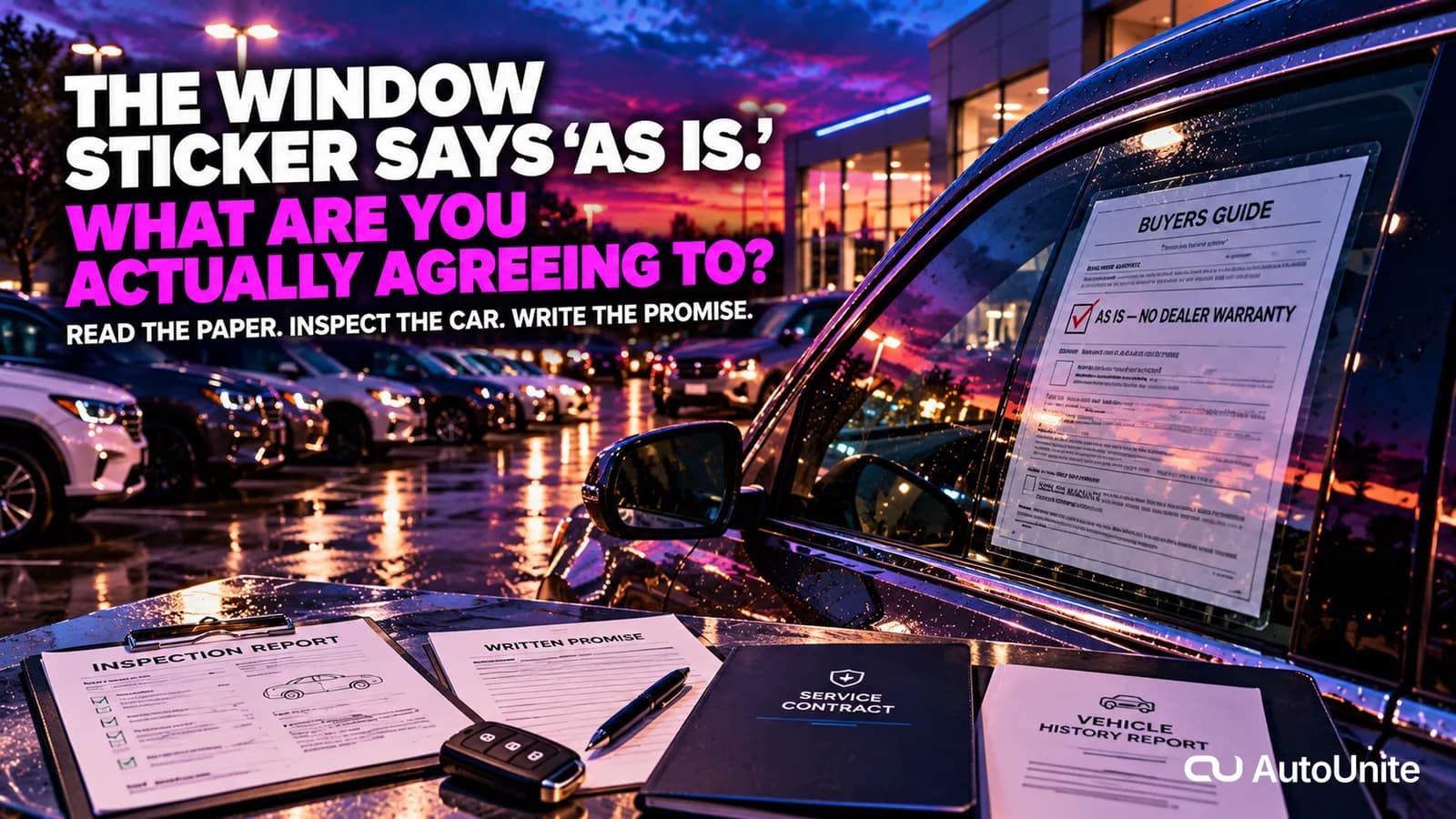
On a dealer's used vehicle, the FTC Buyers Guide tells you something the online listing often does not: whether the dealer is selling the car AS IS - NO DEALER WARRANTY or with dealer warranty coverage, and what that coverage actually includes.
That box is easy to misread.
Some shoppers see AS IS and assume the car must be mechanically bad. Others hear a reassuring sales conversation and assume the dealer will take care of anything serious after delivery anyway.
Neither assumption is a substitute for the document.
The Buyers Guide is primarily a warranty disclosure. It is not a condition grade, a pre-purchase inspection, a vehicle-history report, or a promise that every problem has been found. The practical job is to keep those pieces of evidence separate, then make sure they all describe the same transaction.
That is what the AutoUnite As-Is Evidence Stack is built to do.
Start with the exact box on the exact VIN
The FTC's Used Car Rule requires most dealers that offer used vehicles for sale to display a Buyers Guide before the vehicle is offered to consumers. The Guide identifies the vehicle and tells the shopper whether it is being sold as is, with implied warranties only where applicable, or with dealer warranty coverage.
If the AS IS - NO DEALER WARRANTY box is checked, the federal form states that the dealer does not provide a warranty for repairs after the sale.
That statement is narrower than many people make it sound.
It does not say the car is mechanically defective.
It does not say the car passed a comprehensive mechanical inspection.
It does not tell you whether a manufacturer's warranty still applies.
It does not tell you whether a separately purchased service contract exists.
And it does not erase whatever rights state law may give you in a particular transaction.
Start with what the box actually does: it tells you the dealer-warranty position shown on that Buyers Guide.
Warranty status is not vehicle condition
This distinction is the foundation of the whole issue.
A clean, well-maintained used vehicle can be sold as is. A rough vehicle can be sold with a limited dealer warranty. Warranty coverage transfers some defined repair risk; it does not certify the underlying condition of the car.
To understand condition, you need different evidence.
A useful used-car file has at least five layers:
- Buyers Guide - what warranty position is being offered by the dealer.
- Written warranty or service-contract documents - what is actually covered, by whom, for how long, and under what conditions.
- Independent inspection - what a qualified mechanic can observe about the car now.
- History and recall evidence - recorded title/history information and unrepaired safety recalls tied to the VIN.
- Written promises - anything the dealer agrees to repair, replace, reimburse, or complete before or after delivery.
One layer cannot do the job of all five.
A clean history report is not an inspection. A 30-day warranty is not a condition report. A mechanic's inspection does not tell you every title event. An "as is" disclosure does not prove the car is bad.
This is why a good used-car decision feels more like assembling a file than reading a single label.
The Buyers Guide can control a conflict in the paperwork
One of the most useful parts of the FTC rule is easy to miss.
The required sales-contract disclosure says the information on the window form is part of the contract and overrides contrary provisions in the contract of sale.
So imagine the Buyers Guide says the vehicle comes with a dealer warranty, but another sales document says the car is sold as is. The FTC's consumer guidance says the dealer must provide the warranty described in the Buyers Guide.
The reverse lesson matters too: if you negotiate different warranty terms, the Guide should be changed to reflect the final deal.
Do not treat the Buyers Guide as a disposable pre-negotiation sheet. Keep a copy of the final version.
Before signing, compare it with the purchase agreement and any warranty document. If the documents disagree, stop and reconcile them before delivery.
A verbal promise is not enough protection
Used-car deals often contain small promises that feel obvious in the showroom and become fuzzy three days later.
"We'll fix the air conditioning."
"We'll replace those tires."
"We'll take care of that warning light."
"Bring it back if anything happens."
The Buyers Guide itself warns that spoken promises are difficult to enforce and tells consumers to get promises in writing.
A verbal statement can still matter, but the cleanest deal is the one where the paperwork removes the argument before it can happen.
A useful written promise answers four questions:
- What exactly will be repaired or supplied?
- Who pays for it?
- When will it be completed?
- What happens if the work reveals something larger than expected?
Compare these two lines:
Weak: "Dealer will fix brakes."
Better: "Dealer will replace front brake pads and inspect front rotors before delivery; any required rotor replacement identified during that work will be completed at dealer expense."
The second line is not more hostile. It is more specific.
If the dealer is actually adding warranty coverage as part of the negotiation, the Buyers Guide should be updated to reflect the final warranty terms. If the dealer is simply promising a specific repair, capture that promise in the appropriate written due-bill, "We Owe," repair agreement, or other transaction document.
The paperwork should tell one story.
State law still matters
A national article should not pretend that AS IS has identical legal effect in every state.
The FTC explains that some states allow implied warranties to be disclaimed through proper as-is language. Other states limit or prohibit that result, or require additional language or procedures. Maine and Wisconsin use state disclosure systems rather than the federal Buyers Guide because their rules provide similar protections.
So the useful national rule is not "as is means you have no rights."
It is this:
The Buyers Guide tells you the dealer-warranty position. Your full rights can also depend on state law, other written promises, remaining manufacturer coverage, service contracts, and the facts of the transaction.
If a real dispute is already underway, that is the point to get jurisdiction-specific advice rather than relying on a general article.
For shopping, the practical move is simpler: ask which warranty language applies in your state and make sure the final documents match it.
A service contract is not the same thing as a warranty
Dealership conversations often use the phrase "extended warranty" loosely. Federal consumer guidance distinguishes a warranty from an auto service contract.
A warranty is included as part of the sale and promises specified protection. A service contract is generally an optional agreement purchased separately for an additional charge, with its own provider, exclusions, deductible, claim process, cancellation terms, and repair rules.
That distinction matters on an as-is vehicle.
Buying a service contract does not turn the car into a manufacturer-certified vehicle. It does not make the inspection disappear. It does not make every component covered.
The contract has to be read on its own terms.
Ask:
- Who is legally responsible for claims?
- Which systems are covered?
- What is excluded?
- Is there a deductible per repair or per visit?
- Is pre-authorization required?
- Can repairs be performed anywhere?
- Are towing or rental expenses included?
- Can the contract be cancelled or transferred?
- When does coverage begin and end?
There is also an important federal-law interaction: FTC guidance says that when a consumer buys a service contract from the dealer within 90 days of buying the used vehicle, the dealer cannot disclaim implied warranties on the systems covered by that service contract. The exact rights still depend on state-law implied warranties and the specific transaction, but the point is clear enough for shopping purposes: "as is" and a dealer-sold service contract are not always legally independent ideas.
Keep the contract.
Remaining manufacturer warranty is another layer
An as-is dealer sale can still involve separate manufacturer coverage that has not expired.
The current Buyers Guide includes a place to disclose that a manufacturer's original warranty still applies to some components. The only safe way to use that information in your decision is to verify it on the exact vehicle.
Use the VIN. Check the in-service date if relevant. Check mileage. Read the manufacturer's actual coverage terms.
A three-year-old vehicle with 22,000 miles and the same model with 48,000 miles can have very different remaining protection.
Dealer warranty status and manufacturer warranty status come from different parties. Do not collapse them into one word: "covered."
The inspection should be independent and tied to the VIN
The FTC recommends an independent mechanical inspection before purchase, even when a vehicle has warranty coverage or is described as certified.
That inspection should answer a different question than the Buyers Guide.
The Buyers Guide asks: who is taking defined repair risk under the sale?
The inspection asks: what can we observe about this vehicle today?
A written report is more useful than "the mechanic looked at it and said it was fine." It should clearly identify the car and record material findings and likely repair needs.
The exact checklist will depend on the vehicle, but a serious inspection may look at brakes, tires, suspension, fluid leaks, cooling system, warning lights, evidence of previous repairs, corrosion, underbody condition, drivability, and model-specific concerns.
A state safety inspection is not automatically a substitute. Those programs typically answer whether a vehicle meets defined legal or safety requirements, not whether the car is the best purchase at a particular price or what maintenance it may need next year.
History and recalls have separate jobs
A vehicle-history report can help identify recorded title events, mileage history, reported accidents, fleet/rental use, and other information available to that provider.
That still does not prove the car's current condition.
The FTC recommends using a history report and an independent inspection rather than choosing between them.
For safety recalls, NHTSA's VIN lookup can show unrepaired recalls for many vehicles. It also explains its limitations: the lookup does not show recalls already repaired, some newly announced recalls before all VINs are identified, or certain older and small-manufacturer campaigns.
So the due-diligence stack becomes clearer:
History: what has been recorded about the vehicle.
Recall lookup: whether an unrepaired safety recall appears for that VIN in the federal system.
Inspection: what the vehicle looks like now.
Buyers Guide: what warranty position the dealer is offering.
Written promises: what the parties have agreed will happen.
Those are different questions. Keep them that way.
There is no automatic federal three-day return period for dealer car sales
This myth creates expensive misunderstandings.
FTC consumer guidance states that federal law does not require dealers to give buyers three days to cancel a vehicle purchase and return the car.
Some states create specific cancellation rights in certain circumstances. Some dealers voluntarily offer return or exchange programs. If the dealership offers one, get the exact policy in writing before relying on it.
Look for:
- how many days and miles are allowed,
- whether it is a refund or exchange,
- vehicle-condition requirements,
- restocking or other fees,
- treatment of a trade-in,
- and what happens to financing if the transaction is unwound.
"You can bring it back" should never remain a sentence floating in the air.
A worked example: three documents, three different jobs
This is an illustrative scenario, not a report about a real buyer.
A used SUV is displayed with AS IS - NO DEALER WARRANTY checked on the Buyers Guide.
An independent inspection finds that the rear brakes are near replacement and the battery tests weak. The dealer agrees to replace the rear pads and rotors before delivery and install a new 12-volt battery. The shopper also chooses to purchase a third-party service contract.
Nothing about that situation is accurately summarized by saying, "The car is covered."
Three documents now matter:
- Buyers Guide: still shows the dealer-warranty position unless the dealer actually negotiated a warranty change.
- Written repair promise: identifies the brake and battery work the dealer agreed to complete.
- Service contract: identifies the separately purchased coverage, provider, exclusions, deductible and claim rules.
The inspection is a fourth evidence layer showing why those repairs mattered in the first place.
If those papers are clear, the transaction is easier to understand. If they contradict each other, the problem should be fixed before the keys change hands.
The AutoUnite As-Is Evidence Stack
Before buying an as-is used vehicle, build one file for the exact VIN.
1. Warranty position
Keep a copy of the final Buyers Guide. Confirm the checked box and any warranty systems, percentages and duration shown.
2. Vehicle condition
Get an independent inspection and retain the written report.
3. Vehicle history and recall check
Save the history report you relied on and the date of the VIN-level recall check.
4. Written promises
List every repair, replacement, reimbursement, accessory, second key, inspection, or other dealer commitment. Match each promise to a signed written document.
5. Separate coverage
Keep the complete dealer warranty, remaining manufacturer warranty evidence, and any optional service contract as separate documents.
6. Return policy
If one exists, save the actual written terms. If no return policy was promised, do not assume federal law creates a general three-day right.
7. Repair reserve
If the car is truly being sold without dealer warranty coverage, decide how much near-term repair risk your budget can absorb. A low purchase price does not help if one predictable repair immediately makes the vehicle unaffordable.
This is not paperwork for paperwork's sake. It is a way to know what problem each document is solving.
"As is" should change the way you price risk
An as-is sale can still be a sensible purchase.
The better question is whether the price, condition, evidence, reserve, and remaining protection fit together.
Consider two illustrative vehicles.
Vehicle A: sold as is, strong independent inspection, clear service history, no material current defects identified, competitive price, adequate repair reserve.
Vehicle B: includes a short limited warranty, but the inspection finds a coolant leak, mismatched tires and multiple near-term needs at a higher purchase price.
The warranty label alone does not tell you which is the stronger purchase.
Vehicle A gives the buyer more repair risk but may begin from a better mechanical position. Vehicle B transfers some defined risk to the dealer, but the condition evidence may reveal more problems outside that coverage.
This is why the window sticker and the inspection belong in the same decision, not in separate mental folders.
One sentence to remember before you sign
"As is" tells me what dealer warranty I am not receiving. It does not tell me the condition of the car by itself.
Then ask the follow-up questions:
What did the inspection find?
What does the history show?
Are there unrepaired recalls?
What manufacturer coverage remains?
What service contract, if any, am I buying separately?
What exactly has the dealer promised in writing?
What does state law add or limit here?
That is a much stronger conversation than arguing about whether the words AS IS are automatically good or bad.
The Buyers Guide is not scary fine print. It is a map of one part of the deal.
Read the paper. Inspect the car. Write the promise. Then decide whether the price matches the risk you are actually accepting.
Sources and methodology
This article uses current Federal Trade Commission Used Car Rule / Buyers Guide guidance as its primary authority and NHTSA for VIN-level recall lookup. It is general consumer education, not individualized legal advice; state law can materially change implied-warranty and as-is rights.
- FTC - Buying a Used Car From a Dealer
- FTC - Dealer's Guide to the Used Car Rule
- FTC - Buyers Guide
- FTC - Questions About the Revised Used Car Rule
- FTC - Auto Warranties and Auto Service Contracts
- NHTSA - Check for Recalls
Decide First
What Matters: Treat the Buyers Guide as the warranty layer of the transaction, not as a mechanical-condition score. Build the rest of the evidence around the exact VIN.
Watch This: State law can change implied-warranty rights, a service contract is not the same thing as a dealer warranty, and a verbal promise or assumed three-day return right is weak protection if it is not actually part of the deal.
Your Next Move: Before signing, collect the final Buyers Guide, independent inspection, history/recall evidence, all warranty or service-contract documents, and every dealer promise in writing. Reconcile any conflict while the car is still at the dealership.
Sources
- FTC - Buying a Used Car From a Dealer · Federal Trade Commission
- FTC - Dealer's Guide to the Used Car Rule · Federal Trade Commission
- FTC - Buyers Guide · Federal Trade Commission
- FTC - Answering Dealers' Questions About the Revised Used Car Rule · Federal Trade Commission
- FTC - Auto Warranties and Auto Service Contracts · Federal Trade Commission
- NHTSA - Check for Recalls · National Highway Traffic Safety Administration
AutoUnite content is educational and research-focused. Vehicle information, pricing, ownership costs, maintenance, recalls, and other details may vary by region, dealer, and time.