
Certified Pre-Owned: What Does "Certified" Actually Buy You?
- PublishedSep 25, 2026
- Last verifiedSep 25, 2026
- Sources13
- 14 min read

Explore clearer car-buying guidance, market context, and ownership knowledge in one place.
A CPO Proof Stack that decodes who certifies a used vehicle, what was inspected and reconditioned, how the warranty clock works, and what the premium actually buys.
Decide First
The word certified sounds like a conclusion.
On a used-car window, it is not.
It is the start of a contract question: certified by whom, under which program, and backed by what written protection?
That distinction matters because certified pre-owned programs are not one standardized product. Automakers set their own eligibility rules, inspection processes, reconditioning requirements, warranty clocks, deductibles and benefits. Dealers can also use their own certification programs, and a dealer-backed or third-party program can be legitimate without being the same thing as a manufacturer-backed CPO program.
The badge is useful only after you open it up.
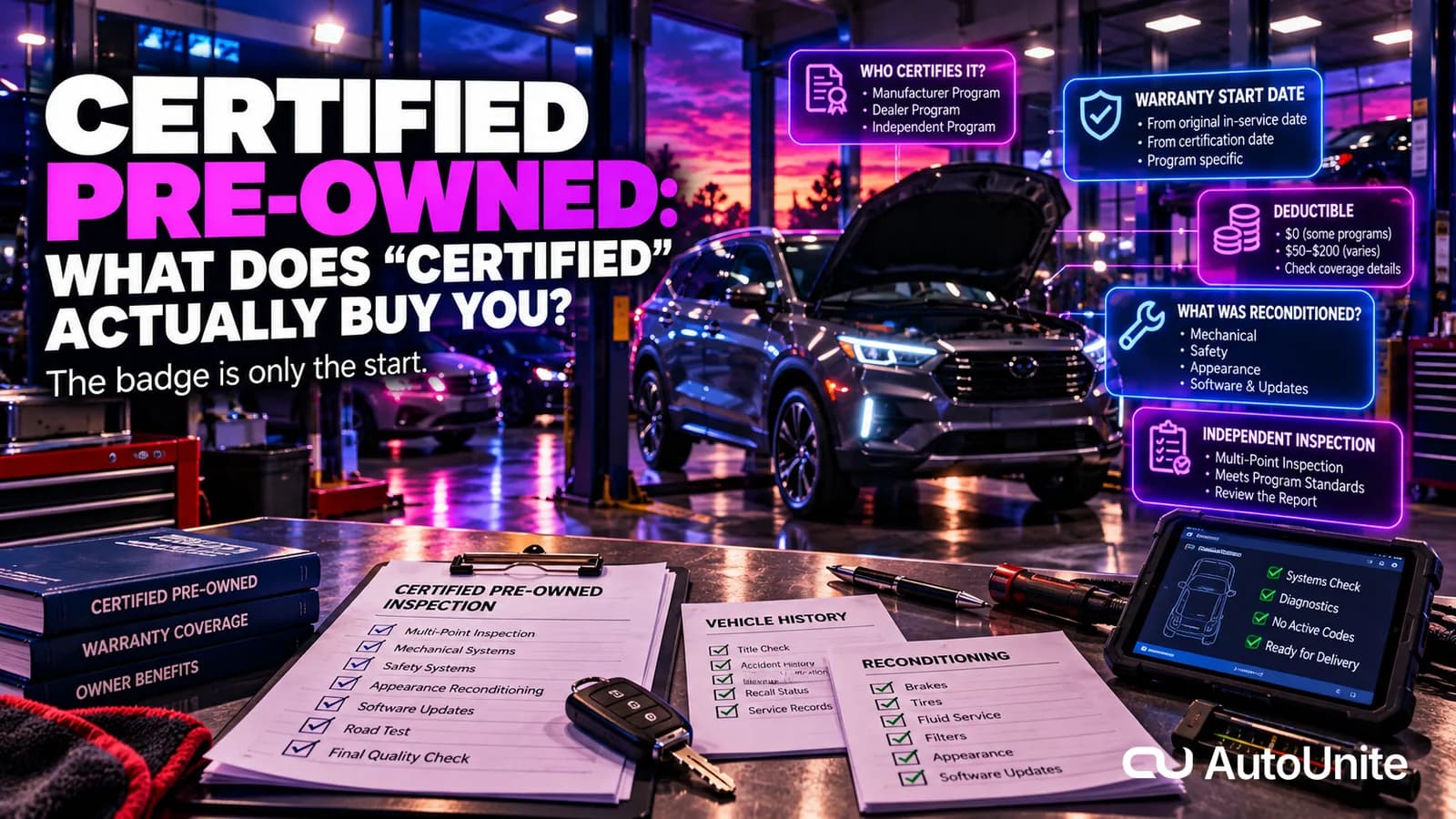
AutoUnite's way to do that is the CPO Proof Stack: six layers of evidence that turn the word certified into something you can actually compare.
Before comparing a CPO vehicle with an ordinary used vehicle, collect six things.
Then there is a seventh question, which is really a price question:
What premium are you paying for that stack?
That is the part shoppers can evaluate instead of asking the almost impossible question, "Is CPO worth it?"
AutoUnite content is educational and research-focused. Vehicle information, pricing, ownership costs, maintenance, recalls, and other details may vary by region, dealer, and time.
Ford is a useful example because its current Blue Advantage program has three certification tiers with materially different rules.
As of September 25, 2026, Ford lists:
| Ford Blue Advantage tier | Eligibility | Inspection | Core warranty structure |
|---|---|---|---|
| Gold Certified | Up to 6 years old; under 80,000 miles | 172-point | 12-month/12,000-mile comprehensive plus 7-year/100,000-mile powertrain |
| EV Certified | Fully electric Ford; up to 6 years old; under 80,000 miles | 127-point | 12-month/12,000-mile comprehensive plus 8-year/100,000-mile BaseCARE EV |
| Blue Certified | Up to 10 years old; under 150,000 miles | 139-point | 90-day/4,000-mile comprehensive |
Ford also lists a 14-day/1,000-mile money-back guarantee at participating dealers, roadside assistance, vehicle-history reporting and program-specific reconditioning. The point is not that one Ford tier is universally better. It is that all three use the word certified while delivering different eligibility and protection. Ford Blue Advantage program overview Ford warranty details Ford money-back terms
Honda makes the same point in a different way. Honda currently separates HondaTrue Certified, HondaTrue Certified EV and HondaTrue Used. Its program page lists different model-year/mileage eligibility and different warranty structures by tier. HondaTrue Used, for example, carries six-month/10,000-mile powertrain and non-powertrain coverage, while HondaTrue Certified uses longer coverage. Honda also currently advertises a $0 deductible for covered HondaTrue repairs and a three-day exchange policy under program terms. HondaTrue benefits
Toyota currently separates Gold and Silver certification. Its program page shows different age/mileage gates and warranty levels, while its warranty supplement spells out when Gold and Silver coverage expires. Toyota Certified program overview Toyota warranty supplement
If three major manufacturers can structure CPO differently, the badge itself cannot be the comparison.
The program has to be.
This is where CPO advertising can become confusing even when every number is technically accurate.
A shopper sees:
7 years / 100,000 miles
and naturally reads it as seven years of protection from today.
That may be wrong.
Ford's Gold powertrain limited warranty is measured from the original Ford new-vehicle limited-warranty start date. HondaTrue Certified powertrain coverage is measured from the original in-service date. Toyota's current Gold CPO warranty supplement, by contrast, states that its Gold powertrain warranty expires seven years from the certified purchase date or at 100,000 total vehicle miles, whichever comes first. The clock is not universal. Ford Gold warranty HondaTrue warranty booklet Toyota warranty supplement
The same problem appears inside comprehensive or non-powertrain coverage.
Honda's current warranty booklet says that if the original new-vehicle warranty is still active when a HondaTrue Certified vehicle is purchased, the CPO non-powertrain coverage runs for two years after the new-vehicle warranty expires, subject to the mileage limit. If the original warranty has already expired, the CPO clock begins at the certified purchase. Ford's Gold comprehensive coverage similarly uses program-specific timing tied to factory-warranty expiration or certified purchase. HondaTrue warranty booklet Ford Gold warranty
So when someone says, "It has a seven-year warranty," the useful follow-up is:
Seven years from what date, covering what systems, with how many miles already used?
That is a much better question.
A 172-point inspection sounds stronger than a 139-point inspection because 172 is a larger number.
That is not how to read it.
Ford's EV Certified inspection contains 127 points because an EV has a different set of systems than a gasoline vehicle. That does not make 127 a lower quality score. It makes the checklist different. Ford's own program separates EV, Gold and Blue inspections for that reason. Ford EV Certified inspection
Edmunds makes the broader caution clear in its May 2026 CPO review: a multipoint inspection does not mean that number of parts were replaced, and the inspection is not necessarily a teardown capable of finding every hidden problem. Edmunds - Are Certified Pre-Owned Cars Worth It?
The useful questions are more concrete:
A checklist proves a process was followed. It does not mean every consumable part is new.
Inspection finds. Reconditioning fixes.
That distinction matters because a shopper is not buying a checklist. The shopper is buying the vehicle that came out the other side of it.
Ford says its certified vehicles are reconditioned with manufacturer-authorized parts when items do not meet program standards. Toyota says dealer-trained technicians complete necessary repairs and reconditioning after inspection. Honda provides downloadable inspection reporting for HondaTrue vehicles. Ford Blue Advantage FAQ Toyota inspection and history HondaTrue benefits
That creates a better question than "Did it pass?"
Ask:
What did this VIN need before it could pass?
If four tires were replaced, the brakes were serviced and a leaking component was repaired, that is useful information. If the vehicle passed with tires and brakes that were still within standard but already partly worn, that is also useful information.
The strongest evidence is VIN-specific: inspection sheet, reconditioning record, service history and warranty registration.
A dealer can create a legitimate certification process. A third-party warranty can also provide real coverage. Neither becomes manufacturer-backed simply because the vehicle is described as certified.
If the program is not the manufacturer's official CPO program, ask who is actually obligated to perform or pay for covered repairs.
There is nothing inherently wrong with a dealer-backed program. It simply needs to be evaluated as the program it actually is.
The Federal Trade Commission's Buyers Guide is useful here because it tells the buyer whether a used vehicle is being sold with a warranty or "as is," what share of covered repair costs the dealer will pay, and reminds buyers to get promises in writing. FTC - Buying a Used Car From a Dealer
This is one of the strongest pieces of federal consumer guidance in the entire CPO discussion.
The FTC specifically says a vehicle-history report is not a substitute for an independent mechanical inspection, and that an independent inspection is a good idea even if the vehicle has been certified and inspected by the dealer and is being sold with a warranty or service contract. FTC - Buying a Used Car From a Dealer
That is not an accusation against the dealer or the CPO program.
The jobs are different.
The certification inspection asks whether the vehicle meets the program standard. A pre-purchase inspection asks what you should know before owning this exact vehicle.
A buyer's mechanic can focus on remaining tire life, brake life, fluid condition, evidence of prior repair, leaks, road-test behavior, near-term maintenance and model-specific concerns. It is another evidence layer.
Certification is also not a substitute for checking open safety recalls by VIN.
NHTSA's recall lookup can show unrepaired safety recalls associated with a specific VIN for participating manufacturers. The agency also notes limits to what the lookup may show, including recently announced recalls whose VIN populations are still being identified. NHTSA recall lookup
For a CPO purchase, the practical move is simple: run the VIN before delivery and save the result with the rest of the purchase records.
Electrified vehicles add questions that a conventional CPO checklist may not emphasize in the same way.
Ford's EV Certified tier uses a dedicated 127-point inspection and pairs it with its EV-specific warranty structure. Honda separates HondaTrue Certified EV and publishes EV-specific inspection and warranty benefits. Ford EV Certified inspection HondaTrue benefits
For an EV or plug-in hybrid, ask about:
Do not assume that a larger inspection-point count on a gasoline car tells you more about an EV. The important question is whether the inspection covers the systems that matter on that vehicle.
A good salesperson should be able to explain the program without hiding behind the badge.
That means showing the tier, inspection, warranty, deductible, warranty clock, reconditioning evidence and benefits in plain language. If the shopper is comparing a non-CPO vehicle, the salesperson should be able to explain what the premium actually buys rather than simply saying the certified car is "better."
That level of specificity is good for the buyer and good for the dealership. It replaces a trust shortcut with evidence.
Certified pre-owned can add meaningful value. It can filter out vehicles that do not meet program eligibility, require a defined inspection, trigger reconditioning, transfer some repair risk through a warranty, and add benefits such as roadside assistance or exchange policies.
None of that makes the badge a universal condition grade.
The right comparison is not CPO versus used in the abstract. It is:
this exact certification package on this exact VIN, at this exact premium, versus the best non-CPO alternative you can actually buy.
Once you know who certifies the vehicle, what the inspection found, what was repaired, when the warranty clocks start, what they cover and what the premium costs after financing, the badge becomes useful.
Until then, it is only a word on the window.
What Matters: Identify the certifier and exact tier, then read the VIN-specific inspection/reconditioning evidence and the written warranty before treating "certified" as added value.
Watch This: Inspection-point counts are not quality scores, and a big warranty number is incomplete without its start date, mileage limit, coverage scope, deductible and repair network.
Your Next Move: Put the CPO vehicle and its closest non-CPO alternative into the AutoUnite CPO Proof Stack. Compare out-the-door price, financing, warranty, reconditioning and independent inspection results before deciding whether the premium earns its keep.