
The Light Went Out. Did the Problem Fix Itself?
- PublishedSep 28, 2026
- Last verifiedSep 28, 2026
- Sources7
- 12 min read

Explore clearer car-buying guidance, market context, and ownership knowledge in one place.
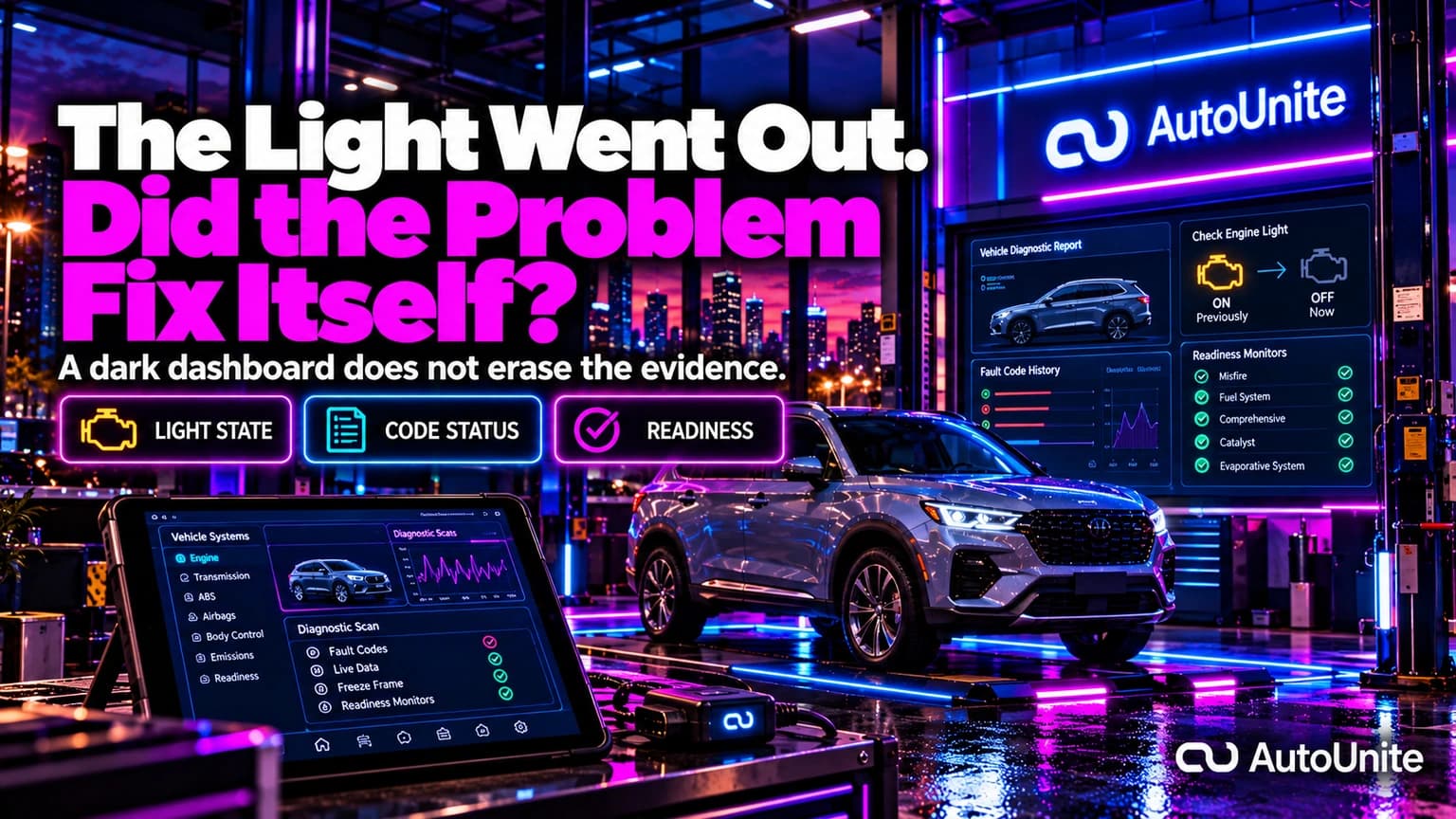
A check engine light can turn off while OBD evidence still matters. Preserve code state, freeze-frame, readiness and repair verification before assuming the problem fixed itself.
Decide First
A dark dashboard can feel like good news. It is not the same thing as proof that the fault is gone. The check engine light comes on Tuesday morning. The vehicle still starts. It still drives. Nothing sounds dramatic. You make a service appointment for Friday because the light is steady, not flashing, and you would rather understand the problem than guess. Thursday night, the light turns off. Now the decision changes in your head. Do you still need the appointment? Did the car fix itself? Was it just a loose fuel cap, bad gasoline, weather, a sensor hiccup, or some harmless electronic glitch that disappeared on its own? This is where a small light can create a big misunderstanding. A check engine light is not the problem itself. It is one visible output of an on-board diagnostic system that watches many engine and emissions-related conditions. The lamp can change state while other evidence remains in memory. The light is a warning state, not a repair receipt.
For 1996 and newer light-duty vehicles, OBD II became the common diagnostic framework that monitors engine and emissions-related systems. When the system detects a qualifying malfunction, it can store diagnostic information and command the malfunction indicator lamp, or MIL, on. The consumer usually sees that MIL as the familiar check engine or service engine soon icon.
EPA consumer guidance makes an important point that is easy to miss: the light may turn off if the problem does not reoccur for a few trips. That means the dashboard can return to normal even though the vehicle has recently detected something worth recording.
That is not a contradiction. The system is doing exactly what it was designed to do. It is evaluating conditions over time.
The question is not simply, "Is the light on right now?"
The better question is, "What did the vehicle detect, what evidence did it preserve, and has the system had enough successful operation to prove the condition is no longer present?"
A driver sees one lamp. A technician can see a much richer record.
Depending on the vehicle, module, scan tool, and fault, the diagnostic picture may include:
AutoUnite content is educational and research-focused. Vehicle information, pricing, ownership costs, maintenance, recalls, and other details may vary by region, dealer, and time.
That distinction matters because two vehicles with dark dashboards can be in very different states.
One may have completed its self-tests and gone many trips without detecting the fault again.
Another may have had its battery disconnected yesterday, its codes cleared, and several monitors still incomplete.
A third may no longer command the light on but still retain a permanent DTC until the vehicle's OBD system verifies that the relevant monitor can run successfully.
From the driver's seat, all three can look normal.
From the diagnostic record, they are not the same.
The language around trouble codes can make a scan report look more definitive than it is.
A confirmed code generally represents a malfunction that met the system's criteria for storage. A pending code can represent a fault detected under an initial or limited set of conditions that may require another qualifying event or drive cycle before it becomes confirmed. A permanent DTC, where supported, is specifically designed to resist simple erasure.
California's Bureau of Automotive Repair explains this clearly in its current OBD test reference: permanent DTCs cannot be erased by clearing codes with a scan tool or by disconnecting the battery. The OBD II system clears them only after it verifies that the previously identified defect is no longer present.
That does not mean every permanent code proves the vehicle is still broken today. It means the system is preserving an evidence trail until its own verification logic is satisfied.
This is one reason "I cleared the code and the light stayed off" is weaker evidence than it sounds.
Clearing memory is not the same as repairing a cause.
When a fault occurs, the diagnostic system may preserve operating conditions associated with the event. The exact data varies, but the snapshot can include values such as engine speed, coolant temperature, load, vehicle speed, fuel-system status, and other parameters relevant to diagnosis.
Think of it as the difference between arriving at a scene after everything looks normal and having a photograph from the moment the abnormal condition was detected.
That snapshot can help answer questions a dashboard cannot:
Was the engine cold or fully warmed up?
Was the vehicle idling, accelerating, cruising, or under load?
Did the condition happen once under a narrow set of circumstances or repeatedly across normal operation?
Did several codes appear together in a way that suggests one root cause instead of several unrelated failures?
This is why indiscriminately clearing codes before diagnosis can destroy useful context. It may remove the very information a technician needs to reproduce or understand an intermittent problem.
After certain repairs, code clearing, or a battery disconnect, the OBD system may need to rerun emissions-related self-tests called readiness monitors.
BAR describes readiness monitors as indicators of whether those diagnostic self-tests have completed. Some run quickly. Others need specific combinations of temperature, speed, fuel level, load, time, or driving behavior.
A vehicle that says "not ready" is not automatically defective. It may simply not have completed enough qualifying operation since memory was cleared or power was interrupted.
But "not ready" also means the vehicle has not yet completed the self-test that could help prove a repair or verify an emissions system.
That distinction becomes practical when an owner is close to an emissions inspection. Virginia, California, Maryland and other programs have their own rules for how readiness and DTCs affect an inspection. The exact thresholds are jurisdiction-specific, which is why the right advice is not to memorize one universal number. It is to check the rules that apply to the vehicle where it is registered.
In Northern Virginia, DEQ uses OBD data as part of the emissions program. Its current consumer guidance notes that OBD diagnostic trouble codes can cause an emissions failure and that those codes must be resolved for the vehicle to pass. A vehicle can also be rejected from testing when required readiness conditions have not been met.
The dashboard alone cannot tell you that whole story.
Some faults are intermittent by nature.
A vapor-system leak can depend on fuel level, temperature and sealing conditions. A sensor signal may leave its expected range only under a certain load. An electrical connection can behave differently with heat, vibration or moisture. A misfire may show up during cold start and vanish when the engine is warm. A fuel cap may be reseated and the system may later run enough checks to stop commanding the lamp.
EPA's check-engine guidance explains that if the condition that caused the light does not reoccur for a few trips, the lamp may turn off.
That is useful information. It suggests the OBD system has not continued to see the fault at the threshold required to keep the lamp on.
What it does not tell you, by itself, is why the fault occurred, whether it is likely to return, whether related diagnostic evidence remains, or whether the relevant monitors have completed.
An intermittent problem can be real even when it is not active during the ten minutes the vehicle is sitting in a service lane.
A steady check engine light usually calls for timely diagnosis.
A flashing light deserves more urgency. EPA guidance warns that a blinking or flashing MIL can indicate a severe condition such as a misfire that can damage the catalytic converter. Its consumer advice is to reduce speed and load and seek service promptly rather than continuing to drive normally.
The exact vehicle's owner's manual is the first authority for warning-light instructions. Some vehicles display additional messages or have manufacturer-specific escalation rules.
The practical point is simple: do not apply "the light went out" logic to an active flashing-light event. If the vehicle was recently flashing, running poorly, overheating, losing oil pressure, or showing another serious warning, the safe decision path is more conservative.
There is another common mistake on the opposite end of the spectrum.
A scan tool returns a code. Someone reads the code description. A part name appears in the description. The part gets replaced.
That can become a very expensive guessing game.
Diagnostic trouble codes identify conditions the system detected. They do not automatically identify the failed component that should be replaced.
A lean-condition code, for example, can have multiple possible causes. A catalyst-efficiency code can require a broader diagnosis than simply ordering a converter. A sensor-related code can reflect the sensor, its wiring, a connector, a reference voltage, a mechanical problem, contamination, or another condition that caused the sensor reading to leave the expected range.
The professional diagnostic sequence is evidence first, root cause second, repair third, verification last.
That is different from "code equals part."
If you are bringing in a vehicle after the light turned off, the service conversation can be much more productive if the evidence is preserved.
Start with the timeline.
When did the light first appear? Was it steady or flashing? What was the vehicle doing? Was there a change in starting, idle, acceleration, fuel economy, smell, noise, temperature, or drivability? Did anyone disconnect the battery or clear the codes? Was fuel added shortly before the event? Did the light go out on its own, and after roughly how many trips?
Then capture the scan state before anyone resets anything unnecessarily.
Ask for the code numbers, not just a verbal description. If useful for the diagnosis, capture code status, freeze-frame information, readiness status and relevant live data. The exact amount of data available will vary by vehicle and fault.
Finally, document what happened after the repair or diagnostic decision. What was tested? What failed the test? What was repaired? Were the codes cleared as part of the procedure? Which monitors have completed? Has the original symptom returned? Was a road test or manufacturer-specific verification performed?
This turns a vague "light came on once" story into a trackable evidence file.
For Newsletter 42, the decision object is deliberately not a list of possible check-engine codes. A giant code dictionary would encourage exactly the behavior we want to avoid: jumping from a code to a conclusion.
The evidence file instead organizes the decision around seven pieces of proof:
1. Exact vehicle VIN, year, make, model, engine or powertrain, mileage and recent service history.
2. Warning-light state When the light appeared, whether it was steady or flashing, when it turned off, and any related messages or symptoms.
3. Code state The actual DTC numbers and whether each is confirmed, pending, permanent, history or manufacturer-specific as reported by the tool and vehicle.
4. Freeze-frame and event context The operating conditions captured around the fault, when available.
5. Readiness state Which supported monitors are complete and which remain incomplete after a reset, repair or power interruption.
6. Diagnostic and repair proof Tests performed, root cause identified, repair made, parts or wiring addressed, technical information used and technician notes.
7. Verification Post-repair scan, road test, monitor completion where applicable, emissions-inspection result if relevant, and whether the original symptom returned.
The spreadsheet does not diagnose a vehicle. It does something more useful for a shopper, owner or service customer: it prevents evidence from disappearing between the warning light, the scan, the repair order and the final decision.
The same logic becomes even more important during a used-car purchase.
A dark check-engine light during a test drive is not proof that the vehicle has no recent diagnostic history.
That does not mean every used vehicle needs a forensic investigation or that a stored historical code makes the vehicle a bad buy. It means a pre-purchase inspection should be allowed to look at the whole vehicle, not just the absence of dashboard warnings.
A buyer can ask whether monitors are ready, whether codes were recently cleared, whether there are active or permanent DTCs, whether the vehicle has completed enough normal driving after recent work, and whether the repair history explains what the scan tool sees.
The goal is not to reject a vehicle because a computer remembers something.
The goal is to understand whether the evidence is consistent with a properly repaired, fully verified vehicle.
A dealership does not benefit from treating every check-engine light like a guaranteed expensive repair. It also does not benefit from treating a dark dashboard as automatic closure.
Used-car managers need recon decisions based on actual condition. Service advisors need to explain why diagnosis is different from code reading. Technicians need the original evidence before it is erased. Sales teams need a clean handoff when a shopper asks what was repaired. Compliance teams need documentation that matches the actual vehicle and actual work.
That handoff matters because the customer experiences one dealership, not five departments.
When the evidence stays connected, the explanation can be simple:
Here is what the vehicle detected. Here is what we tested. Here is what we found. Here is what we repaired. Here is how we verified it.
That is stronger than "the light is off now."
Consumer scan tools have made automotive information much more accessible. That is a good thing.
A basic reader can help an owner capture a code before a service visit. More capable tools can show readiness, live data, freeze-frame information and manufacturer-specific functions. Repair information is more available than it used to be.
But access to data does not eliminate the need to interpret it in the context of the exact vehicle.
The same code can have different diagnostic paths across engines and manufacturers. A monitor may require particular enabling conditions. A technical service bulletin may change the diagnostic sequence. Software calibration, wiring routing, component design and known failure patterns can matter.
A scan result is evidence. Diagnosis is the process of proving what the evidence means.
A repair should not be judged only by whether the lamp is dark at the moment the vehicle leaves the bay.
A stronger definition of fixed is:
Sometimes verification takes time because an intermittent condition needs a real drive cycle before the system can evaluate it again. Sometimes the first diagnostic conclusion changes after more evidence appears. That is not automatically bad work. Intermittent faults can be difficult.
What matters is that the decision trail stays honest.
A check engine light is designed to get your attention, not to tell you the complete cause.
When it turns off, that change is worth noting. It may mean the condition has not reappeared at the threshold required to keep the lamp on. It may follow a real repair. It may follow a reset. It may happen while diagnostic history, permanent codes or incomplete readiness monitors still matter.
So if the light comes on Tuesday and disappears Thursday, do not panic. Do not automatically cancel the appointment either.
Preserve the evidence.
Read the exact vehicle.
Separate the lamp state from the code state.
Separate code state from diagnosis.
Separate diagnosis from repair.
And separate repair from verification.
Because the most useful question is not whether the light is off.
It is whether the vehicle can prove why.