Car Buying, Vehicle Research & Ownership Guides
Explore clearer car-buying guidance, market context, and ownership knowledge in one place.

Explore clearer car-buying guidance, market context, and ownership knowledge in one place.
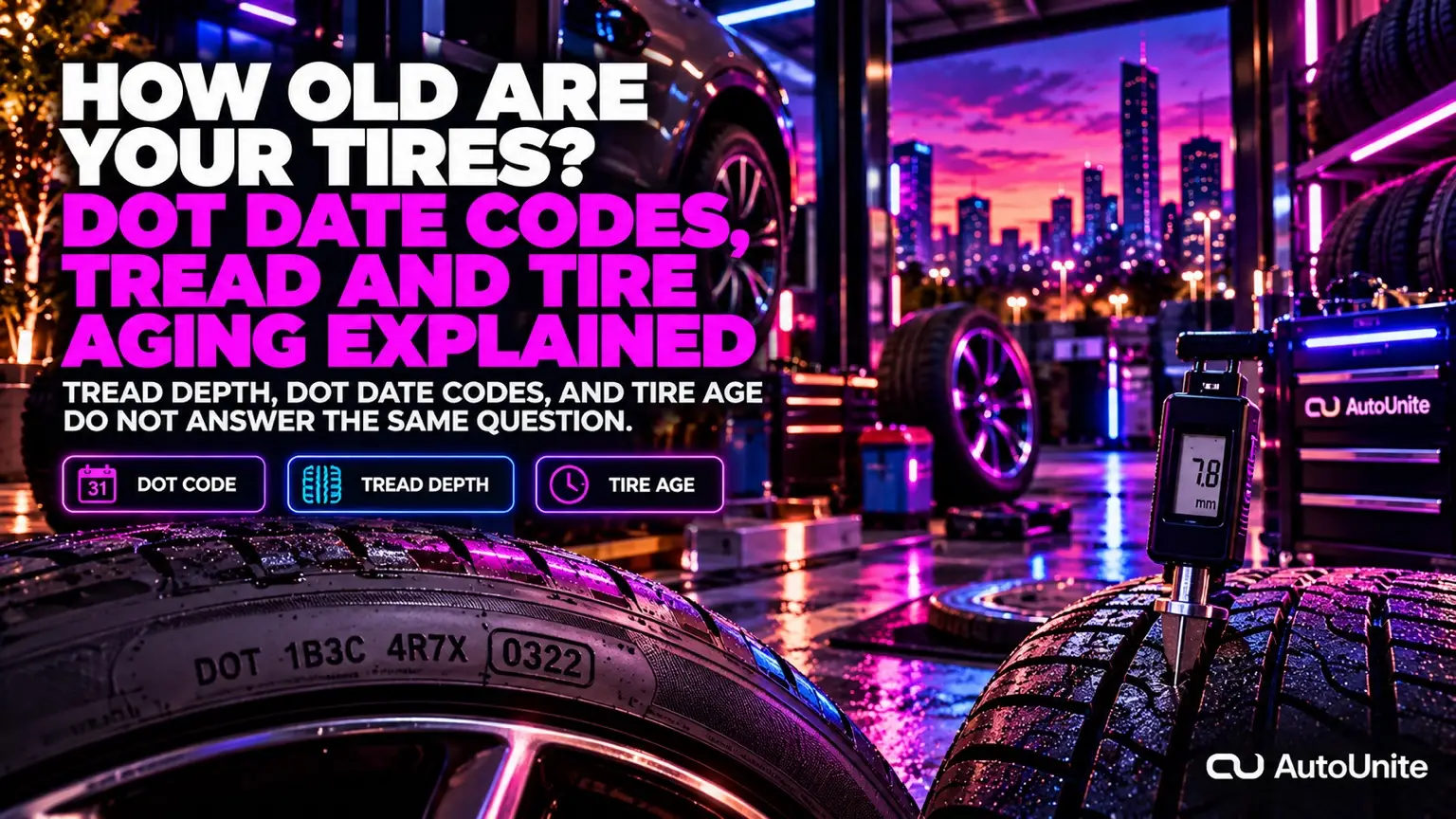
Tread depth measures wear. Tire age measures time. A tire can look lightly used and still deserve a closer inspection because rubber, belts and other materials change while the vehicle sits.
The easiest tire problem to understand is wear.
The grooves get shallower. The wear bars get closer to the road. Eventually there is not enough tread left to move water, snow or slush the way the tire was designed to.
Age is different because the tire can spend years looking almost unchanged.
That is common on low-mileage vehicles, weekend cars, motorhomes, trailers and spare tires. The tread can still look deep because the tire has not traveled many miles. The calendar keeps moving anyway.
NHTSA's current TireWise guidance says tire aging deserves separate attention from treadwear. The agency notes that some vehicle and tire manufacturers recommend replacement at six to 10 years regardless of remaining tread, and it tells owners to use the DOT Tire Identification Number to determine manufacturing week and year.
The important word is some. There is not one federal calendar date that magically makes every passenger tire unsafe. Tire makers and vehicle manufacturers publish their own service-life guidance, and the tire's actual condition and history still matter.
A tire can have plenty of tread and still deserve age-related inspection or replacement consideration.
Tread depth answers how much of the wearable surface remains. Tire age answers how long the structure has been exposed to time, storage and service conditions. NHTSA says older tires are more prone to failure and notes that some manufacturers recommend replacement at six to 10 years regardless of treadwear. Tire makers do not all use the same outer limit.
That is why the useful decision is vehicle- and tire-specific: read the manufacturing date, measure tread, inspect condition, understand how the tire has been used, and compare the result with the current guidance from the tire maker and vehicle manufacturer.
Tread depth tells you how much rubber is left. The tire's age, condition, pressure history, damage and use tell you whether the rest of the tire still deserves your trust.
Tread depth is mostly a wear measurement.
Age is a material-life question.
A tire is not one solid ring of rubber. It is a structure made from multiple rubber compounds, reinforcing cords, belts, bead materials and bonded layers. Heat, oxygen, ozone, ultraviolet exposure, flexing, inflation pressure, vehicle load, storage and road use all influence how those materials change over time.
An older tire is not automatically about to fail, but deep tread is not proof that the rest of the tire has stopped aging.
Michelin's current U.S. guidance says there is no single rule that predicts tire life because design, driving, climate, road conditions and maintenance all matter. Michelin recommends at least annual professional inspection after five years of service and replacement by 10 years from the manufacturing date as a precaution, even if tread remains.
Bridgestone publishes similar guidance for passenger and light-truck tires: regular inspection after five years of service and replacement of tires more than 10 years old regardless of tread depth. Goodyear's current guidance is more conservative, recommending that tires in service for six years or more be replaced even when they still appear serviceable.
Those differences are exactly why the owner's manual and the tire maker's guidance matter. There is no responsible way to reduce the entire subject to one viral number.
You do not have to guess how old the tire is.
Passenger tires sold in the United States carry a DOT Tire Identification Number, commonly shortened to TIN. For tires produced since 2000, the final four digits identify the week and year of manufacture.
A code ending in 2524 means the tire was manufactured in the 25th week of 2024. A code ending in 0319 means the third week of 2019.
NHTSA recommends checking the manufacturing date when buying tires, not only after they have been on a vehicle for years.
The complete TIN may appear on only one sidewall. If the four-digit date is not visible on the outside face, a tire professional may need to inspect the inward-facing side safely.
Do not confuse that four-digit date with the date the tire was sold or installed. A tire can spend time in distribution and storage before it ever touches your wheel. The manufacturing date is the common reference point because it is permanently molded into the tire.
The oldest tire on the vehicle may be the one that has never rolled a mile.
Spare tires are easy to forget because they are hidden under a cargo floor, mounted under a truck, attached to a tailgate or stored in a compartment. They can retain full-looking tread for a decade simply because they were never used.
NHTSA calls out spare-tire aging directly. Michelin and Bridgestone also include spare tires in their age guidance.
That can create an ownership trap. A flat tire happens on a road trip, the driver installs a spare that looks untouched, and the spare is actually older than the tires that just came off the car.
A full-size spare should be checked for age, pressure, cracking, damage and compatibility just like the four tires on the ground. A temporary spare also needs the correct inflation pressure and should be treated as emergency equipment with the speed and distance limits printed for that application.
Modern TPMS is useful, but it answers a narrow question.
TPMS can warn when tire pressure is significantly low. It does not inspect rubber condition, measure tread depth, read the DOT date, detect every internal injury or determine whether an older spare has spent years aging in storage.
Proper inflation is only one part of tire health. Underinflation can create excess flexing and heat. Overloading can add more stress. Impact damage can injure internal structure even when the outside looks acceptable. Aging is another variable layered on top of those conditions.
The dashboard light is not an all-clear certificate for the tire.
Age can show itself as weather checking, sidewall cracking, hardening, vibration or other changes. Those are reasons to have the tire evaluated.
Visual appearance has limits. Michelin notes that age-related changes and impact damage are not always obvious from the outside, which is why an older tire can deserve professional inspection even when it looks acceptable.
Older tires can therefore deserve professional inspection even when the owner sees no obvious crack.
The technician is not just looking for tread. The inspection considers sidewalls, shoulders, beads, punctures, repairs, irregular wear, bulges, vibration complaints and the vehicle's use pattern.
That conversation is more useful than asking, "Does it still pass the penny test?"
Tread depth still matters, and it matters a lot.
NHTSA says tires should be replaced when tread is worn to 2/32 inch, but wet-road performance can deteriorate before that minimum is reached.
AAA's 2018 wet-weather testing is a useful treadwear example. In its test, vehicles on all-season tires worn to 4/32 inch needed about 87 additional feet on average to stop from highway speed on wet pavement compared with the same vehicles on new tires. AAA therefore urged drivers to consider earlier replacement for wet-weather performance rather than waiting for the legal minimum.
The AAA study is about treadwear, not tire age. It belongs here because it proves the larger point: a tire can become a worse safety tool for more than one reason.
A five-year-old tire can have deep tread. A two-year-old tire can be worn out. A new-looking spare can be older than the car's current brake pads. The decision has to look at the whole tire.
A lightly driven vehicle can create its own tire story.
Long periods of sitting can keep one area loaded. Outdoor storage can expose the tire to heat, ozone and sunlight. A performance car may live in a garage but see high speeds and large heat cycles on the few days it is driven. A truck may cover few miles but carry heavy loads or tow when it does move.
Mileage is therefore a weak substitute for tire history.
If you are evaluating a low-mileage collector car or an older vehicle that has barely been driven, the low odometer is not a reason to stop checking the tires. It is a reason to check the date codes more carefully.
Tire dates can tell you more than age.
Four matching tires with similar date codes often suggest they were installed as a set. Two newer tires and two older tires can reveal a partial replacement. One much newer tire may point to a puncture, sidewall injury or road-hazard replacement. None of those patterns is automatically bad, but they create useful questions.
Check size, load and speed ratings as well. Make sure the tires are appropriate for the vehicle and that the axle pairs and all-wheel-drive requirements match the vehicle maker's instructions.
Then look at the spare.
A set of fresh tires does not erase the age of the spare, and a shiny sidewall dressing does not reset the manufacturing date.
A tire does not become unsafe simply because it was manufactured months before you bought it.
NHTSA recommends checking the manufacturing date when purchasing tires because age is relevant context. Tire manufacturers also recognize that storage conditions and service history affect aging.
The useful question is not whether the tire came out of the mold yesterday. It is whether the tire's age fits the manufacturer and vehicle guidance, whether it was stored correctly, whether the retailer is selling it as new with an appropriate warranty, and how much of the expected service-life window you are receiving.
If a tire is already several years old before installation, that deserves a discussion before you pay full new-tire money. The answer should come from the tire maker's current policy and the retailer's documentation, not from a universal internet rule.
Tire aging does not happen at the same rate in every environment.
NHTSA identifies sunlight, warmer climate, poor storage and poor maintenance as contributors to tire aging. Repeated high-speed use, improper inflation and heavy loading can add other stresses that matter to serviceability.
Mileage and calendar age cannot be the only variables.
The more severe the operating environment, the more valuable routine pressure checks, visual inspections and professional evaluation become.
A good tire inspection is more systematic than glancing at the outside shoulder while the vehicle is on the ground.
A technician can measure tread depth at several points across the tire, not just the most visible groove. That matters because alignment, inflation and suspension conditions can wear the inner shoulder faster than the outer one. A tire that looks healthy from the curb can be close to worn out on the inside edge.
The inspection also looks for repairs, puncture location, bulges, cuts, bead damage, sidewall injuries and irregular wear. Pressure is compared with the vehicle placard, not the maximum pressure molded on the tire. The date codes are checked. If one tire is much older than the others, that becomes part of the service recommendation.
On an all-wheel-drive vehicle, a single damaged tire can create another question: whether the remaining tires are close enough in circumference or tread depth for the vehicle maker's drivetrain requirements. Some manufacturers publish limits on tire-size or circumference differences because the system expects the four tires to rotate within a designed relationship. The answer is vehicle-specific, which is why a universal rule that you must always replace one, two or four tires is not reliable.
A professional inspection adds that broader view. The technician is combining age, tread, wear pattern, damage, inflation and vehicle requirements into one decision instead of reading a single number.
A used tire can look like a bargain because tread depth is easy to photograph. What is harder to photograph is how the tire lived before you saw it.
You may not know whether it spent months underinflated, carried too much load, hit a pothole hard enough to damage internal structure, was repaired improperly, sat outdoors in severe heat or was driven while nearly flat. A date code tells you when it was made, not how it was treated.
Goodyear's current Cooper guidance tells consumers not to buy used tires because prior service, maintenance and storage history are largely unknown. That is one manufacturer's policy, not a federal ban on every used-tire sale, but the reasoning is useful: history is part of tire condition.
If you are considering a used tire anyway, age and tread are only the first two questions. Fitment, load rating, speed rating, prior repairs, bead condition and professional inspection matter too. A tire that costs less up front is not useful if the uncertainty is high enough that you replace it again soon after.
That same logic applies when buying an older used vehicle. A seller can install inexpensive used tires to improve appearance before sale. Deep tread does not automatically mean the tires are new, matched or known-history.
Seasonal tires create another version of the same problem. A winter set may spend half the year stacked in a garage, while summer tires sit through the cold months. Storage reduces mileage, but it does not stop the calendar. Heat, sunlight, ozone and storage conditions still matter.
When seasonal tires go back on the vehicle, check more than tread. Confirm the date codes, pressure, sidewall condition and any signs of damage from storage. If the set is approaching the tire maker's inspection or replacement guidance, the fact that it only covered a few thousand miles last winter does not erase its age.
A small amount of documentation makes tire ownership easier.
Keep the purchase receipt, installation date, mileage at installation, exact tire model and the DOT manufacturing date. Record rotation and alignment work if the vehicle is sensitive to uneven wear. If a tire is repaired, keep the repair record.
That history helps the next technician distinguish age from mileage, know how long the tire has been in service and understand whether a vibration or wear pattern is new.
It also makes warranty questions much easier than relying on memory five years later.
Tire age becomes easier to evaluate when the evidence lives in one place. The AutoUnite Tire Life Proof File is a consumer evidence organizer for the tire set, not an AutoUnite safety certification.
It captures five evidence lanes:
The file uses VERIFIED, SOURCE NEEDED, CONFLICT, UNRESOLVED and NOT APPLICABLE. Unknown never becomes "safe" or "unsafe" just because the evidence is missing.
The final status is deliberately administrative: REVIEW FILE COMPLETE, OPEN EVIDENCE, or PROFESSIONAL INSPECTION ADVISED. Those labels organize the evidence. They do not certify the tire as safe for continued service.
A low-mileage SUV has four tires with deep tread. The owner assumes they are nearly new because the odometer is low. The Tire Life Proof File tells a more complete story.
The example does not prove the tires need replacement. It shows why "deep tread" is only one piece of the decision and why missing history deserves to stay visible instead of being converted into a guess.
Tread is not the tire.
It is one part of the tire.
When you are deciding whether to keep an older set, check the date code, remaining tread, pressure history, visible condition, repairs, vibration, vehicle load, climate and the current recommendations from both the vehicle manufacturer and tire maker.
Do not replace a tire only because somebody online announced one universal birthday, and do not keep one only because the grooves still look deep.
The right question is whether this specific tire, with this age and this history, is still serviceable for the way the vehicle is being used.
And yes, check the spare.
AutoUnite content is educational and research-focused. Vehicle information, pricing, ownership costs, maintenance, recalls, and other details may vary by region, dealer, and time.
A practical guide to tire age, DOT date codes, tread depth, spare-tire aging, manufacturer service-life guidance and the evidence owners should review before trusting deep tread alone.
Decide First