
Your Car Was Totaled. Why Do You Still Owe Money?
- PublishedSep 27, 2026
- Last verifiedSep 27, 2026
- Sources8
- 13 min read

Explore clearer car-buying guidance, market context, and ownership knowledge in one place.
A total-loss evidence guide explaining why an insurance settlement and an auto-loan payoff can differ, how GAP may apply, and which credits must be verified before the remaining balance is treated as final.
The call sounds like an ending.
Your insurance company says the vehicle is a total loss. The tow yard is waiting. The car is not coming home. You assume the loan is about to disappear with it.
Then you open the lender app.
There is still a balance.
That can feel impossible: if the insurer has "paid for the car," why can the lender still say you owe money?
Because the insurance claim and the auto loan are two different contracts answering two different questions.
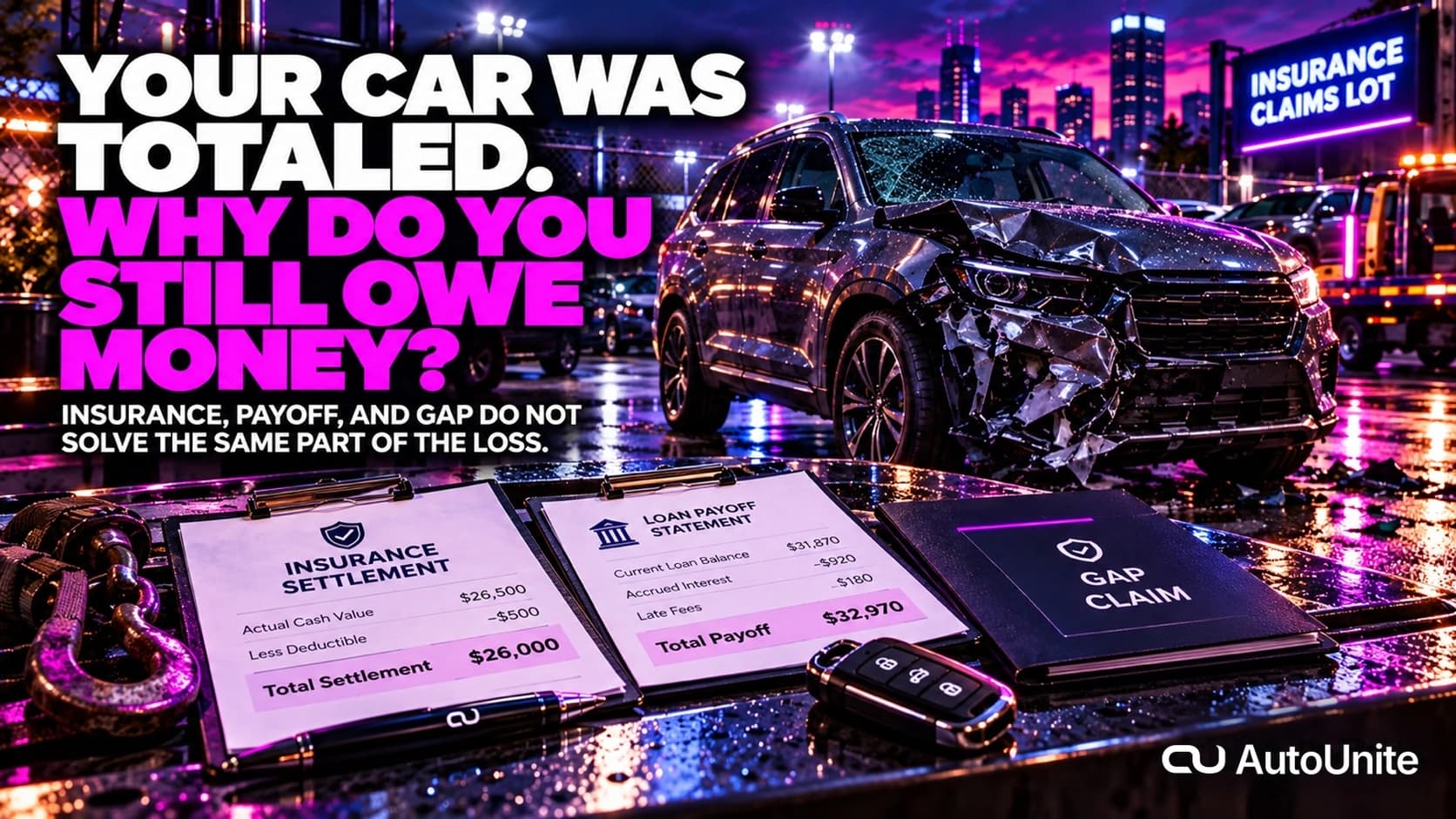
The insurance side asks what the covered vehicle loss is worth under the policy and applicable rules. The lending side asks what amount is still required to satisfy the loan. Those numbers can match. They can also be thousands of dollars apart.
A GAP product may reduce or eliminate some of that difference when its terms apply. Refunds from certain canceled add-on products may also change the loan balance. But none of those outcomes should be assumed before the documents are reconciled.
The clean way to handle a total loss is not to argue from the word "totaled." It is to put the settlement, payoff, GAP terms and credits in one file and make every number explain itself.
A total-loss decision is an insurance claim decision about the damaged vehicle. Your loan balance is a separate financial obligation.
The Consumer Financial Protection Bureau tells borrowers dealing with a totaled vehicle to compare the insurance payment with the amount owed on the auto loan because the borrower may still owe the difference. If the borrower bought a GAP product, the CFPB says to check whether it covers that difference. CFPB guidance (https://www.consumerfinance.gov/consumer-tools/disasters-and-emergencies/start-recovering-and-rebuilding-your-financial-life/) makes the separation clear.
That is the first mental reset.
"The car is totaled" does not mean "the loan is automatically paid in full."
It also does not mean you will definitely owe money. The outcome depends on the actual settlement, the actual payoff, any applicable GAP coverage or waiver, and any credits or refunds that belong in the reconciliation.
The answer lives in the numbers, not in the label.
A total-loss file gets easier to understand when you separate it into three ledgers.
Ledger 1: the insurance claim. What amount is payable for the covered vehicle loss, after the policy's deductible and any other policy-specific adjustments?
AutoUnite content is educational and research-focused. Vehicle information, pricing, ownership costs, maintenance, recalls, and other details may vary by region, dealer, and time.
Ledger 3: GAP and other credits. Is there a GAP policy or waiver? What are its limits, exclusions and claim requirements? Are there unearned amounts from cancelable add-on products that should be refunded or credited?
People often collapse all three into one question: "Did insurance pay off my car?"
That wording hides the mechanics.
The insurer is not calculating your loan. The lender is not valuing the physical loss. A GAP administrator, when one exists, is applying a third contract to the difference between those first two systems.
Physical-damage insurance is built around the covered vehicle loss, not around whatever balance happens to remain on your loan.
The CFPB's current GAP explainer says standard auto insurance pays up to the value of the vehicle, while GAP is intended to address the difference when the loan balance is higher than the insurance payment. CFPB GAP guidance (https://www.consumerfinance.gov/ask-cfpb/what-is-guaranteed-asset-protection-gap-insurance-en-797/) also warns that GAP products can have eligibility restrictions and that terms vary.
State insurance rules and policy language matter to the exact valuation process. As one concrete example, Virginia's State Corporation Commission explains that collision and comprehensive coverage generally pay the actual cash value of a vehicle if it is totally destroyed, subject to the policy, and that a deductible can reduce the amount paid. The same guide says Virginia does not prescribe one single method for determining a vehicle's value in a total-loss settlement. Virginia SCC consumer guide (https://www.scc.virginia.gov/consumers/insurance/property-casualty-consumer/virginia-auto-insurance-guide/)
That is a useful example of why "the insurer should pay what I owe" is the wrong starting assumption.
The insurer and lender are measuring different things.
There is no single reason a borrower can be upside down at the moment of a total loss.
The loan may have started with a small down payment. Taxes and fees may have been financed. Optional products may have been rolled into the amount financed. Negative equity from a prior vehicle may have been included. A long loan term can keep the balance higher for longer. The vehicle can also lose market value faster than the principal balance falls.
The CFPB notes that optional add-ons such as GAP, service contracts and other products can be financed as part of an auto loan, which increases the amount borrowed. CFPB payment guidance (https://www.consumerfinance.gov/ask-cfpb/what-is-included-in-the-monthly-auto-loan-payment-en-819/)
None of those facts automatically means the original deal was improper. They explain why "what the car is worth today" and "what the loan costs to satisfy today" can be different numbers.
This is also why a customer who was never visibly "upside down" during normal ownership can discover the gap only after a major loss forces both numbers onto the same page.
A payoff quote is time-sensitive.
Interest can continue to accrue according to the contract. Payments can come due. Insurance processing can take time. GAP processing can take additional time. A payment already in transit may post after the payoff quote was generated.
Do not use an old statement balance as if it were a current payoff.
Get the lender or servicer's current payoff quote and record the date through which it is valid. Then ask the servicer what it expects you to do with scheduled payments while the insurance and GAP processes are pending.
Do not simply stop paying because the vehicle no longer exists.
That caution is not the same as saying every servicer should collect every payment during a GAP claim. In its 2024 Auto Finance Supervisory Highlights, the CFPB reported exam findings in which some servicers continued collecting monthly payments even after they knew a GAP waiver would cover the outstanding balance, then mishandled refunds. CFPB Supervisory Highlights (https://files.consumerfinance.gov/f/documents/cfpb_supervisory-highlights-special-ed-auto-finance_2024-10.pdf) describes those specific supervisory findings.
The practical rule is narrower: do not guess. Ask the servicer what is currently due, get the answer in writing when possible, and keep a record of every payment made after the loss date.
A deductible is easy to overlook because it is an insurance-policy term, not a loan term.
If a covered total-loss valuation is $29,000 and the applicable deductible is $1,000, the net insurance payment may be $28,000 rather than $29,000, depending on the claim and policy.
That $1,000 does not disappear just because the lender has a lien.
The Virginia SCC guide, for example, describes the deductible as the amount the insured agrees to bear before collecting from the insurer on covered physical damage. Exact handling can depend on the claim, policy and jurisdiction.
When you reconcile the file, separate the gross vehicle valuation from the net insurance payment. Otherwise you can end up comparing the lender payoff against the wrong insurance number.
GAP can be extremely important after a total loss, but the word itself is not enough to prove the outcome.
The CFPB describes GAP as an optional product intended to cover the difference between the amount owed on an auto loan and the insurance payment when the vehicle is stolen or totaled. It also says products can have eligibility restrictions and varying terms. CFPB GAP explainer (https://www.consumerfinance.gov/ask-cfpb/what-is-guaranteed-asset-protection-gap-insurance-en-797/)
That means the useful questions are document questions:
Do not tell yourself, "I bought GAP, so I owe zero."
Tell yourself, "I bought a GAP product, so I need the contract and claim calculation."
The second sentence is slower. It is also far more useful.
Consumers can encounter several products with similar-sounding names around a financed vehicle.
The CFPB distinguishes primary auto insurance, GAP, force-placed insurance, vendor's single interest coverage and credit insurance. CFPB auto-insurance options (https://www.consumerfinance.gov/ask-cfpb/what-kind-of-auto-insurance-options-are-available-when-financing-a-car-en-731/) explains that GAP is an optional add-on intended to address some or all of the difference between a vehicle's cash value and the remaining loan or lease balance when the vehicle is stolen or totaled.
That is different from collision or comprehensive coverage, which responds to covered physical damage under the auto policy.
It is also different from credit insurance, which is designed around events such as death, disability or job loss rather than the vehicle's total-loss value.
The names can blur together on old paperwork. The contracts should not.
A total loss can also end the useful life of other products that were financed with the vehicle.
Depending on the product, contract and applicable law, there may be an unearned refund for a canceled service contract, maintenance plan, GAP product or other add-on. That refund might be sent to the borrower, applied to the loan, or handled another way under the contract and applicable rules.
The CFPB says consumers may be entitled to refunds when they sell, refinance or prepay a loan, and its 2024 auto-finance supervisory work identified problems involving delayed or inaccurate refunds for unearned add-on premiums. Those findings are not proof that every add-on automatically produces a refund after every total loss. They are a reason to put refunds on the checklist rather than ignore them.
Ask for each add-on by name. Ask whether it can or should be canceled. Ask who receives any refund. Then verify that the credit actually appears where it is supposed to appear.
A promised refund is not the same as a posted credit.
A total-loss number can feel arbitrary when all you receive is the final dollar amount.
Ask for the valuation report or other documentation the insurer used to calculate the vehicle's value. Check the basics: year, make, model, trim, mileage, major factory equipment, condition adjustments and the comparable vehicles or data sources used where applicable.
If a material fact is wrong, challenge the fact with evidence.
Do not assume there is one national formula for every total-loss valuation. Insurance is state-regulated, policy language matters, and valuation procedures can vary. The National Association of Insurance Commissioners' 2026 consumer guidance emphasizes that auto-insurance coverage depends on the coverage selected and the rules where the consumer lives. NAIC auto-insurance guidance (https://content.naic.org/es/node/7435)
If you cannot resolve a valuation dispute with the insurer, review the policy's dispute provisions and the consumer-help process offered by your state insurance department. The goal is not to invent your own replacement number. It is to make sure the insurer's number is built from the correct vehicle and the correct process.
Consider a purely illustrative case.
A borrower has a lender payoff of $31,800 on the date the file is reconciled.
The insurer values the covered vehicle loss at $28,400 before the deductible. The policy has a $1,000 deductible, producing a $27,400 net insurance payment in this simplified example.
The first visible difference is therefore:
$31,800 payoff - $27,400 net insurance payment = $4,400 preliminary difference.
That $4,400 is not automatically the final amount the borrower owes.
Now suppose the borrower has a GAP waiver. The contract and claim calculation determine how much of the $4,400 is eligible. If the GAP calculation waives $4,000, there is still $400 to explain.
Then suppose a cancelable add-on generates a verified $300 credit to the loan.
The unresolved amount becomes $100 in this simplified file.
That final $100 could be legitimate. It could also be a timing issue, an excluded amount, a payment that has not posted, a fee that needs explanation, or another credit that has not yet been applied.
The point of the example is not the specific numbers. The point is the sequence.
Insurance settlement first. Current payoff second. GAP calculation third. Verified credits fourth. Only then do you treat the remaining balance as a number that needs a final explanation.
The fastest way to lose control of a total-loss claim is to let every document live in a different inbox, app and phone call.
AutoUnite's Total-Loss Payoff Proof File is an evidence organizer, not an insurance decision, GAP determination or legal conclusion.
It keeps the file in six blocks:
Vehicle and loss: VIN, year, make, model, trim, mileage, loss date, claim number, insurer and total-loss date.
Insurance valuation: gross valuation, deductible, net settlement, valuation report received, key vehicle attributes, adjustments and payment date.
Loan and payoff: lender or servicer, account reference, payoff amount, payoff good-through date, scheduled payment status, insurance payment received and posted balance.
GAP: provider, contract number, product type, claim opened date, required documents, stated eligibility, exclusions or caps, decision and amount paid or waived.
Other credits: service-contract cancellation, maintenance-plan cancellation, other add-on refund, overpayment refund and any credit still pending.
Final reconciliation: original payoff, insurance proceeds, GAP benefit or waiver, verified refunds/credits, payments made after loss, remaining balance and explanation.
The file ends in evidence states, not legal verdicts:
A blank field never turns into "covered." A pending GAP claim never turns into "paid." A phone promise never turns into a posted credit.
A total loss creates pressure to move quickly. You may need transportation now, while the old loan, insurance payment and GAP claim are still moving through separate systems.
Before you finance the replacement, try to answer five questions:
A dealer selling the replacement vehicle may be able to help you obtain payoff information or locate old paperwork, but the dealer does not control the insurer's valuation or the lender's final account reconciliation.
Keep those roles separate.
Do not ask one giant question: "Did insurance pay off my totaled car?"
Ask the file in order.
What did the insurer value the covered loss at? What was the deductible? What was actually paid? What was the lender's current payoff? Did the payment post? Is there a GAP contract? What does it cover? Are any refunds or credits still coming? What balance remains after every verified amount is applied?
A total loss can remove the vehicle from your driveway before it removes every dollar from the loan.
The settlement and payoff are different ledgers. The job is to reconcile them until the remaining number has an explanation.