Car Buying, Vehicle Research & Ownership Guides
Explore clearer car-buying guidance, market context, and ownership knowledge in one place.

Explore clearer car-buying guidance, market context, and ownership knowledge in one place.
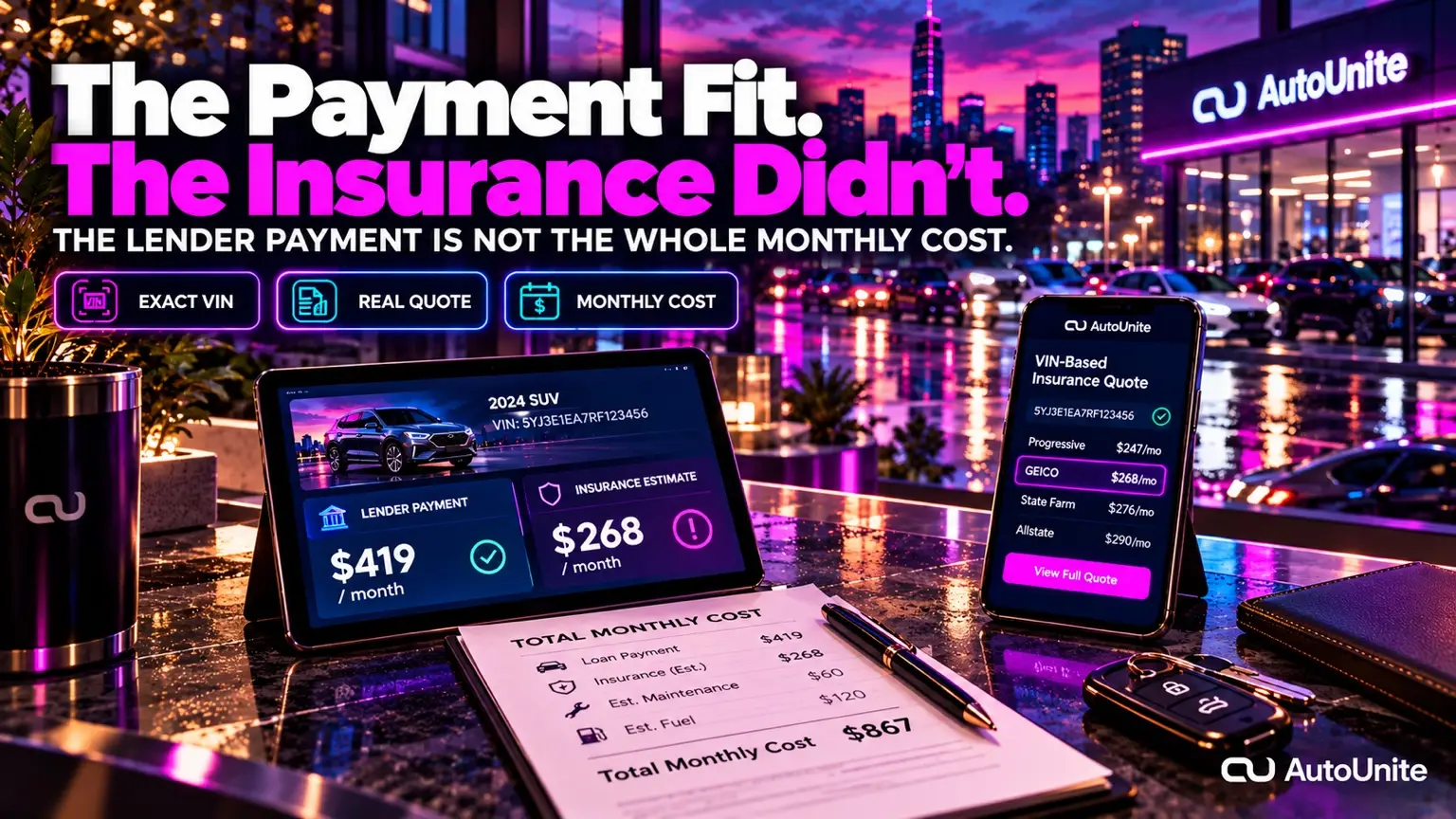
The customer agreed to the payment. Then the insurance quote arrived.
The Mustang had been driven. The trade number was done, the approval was in, and the desk had the payment where the customer wanted it.
They were close.
The salesperson gave him the VIN so he could add the car to his policy before delivery. He made the call from the showroom.
When he hung up, he did not ask another question about the payment.
He looked at the salesperson and said:
“That changes the whole deal.”
This is an illustrative dealership situation, but it is a real kind of problem.
The store had made the car payment fit.
The insurance quote changed whether the car fit.
The customer had come in for a 2026 Ford Mustang GT Premium Fastback.
He knew he was looking at a performance car. Ford’s current 2026 GT Premium page lists the 5.0-liter V8, up to 486 horsepower with the available active-valve performance exhaust, and a standard six-speed manual with rev matching.
Nobody had presented it like a basic commuter car.
The customer liked the Mustang, the trade number was acceptable, and the lender structure worked. The salesperson had done what salespeople are supposed to do: find the right vehicle, answer the questions and keep the deal moving.
The surprise came from somewhere outside the pencil.
The customer had been focused on what he would owe the bank each month. He had not yet seen what his insurer would charge to put that Mustang on his policy.
Most customers know what they currently pay for insurance.
That does not tell them what the next car will cost.
The driver's history, annual mileage, location, coverage, deductible, where the vehicle is parked and the vehicle itself can all affect the premium. Insurance companies may also weigh those factors differently.
So the salesperson should not guess.
Saying, “It is a V8, so your insurance will be high,” may sound reasonable, but the store does not know what that customer's carrier will quote.
The useful move is simpler:
“Here is the VIN. Call your insurance company before we finish everything.” Proof-of-insurance documentation commonly identifies the insured vehicle and VIN, which is why the exact vehicle matters.
That gives the customer a real number while there is still time to make a different decision.
The payment conversation usually starts with the bank because the bank payment is visible on every worksheet. Insurance can remain invisible until the delivery is almost finished.
That is backwards for a household budget. The buyer is not going to live with only the lender payment. The vehicle also brings insurance, fuel or charging, maintenance, taxes and registration, parking or tolls where applicable, and eventually tires and repairs. The dealership does not need to calculate every ownership cost. It does need to avoid treating the bank payment as the entire affordability answer.
The exact VIN is the cleanest handoff point. A 2026 Mustang GT Premium is a real 486-horsepower rear-wheel-drive performance car in Ford’s current inventory. That fact still does not tell AutoUnite, the salesperson or the customer what one insurer will charge. The personal quote is the real number.
A strong delivery process gets that quote while there is still time to change the decision without turning the showroom into a crisis.
Once the quote came back, the payment was no longer the problem.
The salesperson went back to the desk.
Maybe the customer still wanted the GT and had room for the total cost. Maybe he wanted to see an EcoBoost Mustang. Maybe another car made more sense. Maybe he needed to leave, compare insurance options on his own and come back later.
Those are normal deal conversations.
What would not help is stretching the auto loan again while ignoring the number that stopped the customer.
A longer term can lower the payment to the lender.
It does nothing to the insurance quote.
Sometimes the desk does not need another pencil. Sometimes the vehicle needs to change.
The quote is not just a reaction to horsepower. The National Association of Insurance Commissioners lists a wider set of rating factors that can include location, age, driving experience, driving record, claims history, prior insurance, vehicle type, vehicle use, miles driven, selected coverages and deductibles. State law controls which factors may be used and how.
That is why an insurance conversation at the dealership has to stay humble. The salesperson can know the Mustang’s trim, engine and VIN. They do not know the carrier’s full underwriting result for this driver.
A customer can also change the quote without changing the car by changing the coverage structure or deductible, but that changes the amount of risk the customer keeps. A lower premium is not automatically a better policy. The right comparison belongs with a licensed insurance professional, not a guess from the showroom.
The dealership’s role is narrower and more useful: make sure the missing number becomes visible before the customer reaches the signature.
Suppose the auto payment is already at the household ceiling. The insurance quote comes back materially higher than the current policy. The wrong response is to hide that increase by stretching the car loan again without revisiting the whole budget.
The better sequence is:
This is where the dealer and consumer are on the same side. A delivery that becomes unaffordable two weeks later is bad for the customer and bad for the store.
The broader insurance numbers are moving differently than many people might expect.
BLS reported in its August 2026 CPI release that the motor-vehicle-insurance index declined 0.8% in August and was 5.1% lower than a year earlier, while motor-vehicle maintenance and repair was 5.2% higher year over year.
The customer's own quote may still be higher or lower.
Nor does it prove every performance car will be expensive to insure.
The national index describes what happened across the market. It cannot tell the person standing in front of the salesperson what one carrier will charge for one policy and one VIN.
The exact-VIN quote still matters.
A dealership does not need to explain underwriting or tell the customer which coverage to buy.
It needs to recognize when the insurance number is still missing.
The practical sequence is straightforward:
That conversation can happen without the salesperson becoming an insurance adviser.
It is simply another part of making sure the car fits the customer before the paperwork is finished.
The customer is trying to protect the household from a surprise that repeats every month. The salesperson is trying to protect a deal that may already have taken hours to build. Those goals are not opposites.
If the quote works, the delivery gets stronger because the buyer leaves knowing the real monthly obligation. If it does not work, finding out before signature is still the better outcome. It gives the store a chance to show another vehicle and gives the customer a chance to make the decision with complete information.
The worst outcome is not a customer changing cars. It is a customer learning after delivery that the vehicle only fit because one recurring cost was missing from the conversation.
A higher-than-expected quote does not automatically make the GT Premium a bad choice.
The customer may decide the car is worth it.
He may talk with a licensed insurance professional, compare available options and find something that works. He may already have enough room in his budget.
Or he may choose another Mustang.
The important part is that he makes that choice after seeing the number—not three weeks after taking the car home.
The timing matters because a customer who has already negotiated the car, waited on an approval and mentally finished the purchase is less likely to enjoy hearing that another recurring cost still has to be checked. That is not a reason to skip the quote. It is a reason to move it earlier.
A salesperson can make the handoff as soon as the customer is serious about the exact vehicle: “Here is the VIN. Before we finish the contract, make sure your carrier gives you the number for this exact car.” The customer keeps control of the insurance decision, and the store avoids presenting itself as the authority on a premium it does not set.
That also protects the comparison if the customer changes vehicles. An EcoBoost Mustang, a GT Premium and a completely different model are not the same insurance question. The lender payment may move by one amount while the insurance premium moves by another. The only clean way to compare the total monthly obligation is to refresh both numbers when the VIN changes.
This is one of those dealership moments where transparency can save time instead of adding it. The earlier the unknown cost becomes known, the fewer hours everyone spends trying to rescue a transaction that never fit the complete budget.
The salesperson had the right car.
The desk had the payment.
The bank had the approval.
Then the insurance call changed the conversation.
Nobody had necessarily done anything wrong. One important cost simply had not been checked yet.
The desk can make the payment work.
Before delivery, the insurance has to work too. Virginia’s DMV requires insurance or other financial-responsibility compliance for registered vehicles.
AutoUnite content is educational and research-focused. Vehicle information, pricing, ownership costs, maintenance, recalls, and other details may vary by region, dealer, and time.
The car payment can fit while the exact-VIN insurance quote does not. Check coverage and the real ownership cost before the delivery is finished.
Decide First